This is not a standard history lesson; it is a forensic reconstruction of how humanity's first cities rose from a hostile desert and what their collapse teaches us about resilience. Paul Cooper's narrative in Fall of Civilizations bypasses the usual list of kings and battles to focus on the geological and agricultural accidents that made civilization possible, arguing that the Sumerians were not just inventors, but survivors of a fragile ecosystem. The piece's most striking claim is that the very soil that birthed writing and the wheel was also the seed of their eventual destruction, a paradox that demands our attention now more than ever as we face our own environmental tipping points.
The Discovery of the Forgotten
Cooper opens not with ancient history, but with a moment of modern rediscovery, framing the Sumerians through the eyes of Pietro della Valle, an Italian nobleman who stumbled upon their ruins in 1625. This narrative choice is brilliant; it grounds the abstract concept of a "lost civilization" in a tangible, human experience of confusion and wonder. As Cooper writes, "being suspicious for some Arabian vagrants or vagabonds for more security we removed the mile further and took up our station under a little hill near some ruins of buildings which we saw from far away." This quote, drawn from della Valle's own memoirs, immediately establishes the mystery that defined the region for centuries.
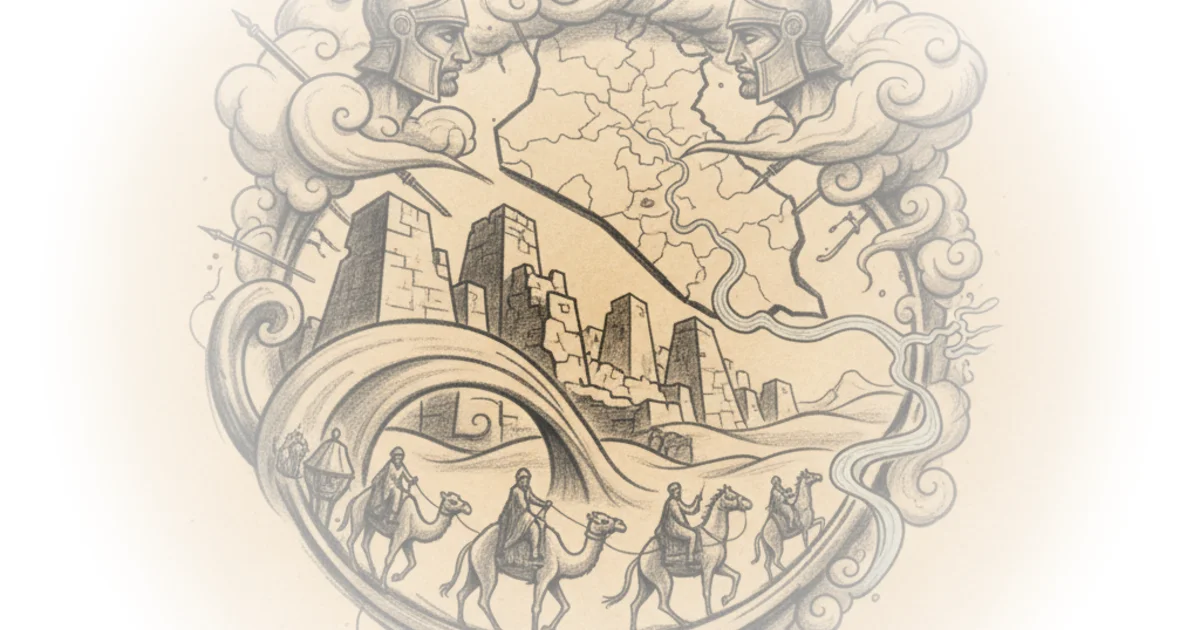
The author emphasizes the sheer alien nature of the discovery. The ruins were not just old; they were incomprehensible. Cooper notes that della Valle found bricks stamped with "unknown letters" and cemented with bitumen, observing symbols like pyramids and eight-pointed stars. The core of Cooper's argument here is that the Sumerian language was so distinct it was initially dismissed as a secret code rather than a real tongue. This framing effectively highlights the "Sumerian problem"—the fact that their language is an isolate, unrelated to any surrounding Semitic languages. It forces the listener to confront the idea that the foundations of our modern world were built by people who were, in a linguistic sense, entirely alone.
"He brought them the knowledge of letters, sciences, and all kinds of techniques. He also taught them how to found cities, build temples, create laws, and measure plots of land."
Cooper uses the legend of Oannes, the half-man, half-fish figure from Roman historian Flavius Josephus, to illustrate how ancient storytellers tried to explain the sudden arrival of complex culture. While this mythological framing is engaging, critics might note that relying on such legends can sometimes obscure the archaeological reality of gradual cultural evolution. However, Cooper uses it not as fact, but as a window into how the Sumerians themselves perceived their origins—as something divine and external.
The Paradox of the Floodplain
The narrative then shifts to the geography, where Cooper makes his most compelling scientific argument: that the Sumerians were born out of a geological accident. He describes the Taurus Mountains in Turkey, where snow-capped peaks and violent thunderstorms create a landscape shaped by water. The rivers Tigris and Euphrates carry "silt," which Cooper poetically terms "rock flower," down to the flat plains of Iraq. "Silt is sometimes known by the more poetic name rock flower and it's particles are smaller than a grain of sand but these tiny specks can have an enormous impact," Cooper explains. This detail is crucial; it explains why a desert became fertile, but also why it was so dangerous.
The author contrasts the predictable flooding of the Nile with the volatile nature of the Tigris and Euphrates. In Egypt, the floods were a stabilizing force; in Mesopotamia, they were a gamble. Cooper writes, "Years of drought can often be followed by years of devastating floods and during winter the whole plane is covered with a thick layer of mud." This volatility is presented as the central tension of Sumerian life. The civilization was a triumph of engineering over a capricious environment. The people didn't just farm; they had to dig canals to divert water inland, creating a "patch of green in the midst of all this desert."
This section is particularly effective because it reframes the Sumerians not as passive beneficiaries of nature, but as active, desperate engineers. They invented the wheel, mathematics, and writing not out of leisure, but out of necessity to manage the complex irrigation systems that kept them alive. The argument holds up well against the backdrop of modern climate anxiety; it suggests that civilization is always a fragile negotiation with the environment, not a permanent conquest.
The Mystery of the People
As the narrative deepens, Cooper addresses the "Sumerian problem" again, this time focusing on the people themselves. The text highlights the symbiotic relationship between the Sumerians in the south and the Akkadians in the north. While the Akkadians spoke a Semitic language related to Hebrew and Arabic, the Sumerians spoke a language isolate. "Sumerian was so alien to the region that early scholars who discovered its first texts didn't believe it could be a real language at all," Cooper notes. This linguistic isolation fuels the theory that the Sumerians may have arrived by boat from the sea, a theory supported by the myth of Oannes.
The author's choice to weave the myth of Oannes back in here serves to humanize the archaeological mystery. It suggests that the Sumerians were viewed by their neighbors as almost otherworldly, bringing the secrets of civilization from the deep. This is a powerful rhetorical move, turning a dry linguistic puzzle into a story of cultural transmission. However, the piece stops short of fully committing to the migration theory, acknowledging that we have no idea who these people were, what they called themselves, or where they came from. This ambiguity is left as a deliberate feature, not a bug, of the historical record.
"I want to show how over the course of millennia the Sumerians would build a society that would form the blueprint for all the followed after."
Cooper's stated goal is to show how this society became the blueprint for everything that followed. By focusing on the invention of writing, mathematics, and the wheel, he connects the ancient past directly to the modern present. The argument is that without the Sumerians' desperate struggle to tame the silt and water of Iraq, the trajectory of human history would have been unrecognizable. The piece effectively argues that the Sumerians are not just a footnote in history, but the authors of the first chapter.
Bottom Line
Paul Cooper's commentary succeeds by grounding the grand narrative of civilization in the gritty reality of mud, silt, and unpredictable floods, making the rise of Sumer feel both miraculous and precarious. The strongest part of the argument is the reframing of the Sumerian achievements as a survival strategy against a hostile environment, rather than a spontaneous cultural flowering. Its biggest vulnerability lies in the reliance on mythological fragments to explain the origins of a people who left no written record of their own migration, leaving the "Sumerian problem" partially unresolved. Listeners should watch for how this narrative of environmental fragility parallels our current climate challenges, as the story of Sumer is ultimately a warning about the limits of human engineering in the face of nature's volatility.