Kings and Generals reframes the opening of the Pacific War not as a singular event at Pearl Harbor, but as a synchronized, multi-front collapse of British imperial confidence. The most striking element of their coverage is the revelation that the British defense was not merely outnumbered, but fundamentally built on a delusion of time and distance that the Japanese command had already dismantled through intelligence. This is essential listening for understanding how strategic overconfidence can render even formidable assets obsolete before a single shot is fired.
The Illusion of the Fortress
The narrative begins by exposing the fatal flaw in the British strategic calculus: the belief that Singapore was an impregnable anchor. Kings and Generals writes, "Singapore was selected due to its strategic importance and because it was the only british territory to be excluded from the non-fortification clause of the washington naval treaty and their intention was to have a strong fleet here to deter japan from any act of war but this was clearly not enough." This framing effectively highlights the gap between diplomatic treaties and military reality. The author argues that the United Kingdom, distracted by the war in Europe, assumed the Far East was a secondary theater, a miscalculation that left the region dangerously exposed.
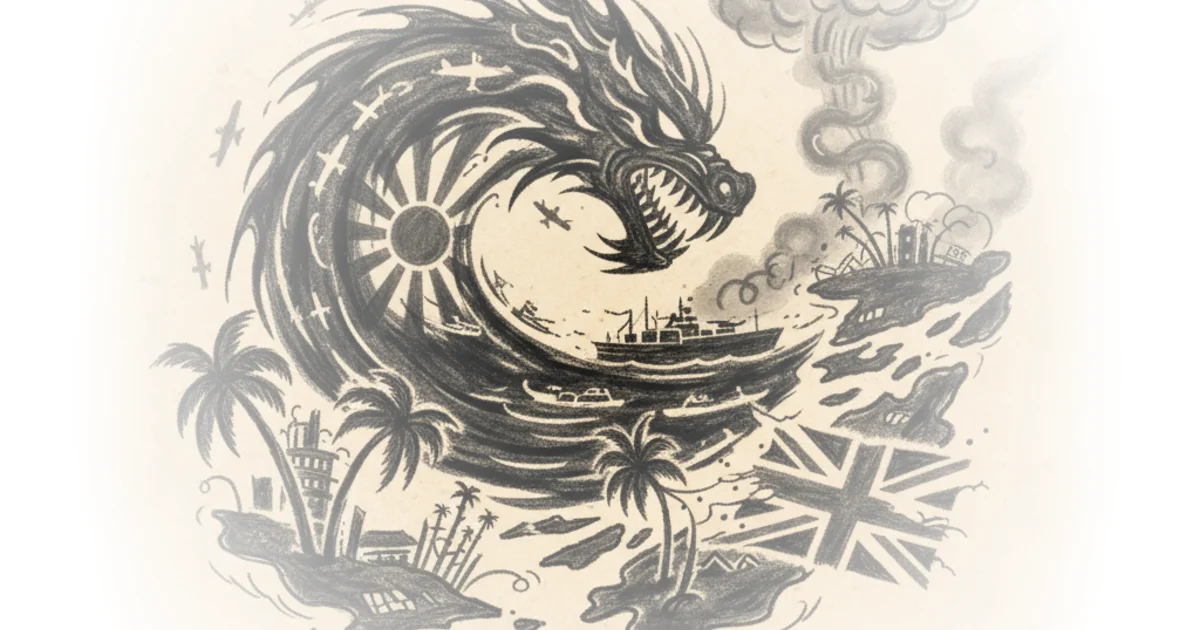
The commentary notes that Prime Minister Winston Churchill's own assessment contributed to this vulnerability. As Kings and Generals puts it, "prime minister winston churchill himself believed that the japanese wouldn't dare to attack them as early as 1941 so he chose to reinforce the mediterranean instead in case of attack." This decision created a vacuum where the British plan relied on a fantasy of reinforcement. The core of the argument is that the defense strategy was a delaying action waiting for a rescue fleet that never existed. This lands because it shifts the blame from tactical incompetence to a systemic failure of resource allocation and intelligence.
Critics might note that the British were in an impossible position regardless of strategy, given the global nature of the conflict. However, the piece suggests that the specific plan to "delay the japanese advance as long as possible while maintaining control over their fortress at singapore" was inherently flawed because it ignored the speed of the Japanese offensive. The author emphasizes that the British command was fighting a war they had already lost on paper, as they "actually couldn't afford to send reinforcements to the far east."
Intelligence and the Race for the Ledge
The coverage pivots to the decisive role of intelligence, revealing how the Japanese turned British secrecy into their greatest weapon. Kings and Generals writes, "the germans handed this information over to the japanese alongside this the japanese broke the british army codes in january 1941 learning the details of the weakened state of the fortress of singapore allowing them to prepare for an invasion." This is a crucial point: the invasion was not a gamble, but a calculated strike against a known weakness. The narrative illustrates that the Japanese did not need to guess the state of the British defenses; they knew them intimately.
The author details the operational boldness of the Japanese plan, which required traversing difficult terrain to outflank the British. "The plan developed by tsuji masinobu was very bold having to traverse 400 miles of jungle road against a major force that had established formidable defenses in singapore." Kings and Generals contrasts this with the British hesitation, particularly regarding the pre-emptive strike known as Operation Matador. The commentary explains that because the order was not granted, the British lost the initiative. "Operation matador didn't get automatic approval the plan was essentially dead but it would have one major consequence the eleventh would be prevented from completing defensive positions at jitra."
The narrative then describes the chaotic opening days, where the Japanese landed in Thailand and Malaya simultaneously. As Kings and Generals puts it, "at 2300 hours on december 7th the japanese presented an ultimatum to the thai government demanding safe passage and giving them two hours to respond." The speed of the Japanese advance is underscored by the race to the Ledang position, a critical road junction. The author notes that a small British detachment, Operation Crocodile, was sent to seize the position but was outpaced. "It turns out the regiment of the fifth division won the race to the ledge arriving there by midday on december 10th as." This detail encapsulates the entire campaign: a race the British were destined to lose due to poor intelligence and rigid command structures.
The sinking of the British battleships was a heavy blow to the British navy but it was also a bad omen for the malayan defenders and for the Chinese still resisting in the north.
The Fall of the Fleet
The most dramatic section of the piece covers the destruction of Force Z, the battleships Prince of Wales and Repulse. Kings and Generals writes, "admiral phillips had already sailed from singapore after dark intending to intercept the japanese invasion fleet in the south china sea he expected to arrive at kotabaru on december 10th and he relied on the surprise factor for the success of his operation." The commentary highlights the fatal error of relying on surprise without air cover, a lesson that would define naval warfare for the rest of the conflict.
The narrative describes the final moments of the ships with stark clarity. "Four hours later the british spotted japanese aircraft tailing them prompting phillips to turn west and return to singapore while the british fled to the south." The author details the specific damage that led to the sinking, noting that "one bomb hit on the repulse and two torpedo hits on the prince of wales that caused considerable damage." The loss of these ships is framed not just as a tactical defeat, but as a psychological collapse for the defenders. The piece argues that the sinking proved that battleships were no longer the kings of the sea without air superiority.
The commentary also touches on the simultaneous collapse in Hong Kong, where the British were forced to withdraw after the Gin Drinkers Line was breached. Kings and Generals writes, "by december 10th the position had fallen into japanese hands and the remaining defenders were now exposed." This rapid succession of defeats across Malaya, Singapore, and Hong Kong demonstrates the effectiveness of the Japanese strategy. The author concludes this section by noting the sheer scale of the loss, with hundreds of sailors dying and the British naval presence in the region effectively neutralized.
Bottom Line
Kings and Generals delivers a compelling case that the Japanese invasion of Malaya was a masterclass in exploiting intelligence and speed against a static, overconfident defense. The piece's greatest strength is its focus on the systemic failures of the British command, particularly the reliance on a fortress that could not be reinforced. The biggest vulnerability in the narrative is the limited perspective on the Thai resistance, which is portrayed largely as a minor obstacle rather than a complex political dilemma. Readers should watch for how these early operational lessons shaped the subsequent island-hopping campaigns in the Pacific.