Why Planes Fly at 30,000 Feet (And Why You Can't Open the Doors)
Most people assume planes fly at extreme altitudes to avoid weather or simply because they're tall. The real answer involves economics — and a pressure difference so powerful that no human can overcome it.
The Altitude Question
Commercial jets cruise at roughly 30,000 feet, far higher than Mount Everest's peak. That's intentional. One of the primary benefits of flying at this altitude is a smoother ride. At 30,000 feet, planes enter the troposphere — the atmospheric layer where most weather occurs — resulting in less turbulence and fewer storms to navigate.
But this isn't the main reason.
The bigger incentive is money. As altitude increases, air density decreases. At 33,000 feet (roughly 10 kilometers), air density is only about a third of what it is at sea level. This means planes encounter far fewer air molecules during flight — and can fly approximately 73% faster for the same amount of thrust.
The practical result: passengers reach their destinations faster, and airlines burn less fuel. During climb, engines consume around 80 kilos of fuel per minute. In cruise mode at altitude, that drops to roughly 40 kilos per minute. During descent, it plummets to just 10 kilos per minute.
Jet engines also run more efficiently at high altitudes because they operate most effectively with cold, dense air. At cruising altitude, external temperatures hover around -50 degrees Celsius — far colder than the average 15-degree conditions at ground level. Colder air is denser, meaning more oxygen molecules enter the engine's intake for each fuel combustion cycle.
Airlines also route flights to take advantage of jet streams and tailwinds, further reducing fuel consumption and costs.
The Air You Breathe
Flying at 30,000 feet comes with a significant trade-off: the air is unbreathable. If an unprotected human were suddenly teleported to that altitude, they'd remain conscious for only about three minutes.
The problem isn't just oxygen scarcity — it's pressure. As altitude rises, air pressure falls rapidly because it depends on the weight of all the air above each person. At 10 kilometers, air pressure drops to a quarter of sea level conditions.
At that pressure, even though the air still contains 21% oxygen, the partial pressure of oxygen — the force exerted solely by oxygen molecules — falls to around 5.5 kilopascals. Humans need at least 16 kilopascals for normal function. Below that threshold, insufficient oxygen molecules can force their way into blood in the lungs.
This is why airplane cabins must be pressurized.
The Door That Never Needs a Lock
Here’s where things get interesting: plane doors don't require locks because they effectively lock themselves.
Before pressurization, planes flew at around 10,000 feet (roughly 3 kilometers). At that altitude, partial pressure of oxygen sat just above the limit people could handle — 15 kilopascals. Doors opened outward, and there was little concern about seals since pressure differences were minimal.
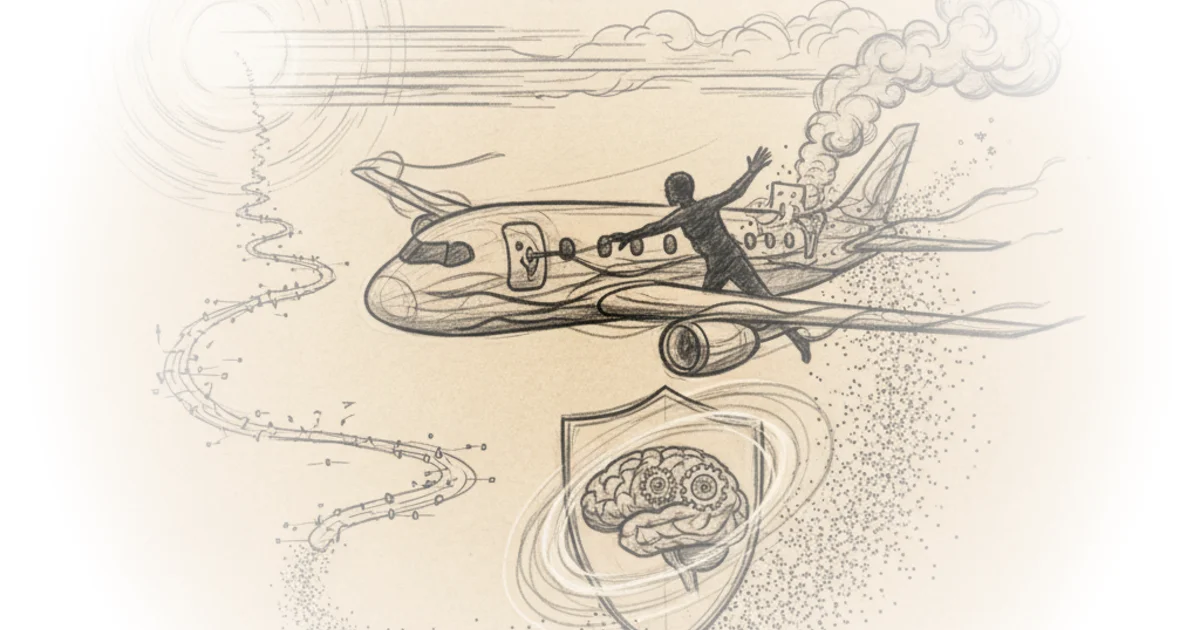
Once aircraft became pressurized, everything changed. Cabin doors were redesigned to be "plugs" — wider on the inside than the outside. When closed, higher cabin pressure pushes the door into its frame, creating an airtight seal. The main passenger door on a Boeing 737 is both wider and taller than the frame it must pass through. While levers at top and bottom fold inward reducing height enough to fit, the sides remain too wide. The door must first pop inside and rotate — movement that becomes physically impossible at cruising altitude.
To open one in flight would require force equivalent to lifting 9,000 kilograms.
Cabins aren't pressurized to sea-level pressure (101.3 kilopascals). They're pressurized to roughly 75% of atmospheric pressure. At cruising altitude, cabin pressure drops to around 77 kilopascals — the minimum required for passengers to feel normal while still minimizing stress on the fuselage.
This is why you can observe an unusual side effect: at altitude, cabin pressure drops enough that chip bags appear to inflate like balloons. The reduced pressure also causes passengers to experience increased gas expansion — meaning they fart more during flights than on the ground.
No one is strong enough to pull a door inward at 30,000 feet. The pressure difference makes it physically impossible.
When It Happened Anyway
In May 2023, an Airbus A320 passenger panicked during final approach and managed to open an emergency exit door mid-flight. The incident shocked aviation experts because the pressure differential was minimal — they were close enough to the ground that cabin pressurization had nearly equalized. With little resistance from ambient pressure, a determined passenger using full force actually succeeded.
Everyone survived. But this near-impossible event highlights how rare such occurrences are: 40 million flights annually, and virtually none involve opened doors during cruise.
The Airplane Mode Mystery
Anyone who's flown has been asked to switch phones to airplane mode. Most assume it's about interference with navigation instruments — but the real story is more complicated.
In 1961, the Federal Aviation Administration found that some portable FM radios could interfere with plane navigation systems since they used neighboring radio bands. Out of caution, they banned most personal electronics on flights.
But phones present a different problem. On the ground, a phone typically sees one or two cell towers at a time. In the air traveling at 800 km/h, it could rapidly connect to dozens of towers simultaneously — potentially overloading ground infrastructure.
The Federal Communications Commission banned phone use in flight in 1991 based on this theory. But there's a problem: planes are essentially Faraday cages that block most electromagnetic signals. Phone signals can only escape through windows, traveling horizontally out the sides before reaching ground-based towers. Unless flying very low during takeoff or landing, connections are nearly impossible.
The FCC never tested whether phones actually caused interference. In 2005, they acknowledged the rule might not be needed to protect ground networks. To date, no mobile phone has ever caused an air accident.
The EU recently eliminated airplane mode requirements and is pushing for 5G service on all flights — making this inconvenience a thing of the past.
Why Plane Food Tastes Like Nothing
Passengers often complain that airplane food tastes bland. The problem isn't poor airline catering — it's the cabin air.
Air pumped into cabins at altitude is extremely dry. The Sahara Desert has average relative humidity of 25%; airplane cabins can drop to just 5%. This dries out nasal passages, hindering smell — and taste depends heavily on aroma.
Lower cabin pressure also decreases sensations like salt and sugar intensity. But one flavor appears enhanced in flight: umami. A 2015 study points to the chorda tympani nerve that carries taste information from the tongue to the brain stem. It runs right past the eardrum between tiny sound-conducting bones, so loud cabin noise might unintentionally stimulate it — producing an illusion that boosts savory taste.
A German survey of thousand flyers found more than a quarter ordered tomato juice in flight, with 23% never drinking it on the ground.
The Safety Culture
Why does this matter? Aviation is one of the safest modes of transportation precisely because investigators dig deeply into every incident and accident. When crashes occur — like Aloha Airlines Flight 243 in 1988, which lost its roof at 24,000 feet but miraculously landed safely — aviation professionals learn from them.
That learned investigation culture makes every flight incrementally safer.
Counterpoints
Critics might argue that framing altitude as primarily about fuel efficiency oversimplifies the complex safety considerations involved. Aviation regulators and airlines prioritize passenger comfort and operational requirements alongside cost savings, and some experts believe weather avoidance remains a significant factor at certain altitudes or in specific conditions.
Bottom Line
Muller makes a compelling case: money drives why planes fly as high as they do — fuel efficiency through thinner air, faster speeds, less turbulence. The most striking insight is how pressure makes cabin doors self-locking: no human can override them mid-flight without the near-impossible physical force required. That same logic explains airplane mode restrictions and why food tastes different at altitude.
The piece's strongest argument is its accessible explanation of pressurization physics — making the impossible seem inevitable. Its vulnerability is that some tangential topics (phone interference, tomato juice) distract from the core thesis. Smart readers will appreciate how much they didn't know about why planes fly where they do.