G. Elliott Morris cuts through the noise of post-election finger-pointing with a stark, data-driven reality check: the Democratic loss in 2024 wasn't a failure of messaging or strategy, but an inevitable result of economic fundamentals that no campaign could overcome. While the party leadership scrambles to find tactical errors in their playbook, Morris argues that the numbers tell a different story—one where high inflation and low approval ratings made the outcome nearly predetermined, regardless of who was on the ballot.
The Illusion of Control
Morris opens by dismantling the Democratic National Committee's recent "autopsy" of their defeat, a document he describes as a collection of conventional wisdom rather than genuine insight. He notes that the report, which was initially withheld before being leaked, contains factual errors and ignores the elephant in the room. "The autopsy does not really present a unified theory of why Kamala Harris lost in 2024," Morris writes, pointing out that it blames the party for moving "too far left" while failing to mention the single most potent force in the election: the economy.
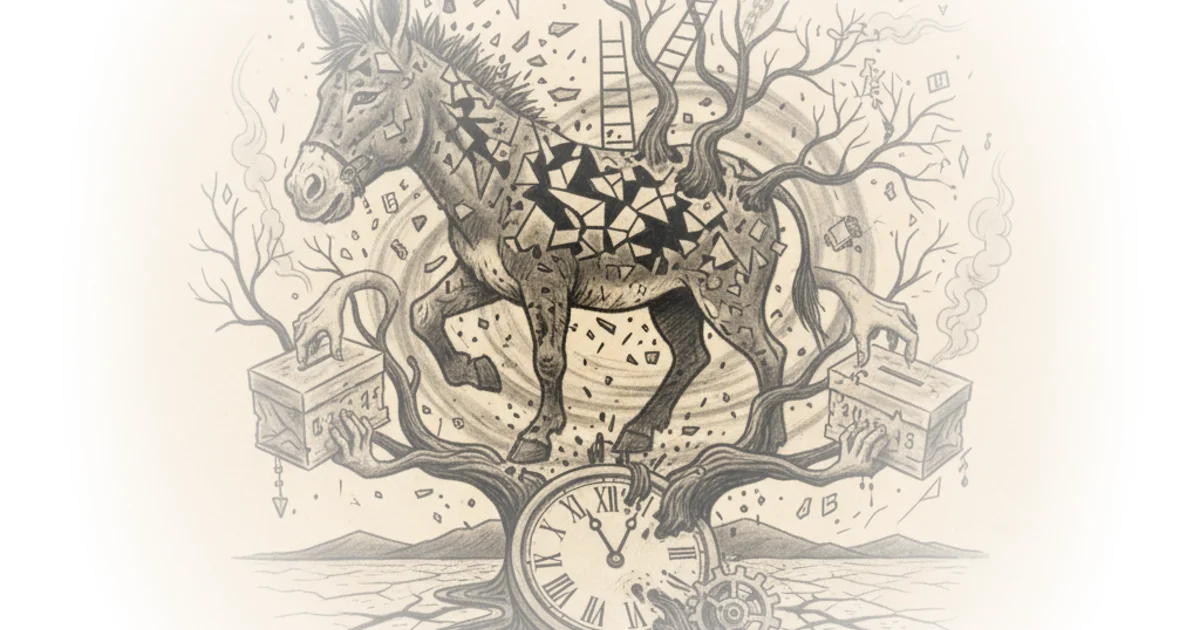
The author's critique is sharp because it targets the self-serving nature of political consulting. Consultants have a vested interest in believing their tactics matter, because if the result is purely structural, they have nothing to sell. Morris observes that the report "straight up ignores the major reasons Harris lost in 2024," specifically the fact that the word "inflation" appears nowhere in the main diagnosis. This omission is not a minor oversight; it is a fundamental refusal to engage with the reality that voters were punishing the incumbent party for price shocks, not for a lack of negative advertising.
"The fundamental issue is that 2024 simply had too much inflation-induced anti-incumbent sentiment for the incumbent party to overcome."
This argument is bolstered by a regression model Morris constructed using only two variables: the incumbent president's approval rating and consumer sentiment. The model, trained on data from 1956 to 2020, predicted a Democratic vote share of roughly 48% for 2024. Harris actually received 49.3%. As Morris puts it, "Harris's vote share lands on the upper end of this range, but still squarely inside of it." In a sense, the surprise of the election was not that she lost, but that she performed as well as she did given the headwinds. This challenges the narrative that a different candidate or a smarter strategy could have flipped the result.
Critics might argue that this structural determinism ignores the nuance of a razor-thin margin where a few thousand votes in key swing states could have changed the outcome. However, Morris counters that focusing on those margins is a distraction from the broader trend that dictated the ceiling of Democratic performance.
A Global Pattern of Rejection
To prove that this was not a uniquely American failure of Democratic branding, Morris expands the lens to a global scale. He cites data journalist John Burn-Murdoch, who documented that every single governing party in a developed democracy that faced voters in 2024 lost vote share. From the Tories in the UK to Macron's coalition in France, incumbents were swept out of office.
"What did all these countries have in common? Not Kamala Harris's communications strategy," Morris asks rhetorically. The common denominator was the post-pandemic price shock that hit virtually every developed economy. This context is crucial because it reframes the election from a story about American political dysfunction to a story about global economic pain. The "dead cat strategy" often discussed in political circles—focusing on a distracting, controversial issue to avoid economic scrutiny—may have been attempted, but it could not overcome the visceral reality of voters' wallets.
"When incumbents lose across dozens of countries with different parties, different candidates, different media environments, and different campaign tactics, the parsimonious explanation should be the one variable they share."
This global perspective adds significant weight to Morris's argument. It suggests that the "Sixth Party System" emerging in the US is being driven by the same anti-incumbent, anti-establishment forces seen elsewhere, rather than by specific policy disagreements over social issues. The idea that the party "went too far left" is rendered less plausible when the same outcome occurred in countries with vastly different political spectrums.
The Consultant's Fallacy
The most biting part of Morris's commentary is his attack on the psychology of the political class. He argues that party autopsies are the purest form of the "Strategist's Fallacy," where tactical choices are overvalued because they are visible, while structural forces are ignored because they are unchangeable. The DNC report recommends running more negative ads or better defining the candidate, but Morris contends these are solutions to a problem that didn't exist.
"The kind of voter the report's recommendations would persuade... is essentially a Washington consultant, not your grandma who can't afford to pay her bills," Morris writes. He highlights that a large portion of the electorate is "non-ideological," making decisions based on whether they feel the system is working for them, not on a left-right spectrum. These voters, often low-information and driven by "vibes," are not swayed by detailed policy plans or ad targeting.
"You can't ad-target your way out of an inflation problem."
This is the core of the piece's warning: if the party learns the wrong lessons, they will be doomed to repeat them. If they believe they lost because they didn't define their opponent early enough, they will spend the next cycle obsessing over messaging while ignoring the economic conditions that will likely persist. Morris suggests that the "anti-system voter" is a decisive bloc that cannot be won over by traditional campaign mechanics.
Critics might note that while economics are powerful, they are not the only factor; cultural issues and the specific charisma of candidates do play a role in close elections. Yet, Morris's data suggests that in 2024, those factors were overwhelmed by the sheer weight of economic dissatisfaction.
Bottom Line
G. Elliott Morris delivers a necessary corrective to the self-congratulatory and self-flagellating narratives dominating post-election analysis. His strongest argument is the empirical demonstration that the election result was statistically predictable based on economic fundamentals alone, rendering most of the DNC's tactical introspection irrelevant. The piece's greatest vulnerability is its potential to induce fatalism, suggesting that nothing can be done in a bad economy, but Morris effectively argues that acknowledging the structural reality is the first step toward avoiding the wrong strategic pivots in 2028.
"The deeper problem with the autopsy is that it imagines a voter who doesn't exist."
Readers should watch for how the Democratic party responds to this data-driven rebuke; if they continue to focus on messaging and culture wars while ignoring the economic anxieties of the non-ideological voter, they risk repeating the cycle of defeat.