This piece from Reason delivers a blistering legal autopsy of a hypothetical 2026 event where the executive branch effectively sued itself to create a billion-dollar slush fund. It strips away the political theater to reveal a procedural absurdity that would make any constitutional law student cringe. The argument is not just that the deal is bad policy, but that the mechanism used to create it—filing a lawsuit against one's own agency to then settle it—is a fundamental breach of the Article III requirement for a genuine "case or controversy."
The Illusion of Adversity
The article opens by dismantling the premise of the lawsuit itself. Reason reports, "You can't sue yourself; the President runs the IRS; he can fire any or all of the IRS employees, and he can determine IRS policies... the President and an Executive Agency wholly within the scope of Presidential control cannot be legal 'adversaries.'" This is the crux of the legal failure. By invoking the concept of Article III standing, the piece highlights a structural impossibility: a court cannot adjudicate a dispute where the plaintiff and defendant are controlled by the same person. The editors note that the District Judge correctly identified this "outstanding question" but was rendered powerless once the plaintiff voluntarily dismissed the case under Federal Rule of Civil Procedure 41(a).
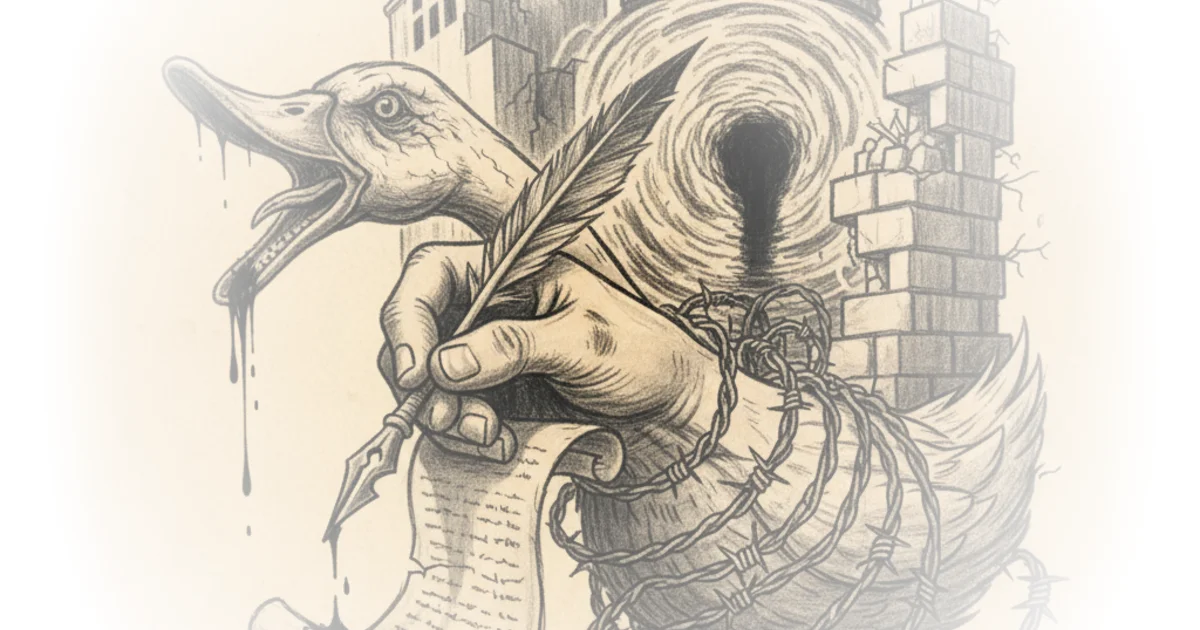
The commentary effectively uses the history of Article III to underscore the gravity of the situation. Just as the Framers designed the judiciary to resolve actual disputes between opposing parties, this maneuver bypasses that check entirely. The piece argues that the court was "stripped of jurisdiction" the moment the dismissal was filed, leaving the judge unable to scrutinize the settlement terms before they were finalized. This creates a dangerous precedent where the executive branch can manufacture a legal victory to bypass judicial oversight.
You can call a duck a goose, but it's still a duck.
Critics might argue that voluntary dismissals are a standard procedural tool and that courts rarely intervene in how plaintiffs choose to end their own cases. However, the piece rightly counters that this is not an ordinary case. The court itself signaled its unease, noting that if a settlement occurred, it might not be "appropriate" given the lack of true adversity. The argument gains weight because it points out that the DOJ, which has an independent obligation to uphold the public interest, failed to file documents ensuring the settlement was legitimate.
The Mechanics of the "Settlement"
Once the legal fiction of the lawsuit is exposed, the piece turns its attention to the contents of the "Great Settlement Agreement of 2026." The editors describe the deal as a transformation of a claim worth zero dollars into a $1.776 billion fund. Reason reports that the agreement establishes an "Anti-Weaponization Fund" with a corpus "based on the projected valuation of future claimants' claims," a phrasing the piece calls a transparent attempt to justify the arbitrary number. The fund is to be administered by five members appointed by the Attorney General, who can be removed at any time by the President, ensuring total executive control over the disbursement of taxpayer money.
The article highlights a particularly egregious detail: the initial agreement failed to mention that the government was releasing its own claims against the plaintiff. This "oversight" was corrected the next day by Acting Attorney General Blanche, who issued a document "FOREVER DISCHARGING" the plaintiff from any potential liability. The piece argues that this retroactive fix was necessary because the original deal only released the plaintiff's claims, leaving the government's potential claims against the plaintiff dangling. This sequence of events suggests a rush to secure immunity and funding without proper legal vetting.
The editors point out the irony of the fund's purpose, noting that it is designed to redress claims of "Lawfare and Weaponization" by a president who has refined the weaponization of the Justice Department into a "fine art." This framing challenges the narrative that the fund is a corrective measure, suggesting instead that it is a tool for political patronage. The piece argues that the deal is "enforceable and challengeable solely by Plaintiffs, Defendants, and the United States," effectively locking the public out of any legal recourse to question the fund's administration.
The Broader Implications
The commentary concludes by placing this event in a historical context of corruption, distinguishing it from past scandals. The editors write, "But Donald Trump is more than just the latest member of this very unseemly fraternity - he is doing something truly without precedent. Never before, in the history of the United States, has the grab been conducted so openly and so brazenly, out there in full view of the very public that is getting fleeced." This distinction is crucial; it suggests that the brazenness of the act is as damaging as the act itself, eroding public trust in the rule of law.
The piece also touches on the political fallout, noting a "semi-revolt by Senate Republicans" that offers a glimmer of hope. However, the editors remain skeptical, questioning whether this revolt will be strong enough to "nullify" the settlement. The argument here is that the institutional norms protecting the public from executive overreach are being tested to their breaking point. The reliance on Mitch McConnell's description of the deal as "utterly stupid, morally wrong" adds a layer of bipartisan condemnation, though the piece implies that even this may not be enough to stop the machinery.
That this all comes as part of an 'Anti-Weaponization' initiative from a president who has refined 'weaponization' of the Justice Department into a fine art is beyond irony and beyond satire.
A counterargument worth considering is that the executive branch has broad discretion in settling litigation, and courts often defer to the government's decision to drop a case. However, the piece effectively dismantles this by emphasizing the lack of a genuine dispute to begin with. When there is no case or controversy, the very foundation of the settlement collapses, making the executive's discretion irrelevant.
Bottom Line
The strongest part of this argument is its rigorous application of constitutional principles to expose the legal vacuity of the settlement, proving that the deal is a shell game designed to bypass the judiciary. Its biggest vulnerability lies in its reliance on a hypothetical future scenario, which, while legally sound, may feel abstract to readers focused on current events. The reader should watch for how the courts respond if similar maneuvers are attempted in real time, as this piece serves as a warning of what happens when the executive branch tries to sue itself to write a blank check.