Then & Now dares to ask a question that most tech optimists avoid: why can we clone genes and simulate reality, yet our trains remain perpetually delayed and our digital lives feel increasingly hollow? The piece does not offer a dry policy paper but a vivid, speculative blueprint for a world where data ownership and democratic governance are baked into the very code of our society, challenging the assumption that current systems are too complex to fix.
The Architecture of Liberation
The author begins by painting a stark contrast between our current digital reality and a potential future. Then & Now writes, "You get home from a meaningful four or 5 hour workday doing creative work you love. Repetitive chores are done for you autonomously." This scenario is not presented as a guaranteed outcome but as a necessary thought experiment to break the paralysis of the present. The core of the argument rests on the idea that technology, currently used to entrap, could be re-engineered to liberate. The author envisions a world where "all of the data is what's called interoperable," allowing individuals to own their digital history and plug it into decentralized, community-run blockchains rather than corporate silos.
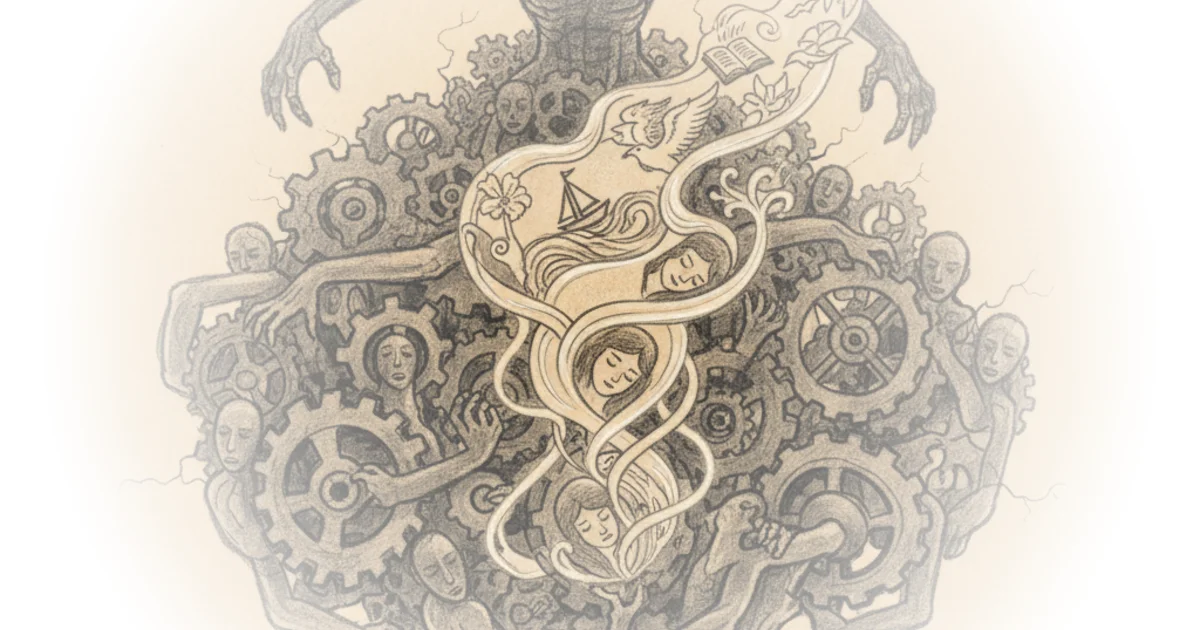
This vision is compelling because it addresses the root of the current crisis: the alienation of the user from their own data and the platforms they inhabit. By proposing that "one blockchain is similar to Facebook as it used to" while the current giants become a "wild west of bots, trolls, AI, super slop," the author reframes the problem not as a lack of innovation, but as a misalignment of incentives. The solution proposed involves user verification to ensure accountability, yet maintains anonymity for activists, a nuanced balance that attempts to solve the privacy versus safety dilemma without resorting to authoritarian surveillance.
"Out of generous dreams come beneficial realities. Utopia is the principle of all progress and the essay into a better future."
Democratizing the Deep State
Moving from social media to the economy, the commentary shifts to how these decentralized systems could govern industry. Then & Now argues that "big industry is partially run by a combination of experts aboard and democratically through the community portal." This is a radical departure from traditional corporate governance, suggesting that transparency and data sharing are not just ethical choices but efficiency drivers. The author notes that companies meeting certain thresholds would see profits "slowly divested away from owners and management to a combination of workers and the community."
The strength of this section lies in its rejection of the binary choice between state control and unfettered capitalism. Instead, it proposes a hybrid model where "citizen revenue is enough to justify the shorter work hours," effectively creating a universal basic income funded by the very industries that currently extract value from workers. Critics might note that the transition to such a system faces immense political inertia and that the assumption of "fair" calculation of contributions is fraught with difficulty. However, the author's point is that the current system's opacity is the greater evil, and that "predistribution is focused on rather than redistribution" could solve inequality at the source.
The piece also touches on the role of artificial intelligence, not as a replacement for human judgment, but as a tool to synthesize the massive amounts of data now made visible. "LLMs find solutions through strange combinations of things," the author observes, highlighting how connecting health data with local marketplaces could yield revolutionary medical breakthroughs. This reframes AI from a threat to a collaborator in human progress, provided the data it learns from is owned by the community.
The Trap of the Deep Algorithm
Despite the utopian vision, the author returns to a sobering analysis of why we remain stuck. Then & Now defines the current global order as "deep algorithms," referencing Manuel Castells' concept of the network society. The argument is that these systems are so flexible and interconnected that they can simply bypass any attempt at reform. "If one of the nodes... refuses to do something... the network can simply bypass it," the author explains. This explains why raising minimum wages in one country leads to sweatshops moving elsewhere, or why criticizing intelligence services often yields no result.
This is the piece's most critical insight: the system is not broken in a way that can be fixed by a single leader or a new law; it is robust precisely because it is designed to absorb and neutralize dissent. The author writes, "No one in them can do anything. It's all body and no head." This metaphor of a system with no central controller to hold accountable is a powerful explanation for the pervasive sense of powerlessness many feel. It suggests that the "deep state" is not a conspiracy of individuals, but a structural feature of global capitalism.
"We can be sick of social media, our phones, but continue using them. We even often hate our own freely chosen routines in ordinary life, but we continue to repeat them day in day out."
The Power of the Dream
In the conclusion, the author confronts the tension between this grim reality and the need for hope. Then & Now admits, "I'm not even sure I believe in it," acknowledging that the utopian vision may be flawed or even impossible. Yet, the piece insists that the act of dreaming is itself a political necessity. The author rejects the "woo woo" of self-help manifestation but champions the "collective human imagination" as the engine of history. "Without the utopians of other times, men would still live in caves, miserable and naked," the author quotes Anatole France, reminding readers that every modern convenience was once a radical fantasy.
The commentary ends by challenging the reader to consider the nature of their own reality. "Is it dream or is it reality?" the author asks, blurring the line between the digital feeds we consume and the physical world we inhabit. This is a call to action, not to build the perfect system tomorrow, but to refuse the idea that the current one is the only possible one. The author's final message is that the "disconnect" between our technological capabilities and our social reality is the space where change must begin.
Critics might argue that the piece relies too heavily on the assumption that decentralized technology is inherently more democratic, ignoring the potential for new forms of oligarchy within blockchain governance. Additionally, the reliance on voluntary corporate compliance with data transparency seems optimistic given the history of regulatory capture. Nevertheless, the piece succeeds in shifting the debate from "how do we fix the broken parts" to "what if the whole thing needs to be reimagined?"
Bottom Line
Then & Now's strongest contribution is the reframing of systemic inertia not as a failure of will, but as a feature of "deep algorithms" that bypass individual resistance. The piece's greatest vulnerability is its reliance on a technological utopianism that assumes decentralized systems will naturally lead to equitable outcomes without addressing the human propensity for power consolidation. The reader should watch for how this vision of "community portals" evolves as real-world experiments in decentralized governance face the friction of actual human behavior.