Sam Denby doesn't just complain about Newark Airport; he dismantles the myth that its failures are merely bad luck. The piece is notable because it moves beyond the usual passenger grievances to expose a structural inevitability: the airport is designed to fail when the weather turns, and its management has made that failure worse.
The Geography of Chaos
Denby begins by establishing that Newark's reputation is not an opinion but a data-driven reality. "Newark Airport sucks. That's not just an opinion. That's an objective characterization backed by data." He marshals FAA on-time rankings and satisfaction indices to prove that while other airports fluctuate, Newark consistently sits at the bottom. The author argues that this isn't random variance but a predictable pattern driven by the region's unique geography. He explains how the Appalachian Mountains force moist air upward, creating thunderstorms that hit the airport with brutal regularity in June and July.
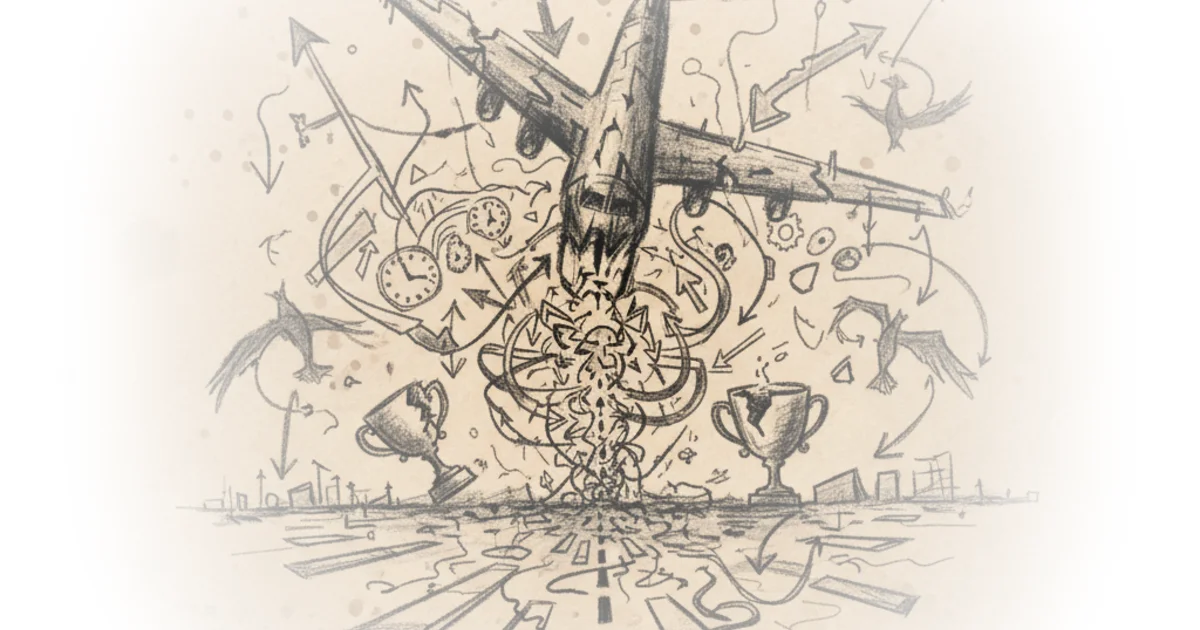
This framing is effective because it shifts the blame from individual airlines to the physical environment. "Thunderstorms and airports are not compatible," Denby writes, noting that the unpredictable wind shifts force planes to hold or divert. However, he quickly pivots to the real villain: the airport's inability to handle these inevitable storms due to its physical layout. Critics might argue that weather is a universal disruptor and that blaming geography lets management off the hook, but Denby's comparison to JFK and LaGuardia suggests that location alone isn't the sole culprit.
The Bottleneck Effect
The core of Denby's argument lies in the airport's cramped infrastructure. He points out that despite having three runways, Newark operates with the capacity of a two-runway facility due to the dangerous proximity of its main strips. "With such proximity, the FAA does not allow for fully independent operations," he explains, meaning that one plane landing can block the next. This constraint creates a domino effect where a minor delay spirals into a gridlock.
Denby illustrates this with a harrowing example of a United Airlines flight from Naples that sat on the taxiway for hours because there were no gates available. "It did not move again until 9:58 p.m. It taxied a bit, stopped for 10 minutes, taxied a few hundred feet further, stopped for 15 minutes, then finally taxi to its gate, opening its door 4 hours and 21 minutes after landing." This anecdote is powerful because it humanizes the abstract concept of "capacity constraints." The author argues that the airport has exactly the number of gates it needs for perfect days, leaving zero slack for the inevitable disruptions.
When something goes wrong, and things do go wrong, and outbound flights are delayed, there might be a backup where inbound aircraft can't get access to the gates they're supposed to.
This lack of redundancy is the airport's fatal flaw. While other airports might absorb a delay, Newark's design amplifies it. The argument holds up well against the data, though it perhaps underestimates the role of airline scheduling practices that push flights into tight windows regardless of airport capacity.
The Human Factor and Systemic Fragility
The commentary takes a darker turn as Denby examines the air traffic control system. He details the FAA's controversial decision to move controllers from Long Island City to Philadelphia, a move intended to solve staffing shortages but which instead created new vulnerabilities. The transition was fraught with resistance, and the new facility relied on a fragile data feed. "Reportedly, the data traveled via an old copper telecom wire with no redundancy," Denby notes, leading to moments where controllers lost radar contact entirely.
This section is crucial because it reveals that the problem isn't just concrete and steel; it's also bureaucratic mismanagement. The stress on the controllers was immense, leading to a wave of trauma leave. "For many, these brushes with disaster were seemingly the straw that broke the camel's back," Denby writes. The argument here is that the system is so tightly wound that any single point of failure—be it a storm, a gate shortage, or a copper wire—causes the whole thing to unravel.
Bottom Line
Denby's most compelling contribution is his demonstration of how Newark's physical constraints and management decisions create a perfect storm for operational collapse. The strongest part of the argument is the clear link between the airport's lack of slack capacity and the cascading nature of its delays. Its biggest vulnerability is the assumption that the FAA's recent moves will not improve the situation, a prediction that remains to be tested. Readers should watch for how the new Philadelphia facility stabilizes, but the fundamental design flaws of the airfield itself remain a ticking time bomb.