In a rare fusion of military memoir and literary criticism, Theo Lipsky argues that the true measure of a nation's readiness isn't found in its stealth bombers, but in its willingness to pause for the mating rituals of a small, picky bird. This piece is notable not for its policy prescriptions, but for its radical reordering of priorities: it suggests that the absurdity of halting live-fire exercises for the greater sage-grouse is actually a necessary check on the machinery of war, a concept Lipsky explores by juxtaposing modern American training grounds with the poisoned soil of the First World War.
The Absurdity of Priority
Lipsky, an active-duty captain, writes from a position of unique authority, having personally commanded a cavalry troop restricted by the presence of the sage-grouse. He describes the frustration of his soldiers, who are told their training is vital for national security, only to be halted by yellow-splotched maps protecting the bird's "lek," or mating ground. "Soldiers are alert to the absurdity of their position," Lipsky observes, noting that the experience can feel like an "infinite staircase drawn by Escher" where the high purpose of self-sacrifice loops back into squabbling with a game bird. This framing is effective because it doesn't shy away from the genuine friction between operational readiness and environmental protection; instead, it leans into the cognitive dissonance to make a larger point about the nature of civilization.
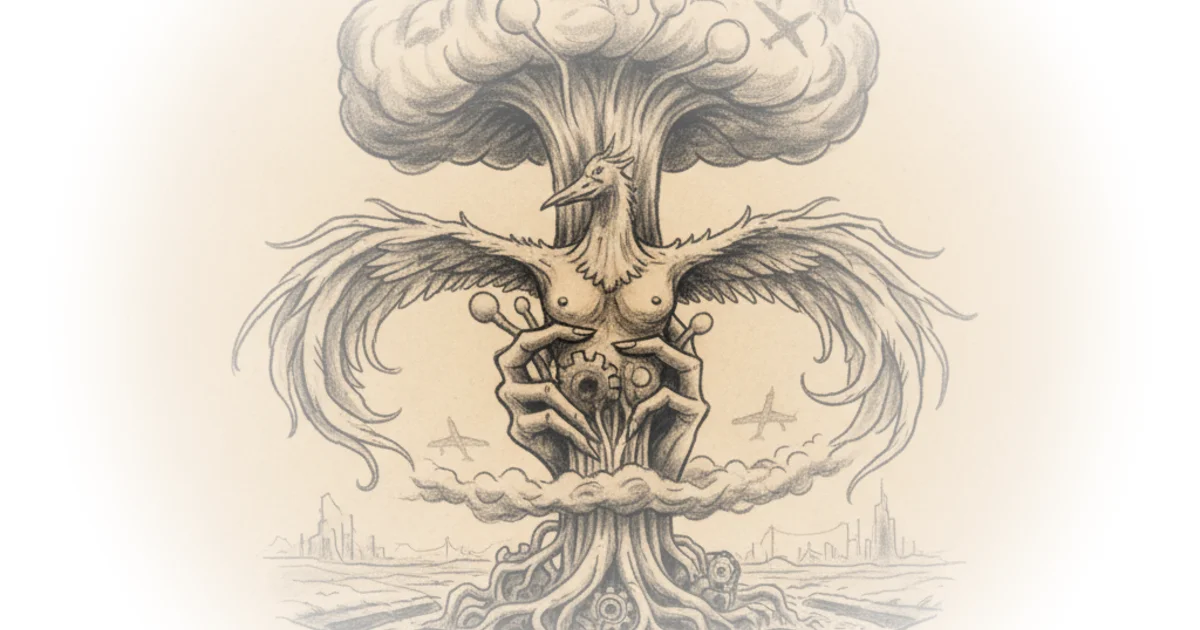
The author posits that this friction is actually a feature, not a bug. He argues that if the winners of a war inherit a poisoned earth, "theirs is a pyrrhic victory." By forcing the military to yield to the ecological needs of the sagebrush steppe, the system acknowledges that the land itself has value beyond its utility as a firing range. Critics might note that in a genuine high-intensity conflict, such environmental constraints could be viewed as a critical vulnerability, potentially jeopardizing the very lives of the troops Lipsky seeks to protect. However, Lipsky's argument rests on the premise that peacetime training is the exact moment to practice restraint, ensuring that the "credible deterrent" does not come at the cost of the habitat it is meant to defend.
"There need not be anything else going on — Zone Rouge is a beautiful story in its own right — but there is. In life it is easy to get confused about the order of things."
The Long Shadow of Verdun
To deepen his argument, Lipsky pivots from the American West to the battlefields of France, drawing on Michael Jerome Plunkett's novel Zone Rouge. He uses the novel to illustrate the permanent, toxic legacy of warfare, contrasting the temporary inconvenience of the sage-grouse with the century-long struggle to clean up the Verdun battlefield. Lipsky writes that the novel depicts the "manual extraction of shrapnel, gathered while grazing, from the stomach of a suffering heifer," a scene that immediately grounds the reader in the physical reality of war's aftermath. This historical parallel is powerful; just as the Second Battle of Champagne in 1915 left a landscape so contaminated that it remains dangerous today, the author implies that the unchecked expansion of military training could leave similar scars on the American landscape.
The narrative of the démoneurs—the French bomb disposal experts who spend their lives removing unexploded ordnance—serves as a haunting counterpoint to the modern soldier's training. Lipsky describes their work as a "Sisyphean aspect" where the earth "finally heaves [shells] to the surface" after a century of freeze and thaw. He notes that these workers eventually succumb to the very toxins they remove, with one character dying of cancer from the "poison amidst which he lives." This section of the commentary underscores the central thesis: the cost of war is not just the immediate loss of life, but the long-term contamination of the world we leave behind. The comparison suggests that protecting the sage-grouse is a small price to pay to avoid becoming the next generation of démoneurs.
Finding Meaning in the Pause
Ultimately, Lipsky uses the novel to argue that the "order of things" is often inverted by the machinery of war. He suggests that the moments of beauty and connection found in the pause—whether a soldier waiting for a bird to finish mating or a character in a novel remembering a summer lake—are what make life worth saving. "We held it and then it was gone. It happened," he quotes, capturing the fleeting nature of peace and the importance of seizing it. The author concludes that the confusion about whether work interrupts rest or vice versa is a false dichotomy; instead, we must find what is good and decide our work is in service to that good thing.
This philosophical turn elevates the piece from a simple policy critique to a meditation on the purpose of defense. Lipsky writes, "So if one must cease his work to let the sage-grouse lek, it is perhaps best to let it lek." This conclusion is striking because it reframes the restriction not as a hindrance to the mission, but as the mission itself: the preservation of life in all its forms. The argument holds up because it acknowledges the gravity of military duty while refusing to let it consume the very world it is meant to protect. It challenges the reader to consider that the "absurd harvest" of war is not just the dead, but the poisoned soil, and that the only way to avoid it is to respect the boundaries of the living.
Bottom Line
The strongest part of Lipsky's argument is its ability to reframe environmental restrictions as a moral imperative rather than a bureaucratic hurdle, using the visceral reality of Verdun to illustrate the permanent cost of unchecked conflict. Its biggest vulnerability lies in the idealism of applying this philosophy to a potential high-intensity war, where the stakes of delay could be catastrophic. Readers should watch for how the military integrates these ecological constraints into long-term strategic planning, as the tension between immediate readiness and long-term sustainability will only intensify.