Jeff Rich challenges the 50-year-old Australian political obsession with the 1975 constitutional crisis, arguing that the event was not a singular tragedy but a symptom of global forces that rendered the very idea of 'national sovereignty' obsolete. While history books focus on the drama of a Prime Minister being sacked, Rich reframes the dismissal as the moment Australia's 'clapped-out' vision of an independent nation collided with the rising tides of neoliberalism and American hegemony.
The Myth of the Coup
Rich begins by dismantling the popular narrative that the dismissal was a simple act of domestic betrayal or a straightforward CIA plot. He acknowledges the enduring fascination with conspiracy theories, noting that "the history of Australia's greatest constitutional crisis remains passionately debated, although after 50 years clear memories are clouded by political mythologies." Yet, he pushes back against the tendency to view every global political shift as a result of "omnicompetent deep state operatives from the USA." Instead, he suggests a more complex reality where local political failures met global structural changes.
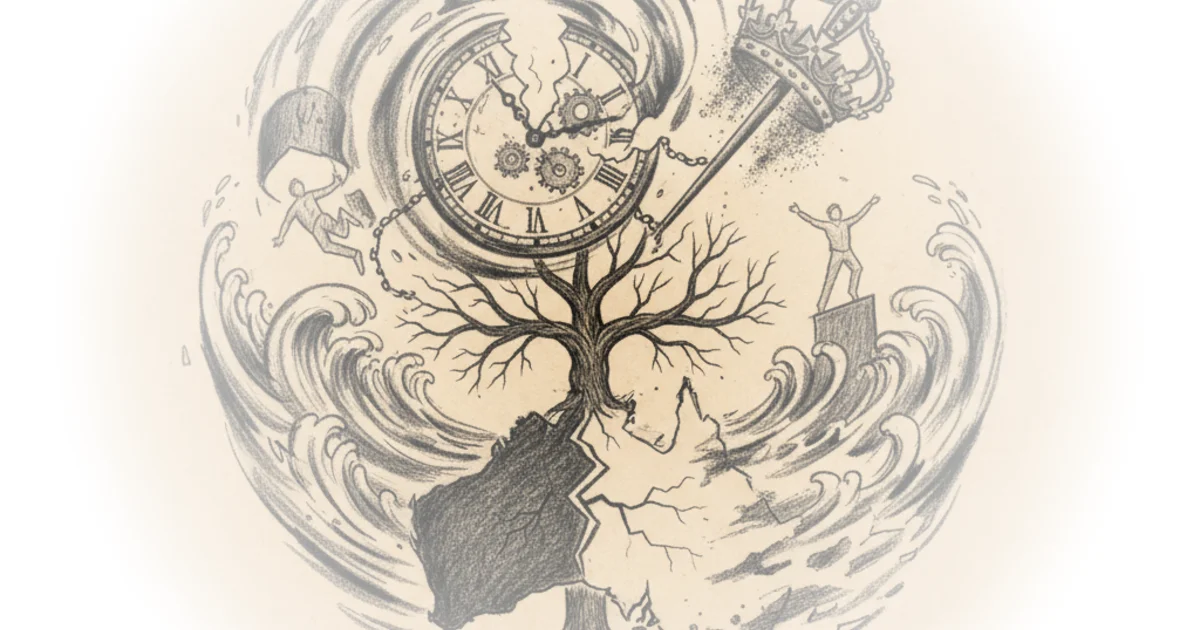
The author's most provocative claim is that the dismissal was less about a specific conspiracy and more about the inevitable collision of eras. He writes, "The Whitlam Government was an early victim of these changes... In many ways, Whitlam was the last government in Australia to aim for democratic socialism." This reframing is powerful because it shifts the blame from a single villainous Governor-General to a broader historical tide. However, critics might argue that this structural determinism risks absolving the specific actors—like Sir John Kerr and the opposition—who made deliberate, illegal choices to break the parliamentary deadlock.
Rich points to the electoral aftermath as proof that the public did not view the event as a theft of democracy, but as a necessary correction. "In both the 1975 and 1977 elections Whitlam and the Labor Party were defeated in landslides," he observes, noting that the electorate chose to "save the Governor-General's judgement." This suggests that the "rage" Whitlam famously called for was not the dominant sentiment of the nation, but rather a specific emotional response that failed to translate into political power.
Whitlam has become in Australian left nationalist circles the father of the nation, like Garibaldi or Washington, and the saint of progressive tradition. But even fathers sometimes need their grand balloons deflated.
The End of Sovereignty
The commentary then pivots to the broader historical context, identifying three converging forces: the shift in decolonization, the rise of "liquid modernity" in social identity, and the global march of neoliberalism. Rich argues that the 1970s saw a "phase-shift in the processes of decolonization" where a "tide of American neo-colonialism surged through its 'pointillistic empire of bases'." This is a crucial distinction; while the Whitlam government was busy managing the transition of Papua New Guinea to independence, the global power dynamic was tightening around the United States.
Rich suggests that the crisis was not just about Australian internal politics, but about the death of a specific type of nationalism. He writes, "This tide of recolonization would drown the Whitlam Government and the 1960s/1970s surge of Australian nationalism that went underwater in search of a republic." The argument here is that the desire for a republic or full sovereignty was already becoming anachronistic in a world increasingly defined by transnational capital and security alliances. The dismissal, therefore, was the moment the illusion of total independence was shattered.
He also touches on the role of media, specifically Rupert Murdoch, suggesting that the media landscape was shifting in tandem with political power. Rich notes that "one year after the Dismissal, in 1976, Rupert Murdoch became a major media player in the USA by purchasing the New York Post," implying a potential exchange of political favors or at least a shared ideological alignment that reshaped global media. While this is a compelling narrative thread, it relies heavily on inference rather than direct evidence of a quid pro quo, leaving room for skepticism about the extent of Murdoch's direct influence on the Governor-General's decision.
A World Without Sovereigns
Ultimately, Rich's conclusion is that the Australian political imagination is stuck in a trauma that no longer serves a purpose. He asks, "Has Australia's 1975 generation fixated on the constitutional crisis for too long?" and suggests that the nation needs to let go of the "fantasies that modern political parties can deliver a reform vision for the nation." The core of his argument is that the world has moved on to a state where "national sovereignty" is a fiction. "Australian sovereignty died in 1975; or maybe it was stillborn in 1945," he posits, challenging readers to accept a "world without sovereign nations."
This is a bold, perhaps uncomfortable, conclusion for a nation that still prides itself on its democratic resilience. Rich argues that the "human comedy" of 1975 should be viewed not as a tragedy, but as a moment where the "grandeur" of Whitlam met the "comically misjudging" reality of global power. He writes, "It may be time to heal the wounds of Australian political culture inflicted by the Dismissal with a little comic history." This call to move from tragedy to comedy is a unique rhetorical strategy that aims to disarm the emotional intensity that has kept the issue alive for half a century.
Australian sovereignty died in 1975; or maybe it was stillborn in 1945. In 2025 is even the hyper-power the USA sovereign over its own destiny?
Critics might note that dismissing the constitutional crisis as merely a symptom of globalization ignores the specific damage done to democratic norms when an unelected official removes an elected government. The precedent set by the dismissal remains a live wire in Australian constitutional law, regardless of whether the nation is truly sovereign in a global sense. Rich's argument, while intellectually stimulating, risks underestimating the practical importance of institutional safeguards.
Bottom Line
Jeff Rich's strongest move is reframing the 1975 dismissal not as a local scandal, but as a global inflection point where the old model of the sovereign nation-state collided with the realities of American hegemony and neoliberal economics. However, the piece's biggest vulnerability is its tendency to let structural forces absolve the specific actors of their responsibility for breaking democratic conventions. Readers should watch for how this historical revisionism influences current debates on Australian republicanism and the role of the Governor-General.