Sabine Hossenfelder tackles a provocative claim that has resurfaced in physics circles: the idea that black holes, those cosmic monsters predicted by Einstein, might not actually exist. Her angle is not to debunk the mathematics but to dissect the philosophical and observational gaps that allow skeptics to argue the horizon never truly forms. For busy minds tracking the frontiers of astrophysics, this piece cuts through the hype to ask a fundamental question: if we can't see the inside, does the inside exist at all?
The Illusion of Infinite Time
Hossenfelder begins by addressing the most common objection: that from an outside observer's perspective, a black hole takes an infinite amount of time to form. She explains that while a distant viewer would see a collapsing star slow down and fade away, this is a quirk of perspective, not a physical barrier. "The time that an observer outside of the black hole perceives is only one of them," she notes, highlighting the relativity of time itself. This distinction is crucial because it separates the mathematical model from the subjective experience of an observer.
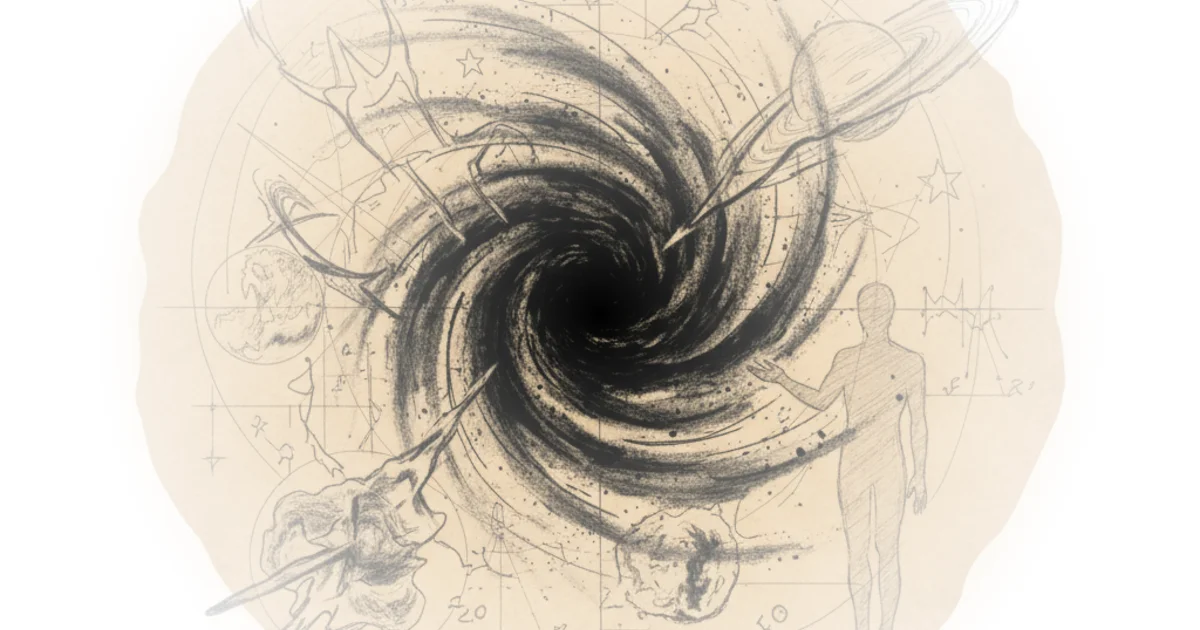
She acknowledges the philosophical weight of the counter-argument, which suggests that if no one can ever witness the horizon form, the concept is meaningless. "An observer who jumps into a black hole, crosses the horizon in finite time, and reaches the singularity at finite time," she writes, contrasting the external view with the internal reality. The strength of her position lies in her pragmatic approach to physics; she argues that the existence of the interior is validated by the fact that it will eventually become visible through evaporation. "If black holes evaporate, then the inside becomes slowly visible and eventually the black hole entirely disappears," she concludes, turning the argument of infinite time on its head by introducing a finite lifespan.
If one takes into account that black holes evaporate, as Steven Hawking showed, they do, then it's no longer true that black holes take an infinite amount of time to come into existence and that the inside is forever disconnected.
Critics might argue that relying on a process taking 10^100 years to validate existence is a stretch for empirical science, but Hossenfelder's point is that the theoretical framework remains consistent even if the timeline is absurdly long.
The Math of Radiation and Reality
The piece then pivots to a more technical claim: that Hawking radiation might prevent the horizon from ever forming in the first place. Hossenfelder dismantles this with characteristic bluntness, pointing out that the energy loss from radiation is negligible for large astrophysical objects. "The total loss of mass/ energy from black hole radiation has been calculated thousands of times," she states, noting that for massive stars, the effect is "ridiculously tiny and can't prevent them from forming." This is where her background shines; she references her own master's thesis work where she attempted to prove the opposite, only to find the math didn't support the skepticism.
She also clarifies a common misunderstanding regarding Stephen Hawking's own provocative statements. When Hawking said black holes don't exist, he was being semantically precise about the difference between an eternal event horizon and a temporary "apparent horizon." "Inert one has what's called an apparent horizon that looks for a potentially very long time like an event horizon but ultimately isn't," she explains. This nuance is vital for readers to understand that physicists are often arguing about definitions rather than the physical reality of the objects themselves. "Basically if it walks like a black hole and coax like a black hole we call it a black hole," she quips, grounding the debate in practical utility.
Alternative Theories and the Hard Surface Problem
Hossenfelder does not shy away from fringe theories, giving a nod to Gerard 't Hooft's idea that matter might pass through the horizon and emerge transformed, effectively eliminating the "inside." She admits that while this is not the consensus, it deserves respect for its originality in addressing the information loss problem. However, she is far more critical of the "gravastar" hypothesis, which posits that black holes are solid objects with hard surfaces. "If black holes had a sort of hard surface rather than a horizon where things just fall through, you'd expect to see emissions when infalling stuff hits the surface," she argues, pointing out the lack of observational evidence for such explosions.
She further dismantles the gravastar idea by examining density. As mass increases, the average density of a black hole decreases, meaning supermassive black holes are surprisingly diffuse. "The density of a super massive black hole like that in the Milky Way is comparable to the density of water," she notes, making the idea of a solid surface at such low densities theoretically untenable. This section effectively uses basic physical principles to show why the "hard surface" model fails to match the data we have.
Bottom Line
Hossenfelder's strongest contribution is her insistence that the existence of black holes is defined by the success of their mathematical description, not by our ability to peer inside. The piece's greatest vulnerability is its reliance on the eventual evaporation of black holes to prove the reality of their interiors, a process so slow it borders on the abstract. However, for readers seeking clarity on why physicists remain confident despite the philosophical hurdles, this is a definitive guide to the current state of the debate.