More Perfect Union uncovers a political anomaly that defies the rigid tribalism defining modern American discourse: a coalition of voters who supported the president and then elected a Democratic socialist mayor. This isn't a story about confused voters, but rather a calculated rejection of ideology in favor of raw economic survival. The piece matters because it suggests the traditional left-right axis is collapsing under the weight of a cost-of-living crisis that no single party has solved.
The MAGA for Mamdani Phenomenon
The author begins by dismantling the assumption that political identities are monolithic. More Perfect Union writes, "When Zoron Mandani, a Democratic socialist, met with Donald Trump in the Oval Office, it wasn't supposed to go well." Yet, the coverage reveals that these voters do not see a contradiction in supporting both men. The narrative follows Ron Barbara, a self-described "unelected leader" of the "MAGA for Mamdani" movement, who notes that seeing the faces of people at his rally was "the most beautiful thing." The author effectively uses Barbara's story to illustrate that for many, political labels are secondary to tangible results.
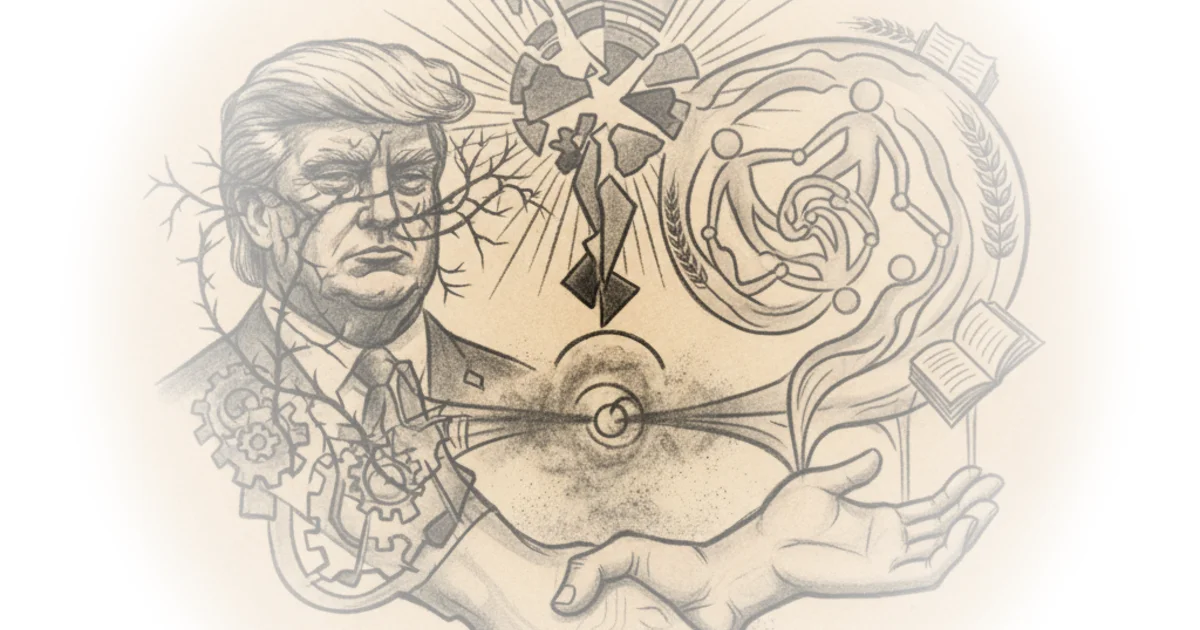
The coverage highlights that this shift is not limited to a few outliers but represents a significant demographic. More Perfect Union notes, "Most Trump to Mam Donni voters live in workingclass immigrant communities across the city and many belong to a group that the Democratic party has been losing for years." This is a crucial distinction. It suggests that the Democratic Party's failure to address the economic anxieties of the working class has created a vacuum that both the president and Mamdani are filling, albeit with different rhetoric. Critics might argue that conflating the administration's populist nationalism with Mamdani's democratic socialism ignores profound differences in their policy goals, yet the voters interviewed seem to care less about the labels and more about the outcome.
"I mean they both want the same thing. Affordability. Affordability. Everybody's talking about it. And in New York, it's impossible to ignore."
The Economics of Disillusionment
The heart of the argument rests on the visceral reality of New York's housing and cost-of-living crisis. The author introduces Christian Spariosu, a former college Republican whose worldview shifted after a personal encounter with the city's bureaucracy. More Perfect Union paraphrases his journey: after his landlord ignored his requests to fix a leaking roof, it was Mamdani's office that intervened, citing safety violations and forcing repairs. This personal anecdote serves as a microcosm for the broader political shift.
The piece argues that for voters like Spariosu, the appeal of socialism is not ideological purity but practical efficacy. As More Perfect Union puts it, "When I got to study abroad in Japan... I had to go to the hospital for a medical emergency. They have universal healthcare... Just out of pocket, I paid somewhere between like 30 to 50 bucks for like a full day." This experience shattered his belief that the American system was superior. The author uses this to explain why a former the president supporter would embrace a socialist platform: the promise of a social safety net is more attractive than the promise of deregulation when one is drowning in medical debt or rent.
The coverage suggests that the traditional conservative argument against socialism has lost its grip on voters who have seen the failure of the current system. More Perfect Union writes, "I think one of the most conservative things you can do is trying to get people to have a family with no cost child care. Like being able to have a family and afford to have kids. How is that not conservative?" This reframing of "conservative" values through an economic lens is the piece's most provocative move. It challenges the reader to consider that supporting a socialist might actually be the most pragmatic, even conservative, choice for a working-class family trying to survive.
The Test of a New Coalition
The final section of the commentary focuses on the sustainability of this unlikely alliance. The author quotes Mamdani's inauguration speech, where he promised a city governed not by the 1%, but by the 8.5 million New Yorkers. More Perfect Union writes, "Few of these 8 and 12 million will fit into neat and easy boxes. Some will be voters who supported President Trump a year before they voted for me." The author poses a critical question: can this coalition hold together when the initial promise of affordability meets the hard realities of governance?
The piece acknowledges the skepticism of these voters. One interviewee admits, "I don't know. Superman and the Justice League ain't real. So like I don't know who the hell going to help us for real." This cynicism is a double-edged sword; it drives them to support outsiders, but it also makes them quick to abandon them if promises are not kept. The author suggests that the real test is whether Mamdani can deliver on his economic promises without alienating the very voters who brought him to power.
"For too long in our city, freedom has belonged only to those who can afford to buy it. Our city hall will change that."
Bottom Line
More Perfect Union's strongest asset is its refusal to dismiss these voters as confused or hypocritical, instead treating their cross-party support as a rational response to a broken economic system. The piece's biggest vulnerability is its reliance on anecdotal evidence, which, while powerful, may not fully capture the complexity of the national political landscape. However, the core insight remains undeniable: when the cost of living becomes the only issue that matters, the traditional political map is rendered obsolete.