Babbage reframes the current trade war not as a simple dispute over tariffs, but as a collision between political theater and a supply chain so deeply entangled that untangling it could break the global economy. The piece's most startling claim is that the United States has effectively outsourced its own industrial capacity to a rival power, creating a dependency that no amount of political posturing can quickly reverse. This is not just about where a phone is assembled; it is about a thirty-year transfer of technical expertise that has fundamentally altered the balance of power in the electronics sector.
The Illusion of the "Screwdriver" Factory
The commentary opens by dismantling the administration's simplistic view of manufacturing. Babbage highlights a quote from U.S. Secretary of Commerce Howard Luttnick, who envisioned a future where "the trade craft of America is going to fix them, is going to work on them" regarding the millions of screws in an iPhone. Babbage argues this framing ignores the reality of modern production. The author notes that the administration sees the reliance on China as a vulnerability, yet fails to grasp that the problem isn't just labor cost, but the sheer density of specialized skills.
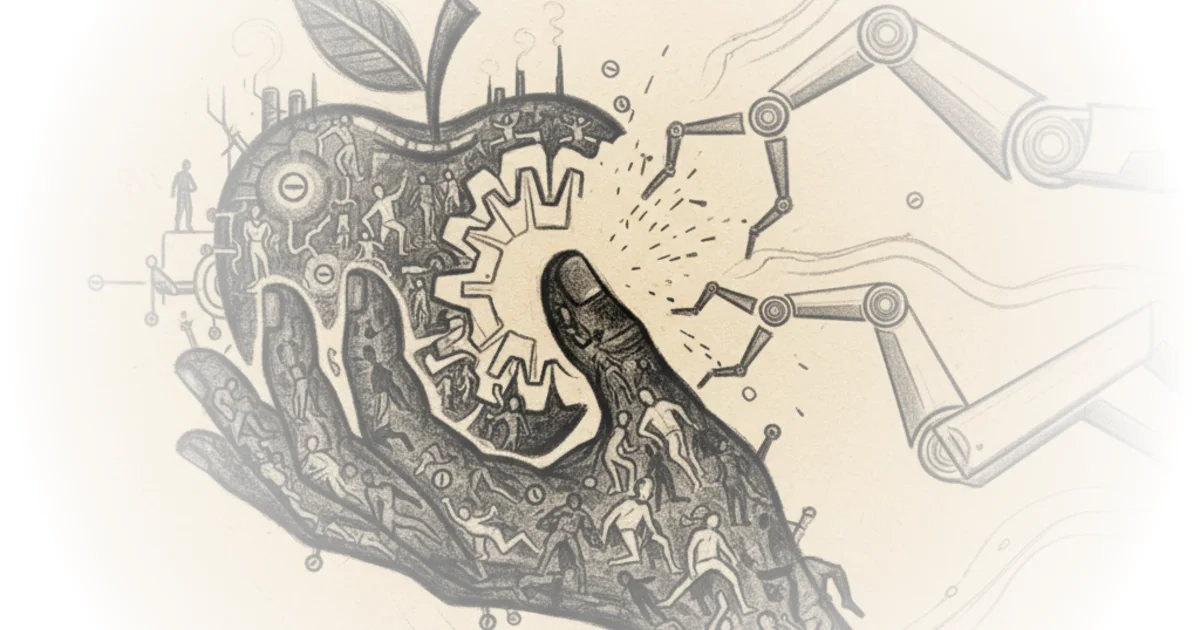
The core of the argument rests on the idea that moving assembly is not a switch one can flip. Babbage writes, "There was a bunch of stuff that we at Apple were very used to doing, that just didn't work anymore. Like, we're very fond of making custom fastening hardware, custom screws—you know, little nuts and stuff like that. Well, in China, if you're building and it's like, 'Oh, shit, the screw is too short,' and like, 'I need a longer one,' you call someone on a cellphone and 1,000 are at the factory tomorrow. That was not a thing in Texas. It would take two months. That was absurd." This anecdote, drawn from Patrick McGee's new book Apple in China, effectively illustrates the logistical nightmare of replicating China's ecosystem in the U.S. The commentary suggests that while the political demand for domestic production is clear, the operational reality is a wall of time and infrastructure that the current administration has not accounted for.
Critics might argue that the two-month delay is a temporary friction that could be solved with enough investment, but Babbage's evidence points to a deeper structural deficit in vocational training and supplier networks that took decades to build in China.
The Unintended Consequences of Success
The piece then pivots to the historical irony: Apple's massive success in China was the very engine that built its current rival. Babbage explains that while Apple sought efficiency, it inadvertently created a "trap" by transferring its manufacturing prowess to local competitors. The author details how Apple's presence led to a massive transfer of expertise, noting that "Cook's team grew to understand that the innovations it came up with would be mimicked in China, usually within a year. This was simply the cost of doing business there." This admission is crucial; it reframes the trade deficit not as a failure of policy, but as the inevitable outcome of a strategy that prioritized speed and scale over long-term security.
You keep talking about geopolitics, but I was there in the 2000s when we were setting up production in China, and I can tell you, we weren't thinking about geopolitics at all.
Babbage uses this quote from a former Apple employee to underscore the blindness of the era. The argument is that the current geopolitical impasse was not a calculated risk but a byproduct of ignoring the long-term strategic implications of deep integration. The commentary posits that the administration's current threats of tariffs are a reaction to a reality that was created by the very companies they are now trying to regulate.
The Deepening Entanglement
As the analysis moves to the present day, Babbage challenges the popular narrative that companies stay in China solely for cheap labor. The author cites Tim Cook directly to dismantle this myth: "The popular conception is that companies come to China because of low labor cost. I'm not sure what part of China they go to, but the truth is China stopped being the low labor cost country many years ago. And that is not the reason to come to China from a supply point of view. The reason is because of the skill and the the quantity of skill in one location... In China, you could fill multiple football fields." This distinction is vital. It shifts the debate from economics to capability. The U.S. does not just lack the factories; it lacks the engineers and the tooling experts required to run them.
Furthermore, the commentary highlights the coercive nature of the Chinese market. Babbage writes, "The cost of doing business in China today is a high one, and it is paid by any and every company that comes looking to tap into its markets or leverage its workforce. Quite simply, you don't get to do business in China today without doing exactly what the Chinese government wants you to do. Period." This suggests that the administration's pressure on Apple is a double-edged sword; while it demands American production, it ignores the fact that Apple is held hostage by the Chinese government's control over its supply chain and its massive consumer market.
A counterargument worth considering is whether the U.S. could eventually rebuild this capacity with sufficient subsidies and time, but the text implies that the window for a seamless transition has closed, leaving only a painful decoupling.
Bottom Line
Babbage's strongest contribution is the revelation that the supply chain is not a commodity that can be easily relocated, but a complex ecosystem of skills and relationships that took thirty years to cultivate. The argument's vulnerability lies in its potential fatalism; while the barriers are immense, it does not fully explore whether a long-term, multi-decade national strategy could eventually overcome them. However, the immediate takeaway is clear: the administration's demand for immediate domestic production ignores the reality that the U.S. has lost the vocational foundation required to make it happen.