In a political landscape where energy policy is often framed as a battle between climate urgency and consumer costs, Energy Bad Boys delivers a jarring twist: the very lawmakers decrying record utility profits may have engineered them. The piece argues that Democratic support for renewable mandates and tax credits has inadvertently created a lucrative feedback loop for the industry, turning a symbiotic relationship into a source of public backlash. This analysis is timely because it challenges the prevailing narrative that rising electricity bills are solely the result of market forces or data center demand, pointing instead to the mechanics of regulated monopolies under green policy regimes.
The Profit Paradox
The article opens with a stark data point that reframes the current political debate. "Our analysis, which examined the top 50 U.S. utilities... found that profits for these 50 utilities rose by 75 percent over this period," Energy Bad Boys reports, citing S&P Global Market Intelligence data from 2018 through 2025. This surge is not attributed to a sudden spike in electricity demand, which has remained largely stagnant, but rather to policy-driven capital expenditures. The editors argue that "liberal energy policies helped support these record-breaking utility profits using two key mechanisms": state-level mandates for wind and solar, and generous tax credits that reduce corporate tax liabilities.
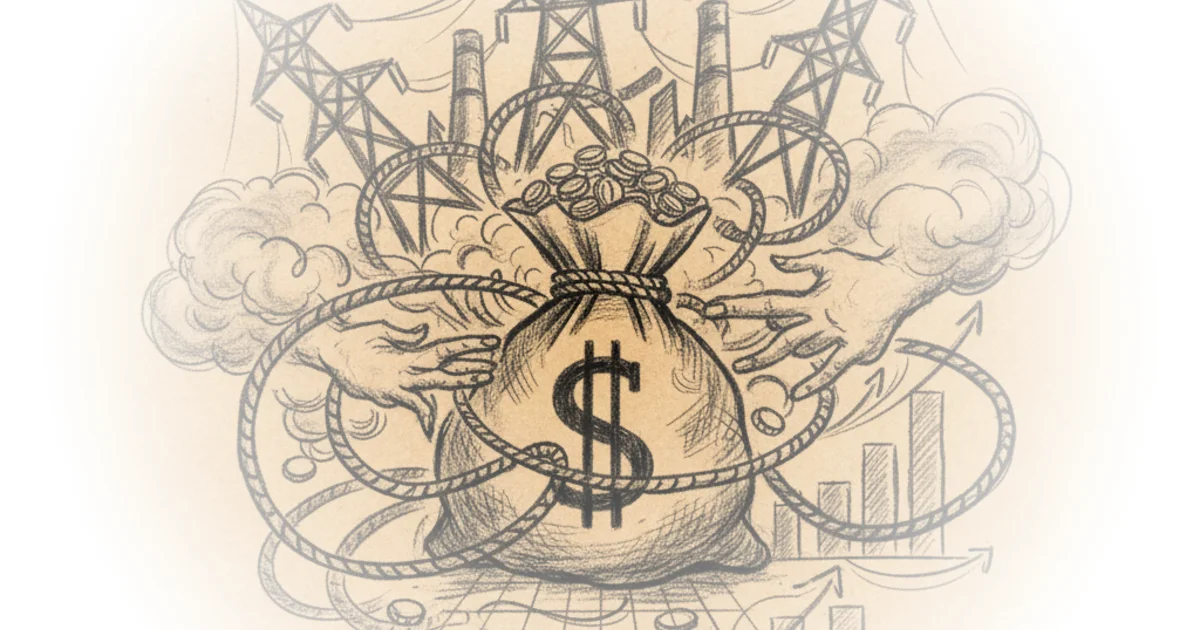
This argument leans heavily on the economic concept of rate-of-return regulation, a system where utilities are guaranteed a profit on their investments. The piece notes that "utility companies can earn more profit by doing two things: increasing the approved Return on Equity, or increasing the Rate Base by building more infrastructure." By mandating the retirement of depreciated coal plants and the construction of new renewable assets, policymakers effectively forced utilities to expand their rate base, thereby increasing the total dollar amount on which they can earn a return. "There is no question as to what is inflating utility rate bases... to satisfy net-zero policies that required a massive buildout of new generation resources," the editors assert.
Utilities built the wind and solar resources that Democrats demanded and supported their regulations on carbon dioxide emissions from power plants, and in return, utilities were allowed to laugh all the way to the bank while lawmakers celebrated their commitment to the climate.
The historical parallel here is reminiscent of the "Bootleggers and Baptists" theory, where unlikely coalitions form around regulation. In this iteration, the "Baptists" (climate advocates) and the "Bootleggers" (utility executives) found common ground in mandates that expanded the utility's asset base. While the political intent was decarbonization, the economic result was a guaranteed profit increase for the regulated entities. Critics might note that this analysis assumes utilities cannot absorb costs or that the transition to renewables would have been equally profitable under a different regulatory framework, but the correlation between policy shifts and profit spikes is difficult to ignore.
The Political Reversal
The piece identifies a distinct shift in political rhetoric, describing a "Baptist and Bootlegger Breakup." For years, Democrats focused their criticism on fossil fuel companies, but as electricity bills became a more visible household expense, the focus shifted to utilities. "As electricity bills become a more visible household expense, utilities — and their executives — are attracting more attention," the article observes. The editors suggest that this new tenor marks the beginning of a rift, noting that "Democrats in Congress are increasingly signaling they want a role in reshaping how the industry operates."
This shift is framed as a political calculation. The editors write, "Democrats are seeking to turn rising power prices into the new 'egg prices,' to drag down President Trump's approval ratings." While the political maneuvering is clear, the article argues that the underlying economic reality remains unchanged. The introduction of the "Lowering Utility Bills Act" (H.R. 8568), which aims to cap the return on equity (ROE) for utilities, is presented as a reactive measure to a problem the party helped create. "This bill is saying all of those calculations that you're doing for that return on equity, those have got to be thrown out the window," a sponsor of the bill is quoted as saying. However, the editors caution that capping the ROE is only half the solution, as the rate base itself continues to swell due to mandated infrastructure spending.
Regional Case Studies
To ground the national data, the piece dives into specific regional examples, starting with Florida. "One surprise in our analysis was the prevalence of Florida utilities in the Green-Plating analysis," the editors note. They contrast investor-owned utilities like Florida Power and Light with municipal utilities, finding that bills for the latter rose by only 5 percent since 2010, while the former saw a 38 percent increase. Jacob Williams, head of the Florida Municipal Power Agency, is quoted explaining the difference: "FPMA's resource portfolio consists of 81 percent natural gas... In contrast, 18 percent of FPL's mix was solar in 2025."
The argument here is that the timing and cost of renewable investment matter. "Rather than only buying solar when it was affordable, FPL and DEF have continued investing in solar, incurring higher costs on their systems and boosting the utility's profits," the piece argues. This suggests that the profit surge is not just about the existence of renewables, but about the specific regulatory environment that allows utilities to pass on the full cost of these investments, including those made when prices were high, to ratepayers.
In Michigan, the analysis highlights Consumers Energy, which added significant wind capacity even before a 2023 mandate required 100 percent carbon-free electricity by 2040. The editors point out a critical detail: "Consumers was allowed to continue recovering costs and earning returns associated with the coal plant it retired in 2023, further supporting the company's bottom line even after the facility stopped generating electricity." This practice, often called "stranded asset recovery," allows utilities to profit from assets that are no longer in use, a mechanism that directly links policy-driven retirements to increased profitability.
The piece also examines MidAmerican Energy, a subsidiary of Berkshire Hathaway, noting that its profits soared while rates remained flat. "The ability for MidAmerican to increase its profits and wind portfolio without raising rates for customers is somewhat of an anomaly in the utility world," the editors admit. They attribute this to the Production Tax Credit (PTC), which allows conglomerates to use wind credits to offset taxes on other profitable businesses. "In effect, the federal subsidies used to promote wind power also reduce the tax burden of one of the richest men in America," the article concludes. This highlights a nuance often missed in public debates: the same subsidies that drive rate increases for some utilities can act as a massive tax break for vertically integrated conglomerates.
Utility profits are indeed soaring, and they are the result of investments in wind, solar, and battery storage projects and the lavish federal subsidies paid to the utility companies that own them—decisions and policies endorsed by the very Democrats now complaining about the results.
Bottom Line
The strongest part of Energy Bad Boys' argument is its rigorous application of rate-of-return mechanics to explain the disconnect between policy intent and financial outcome, effectively dismantling the idea that rising profits are an accident of the market. However, the piece's vulnerability lies in its somewhat deterministic view that these outcomes were inevitable, potentially underestimating the role of regulatory oversight failures or the specific choices made by utility boards. As the political pressure mounts to cap returns, the real test will be whether policymakers can address the inflated rate base without undermining the capital investment needed for the energy transition.