This piece from Works in Progress argues that we are standing on the precipice of a medical revolution, not through the discovery of new drugs, but through the ability to simply turn off the genes that cause disease. It suggests that decades of struggle in traditional drug discovery are finally being bypassed by a technology that treats the body's instructions as editable code rather than immutable fate. For busy leaders tracking the future of biotech, this is not just a scientific update; it is a signal that the most intractable diseases may soon be manageable with a quarterly injection rather than a lifetime of complex regimens.
The End of the "Undruggable" Era
The article opens with a stark metaphor for the current state of pharmaceutical research, describing it as "a boot stamping on a biologist's face" where the boot is labeled "medicinal chemistry." This vivid imagery sets the stage for the central problem: traditional small-molecule drugs rely on finding a specific "pocket" on a protein to bind to, a process that fails for the vast majority of human proteins. Works in Progress notes that "the majority of human proteins are considered 'undruggable'... either because those proteins lack a convenient pocket for drugs to attach to or because they are 'intrinsically disordered'."
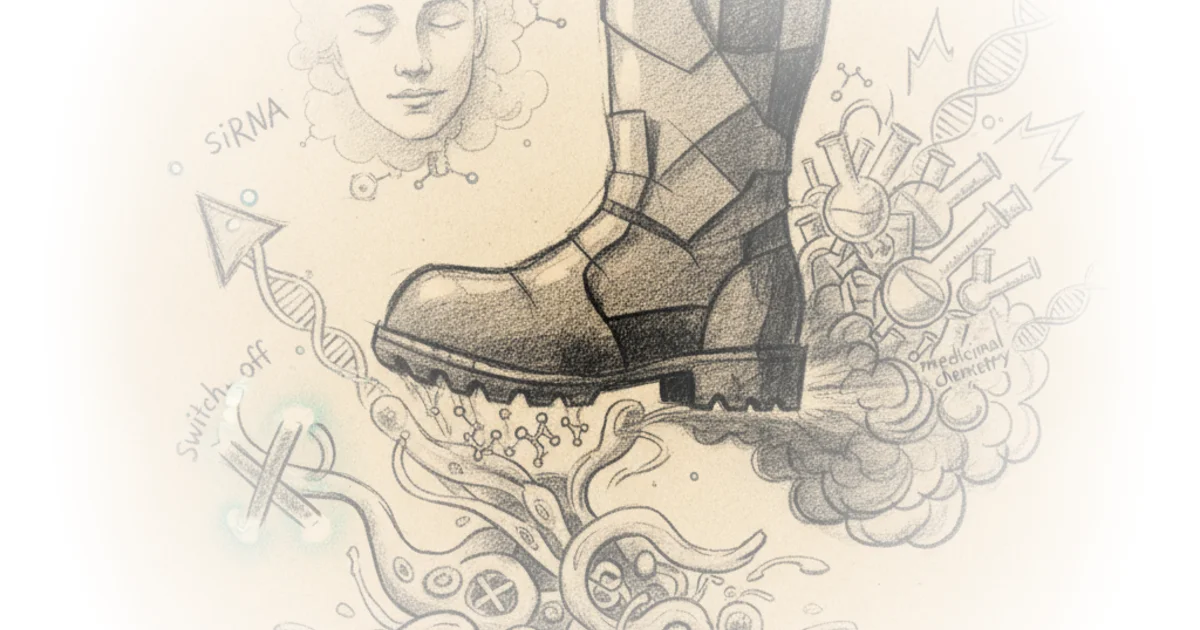
The piece argues that this limitation has forced researchers to focus only on the easy targets, much like "the proverbial drunk searching for his keys under the streetlamp because that's where the light shines." This framing effectively highlights the inefficiency of the current paradigm. By shifting the focus from designing chemicals to fit proteins, to designing molecules that destroy the instructions for making those proteins, the field bypasses the structural limitations that have stalled progress for decades. This is a profound shift in strategy, moving from physical blocking to genetic silencing.
"If the mRNA is destroyed, the protein won't be built. That's exactly what siRNA, or 'small interfering RNA', does: it's a short strand of RNA that interferes with the production of protein by destroying mRNA."
The historical context provided is particularly compelling. The technology emerged not from a grand design for human medicine, but from a botched experiment with petunias in 1990. Scientists at DNA Plant Technology Corporation were trying to make flowers darker by adding extra pigment genes, only to find the flowers turned white. As the editors explain, "Adding an extra copy of a gene for an enzyme would mean more enzyme and therefore more pigment. But somehow, the extra copy eliminated the enzyme's production, rather than boosting it." This accidental discovery of "cosuppression" revealed a natural mechanism where cells use small RNA strands to silence genes, a process that was later validated by Nobel laureates Andrew Fire and Craig Mello. It serves as a reminder that some of the most transformative medical breakthroughs come from understanding nature's own error-correction systems.
Solving the Delivery Puzzle
The core of the argument, however, is not the mechanism of silencing, but the decades-long struggle to deliver the silencer to the right cells. The piece details why simply injecting RNA is futile: "If you just injected siRNA into a patient's veins, nothing useful would happen." The body's enzymes destroy unprotected RNA, and even intact molecules cannot easily enter cells or escape the digestive compartments within them.
Works in Progress traces the evolution of delivery systems, noting that while viruses were an obvious candidate, they carry significant risks of immune reaction. Similarly, early lipid-based carriers struggled with toxicity or inefficiency. The breakthrough came with "ionizable lipids," which are neutral in the bloodstream but turn positive inside the acidic environment of a cell's endosome, destabilizing the membrane and releasing the payload. This chemical ingenuity allowed for the first FDA-approved siRNA drug, patisiran, which treats hereditary transthyretin amyloidosis. The editors note that this drug "needed to be dosed every three weeks," highlighting that while the problem was solved, the solution was still cumbersome.
The narrative then pivots to a more elegant solution that emerged from the same research lineage. Instead of relying on complex carriers, researchers began chemically modifying the RNA itself to make it durable enough to survive "naked" in the bloodstream. By swapping reactive oxygen atoms for stable fluorine or hydrogen, they created molecules that could persist indefinitely. To target the liver specifically, they attached a "sugar molecule called GalNAc," which acts as a homing beacon for liver cells. The result was a dramatic improvement in patient convenience and safety. As the piece states, "Patisiran, which is carried by a lipid nanoparticle, needed to be dosed every three weeks. In contrast, Alnylam's newer drug, vutrisiran, a naked siRNA drug attached to a GalNAc sugar, is approved to treat the same medical condition, but needs to be dosed only once every three months."
This transition from complex, frequent dosing to a simple, quarterly regimen represents a massive leap in the viability of gene therapies. It transforms a treatment from a medical burden into a manageable routine. Critics might note that this success is currently limited almost exclusively to the liver, as the GalNAc receptor is abundant there but rare elsewhere in the body. The article acknowledges this, noting that "every success story so far has involved the liver," and that expanding this technology to the brain or muscles remains the next great frontier.
"Simply put, temporarily switching off a precise gene in the liver is now a solved problem, and it can be achieved with drugs that require no more than four administrations per year."
The implications for public health are staggering. The editors point out that this technology is already being applied to high cholesterol, hemophilia, and acute hepatic porphyria, with trials underway for hypertension and diabetes. The ability to silence a gene that causes high blood pressure could potentially prevent strokes and heart attacks before they occur, shifting medicine from reactive treatment to proactive prevention. This aligns with the broader historical trend seen in other biotech sectors, such as the development of intrathecal administration techniques which allowed drugs to bypass the blood-brain barrier, proving that delivery hurdles are often the only thing standing between a hypothesis and a cure.
Bottom Line
The strongest part of this argument is its clear demonstration that the "undruggable" label is no longer a biological fact but a technological limitation that has been overcome for a specific class of diseases. The piece effectively reframes the history of drug discovery, showing how a failed petunia experiment led to a solution that could treat dozens of deadly conditions. However, the argument's biggest vulnerability lies in its optimism regarding non-liver targets; until delivery systems can be perfected for the brain or heart, the revolution will remain partial. The reader should watch for the next wave of clinical trials that attempt to break the liver's monopoly on siRNA success, as that will determine whether this technology truly changes medicine as we know it.