A Crisis With No Good Options
Caspian Report's Shirvan offers one of the more sober assessments of Iran's current protest wave, cutting through what he describes as a "media distortion field" to examine the structural forces that will ultimately determine the movement's fate. The analysis arrives at a moment when Western coverage has oscillated between breathless predictions of imminent regime collapse and dismissive skepticism, and it lands squarely in the uncomfortable middle ground where most complex geopolitical situations actually live.
The central argument is that Iran's protests, while genuinely the most significant since the 1979 revolution, are constrained by structural realities that make a quick regime change scenario deeply unlikely. This is not a contrarian take for its own sake. It is grounded in a careful reading of Iran's layered security apparatus, its fragmented opposition, and the cyclical nature of Iranian unrest over the past decade.
The Three Crises Converging
What makes the current moment distinctive is the convergence of three long-running crises that have each independently triggered mass demonstrations in recent years. Iran's water crisis has been hollowing out rural communities for years, with lakes vanishing and aquifers running dry. Its energy deficit, worsened dramatically after Israeli strikes on oil and gas infrastructure during the June 2025 conflict, has made winters increasingly unbearable. And the economic spiral, accelerated by Trump's maximum pressure campaign and the collapse of the 2015 nuclear deal, has eroded the currency and purchasing power of ordinary Iranians at a staggering pace.
The Iranian rial has plummeted against the US dollar since the Israel-Iran war, losing about 40% of its value in less than 7 months. In late December, things finally snapped. Shopkeepers in Tehran's Grand Bazaar and other commercial districts took to the streets.
The involvement of bazaar merchants is historically significant. In the 1979 revolution, the bazaaris played a crucial role in undermining the Shah's regime by shutting down commercial activity. Their participation signals that economic pain has penetrated deep into the social classes that typically prefer stability over upheaval. When shopkeepers close their doors to protest, it carries a different weight than student demonstrations, however brave those may be.
The Information War
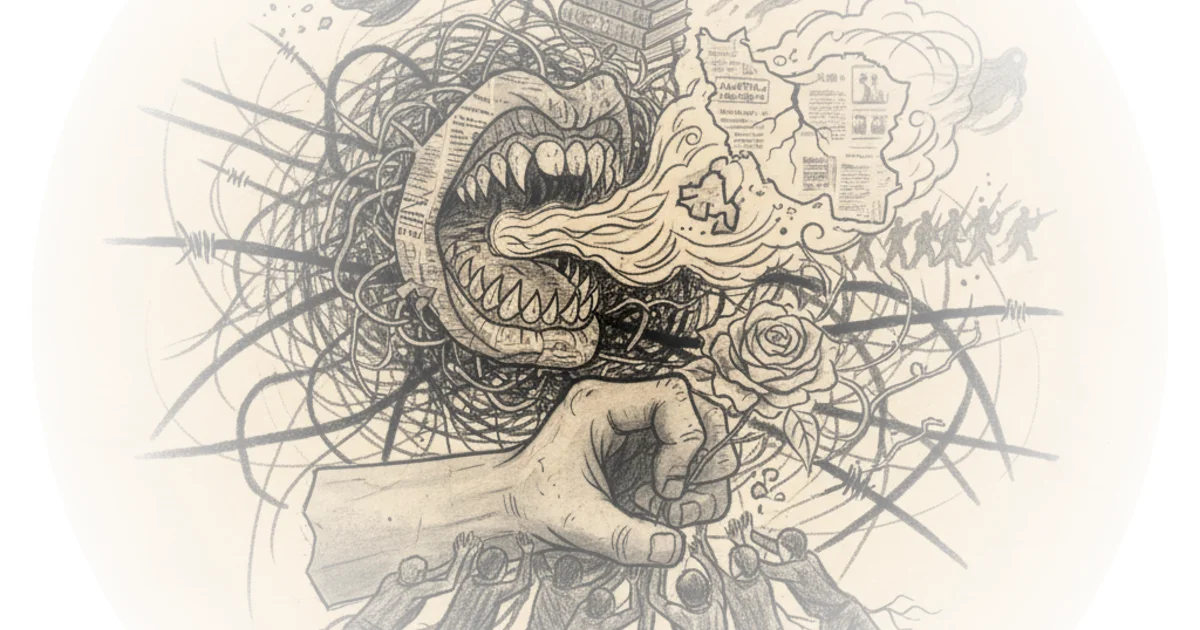
One of the more valuable threads in the analysis concerns the information environment surrounding these protests. Iran's self-imposed internet blackout means that virtually all information flowing out of the country is unreliable to some degree. Into that vacuum rush competing narratives: Western governments embellishing events to justify pressure campaigns, monarchist exile groups spreading disinformation at scale, and Iranian state media minimizing the scope of unrest.
CIA and Mossad operatives are on the ground flooding the information space with noise. When you look past the distortion, for Iran and its people, there are no good options. There is only a race to the bottom.
This framing deserves scrutiny. The claim about intelligence operatives "on the ground" is presented without sourcing, and conflating all external information manipulation with organized intelligence operations risks overstating the case. That said, the broader point about information distortion is well-taken. The history of Western media coverage of Middle Eastern uprisings, from the Arab Spring onward, has been marked by a persistent tendency to project liberal democratic aspirations onto movements whose internal dynamics are far more complicated. The 2011 Libyan uprising and 2019 Syrian conflict both demonstrated how quickly Western narrative frameworks can diverge from ground realities.
Why This Is Not Syria
The comparison to Syria's rapid collapse under Assad is instructive precisely because of how different the Iranian case is. Assad's regime was a minority Alawite government ruling a Sunni majority, with a military that fractured along sectarian lines. Iran's government, for all its repressive characteristics, maintains what the analysis describes as a "stable support base."
In the last presidential election, over 13 million people voted for the ultraconservative candidate. This support base underpins the government, the IRGC, and other paramilitary groups. It's essentially what keeps the country running despite all its complications and shortcomings.
This is an inconvenient fact that much Western commentary elides. The Islamic Republic is genuinely despised by millions of Iranians, but it is also genuinely supported by other millions. The Revolutionary Guards are not merely a mercenary force held together by patronage; they represent a ideological constituency with deep roots in Iranian society. Dismissing that constituency as brainwashed or coerced is analytically lazy and leads to consistently wrong predictions about regime durability.
A counterpoint worth raising, however, is that support bases can erode faster than they appear to. The Shah's regime also appeared to have broad institutional support right up until it did not. The question is less about the current size of the IRGC's constituency and more about the rate at which economic collapse is shrinking it. When inflation makes daily life agonizing even for regime loyalists, ideological commitment faces its most severe test.
The Opposition Problem
Perhaps the most underappreciated dimension of the analysis concerns the state of Iran's opposition, both internal and external. Inside the country, organized opposition has been systematically co-opted or crushed. Outside it, the exile opposition is a fractured mess of communists, republicans, and monarchists who agree on almost nothing beyond their opposition to the Islamic Republic.
Many Iranians who oppose the government also fear that a collapse would lead to an unpredictable power vacuum and possibly the disintegration of Iran into many smaller countries based on ethnic fault lines. Thus, even Iranians who oppose the government acknowledge that the current system provides some degree of national unity even if that unity is coerced.
This is the grim paradox at the heart of Iranian politics. The fear of national disintegration along Kurdish, Azeri, Baloch, and Arab ethnic lines acts as a powerful brake on revolutionary sentiment. Iranians who might otherwise support regime change look at the post-Saddam fragmentation of Iraq or the post-Gaddafi chaos in Libya and conclude that a flawed state is preferable to no state at all. It is a calculation born of genuine historical experience, not mere propaganda effectiveness.
The Regular Army as a Wild Card
The analysis identifies Iran's regular military, as distinct from the IRGC, as the potential weak point in the regime's security apparatus. Regular army members are described as less ideologically committed and less financially entrenched in the system. If defections occur, they will come from this institution rather than the Revolutionary Guards.
This is a reasonable assessment, but it also highlights how far the protests are from posing an existential threat. Military defection typically requires a perception that the regime is already losing, creating a tipping-point dynamic. As long as the IRGC remains cohesive and willing to use force, regular army officers have every incentive to stay on the sidelines rather than risk backing a losing cause. The regime's willingness to accept thousands of casualties among protesters signals clearly that it has not reached the point of internal doubt where defection cascades become likely.
Bottom Line
Caspian Report delivers a valuable corrective to the breathless coverage of Iran's protests by grounding the discussion in structural analysis rather than wishful thinking. The convergence of water, energy, and economic crises has produced genuinely unprecedented pressure on the Islamic Republic, and the participation of bazaar merchants signals a depth of discontent that previous protest waves lacked. But the absence of organized opposition, the regime's still-substantial support base, the IRGC's institutional cohesion, and the widespread fear of national disintegration all point toward a grinding, cyclical pattern of unrest and repression rather than a revolutionary tipping point. The most likely outcome, as the analysis suggests, is not regime collapse but internal political realignment, though whether that realignment favors reformists or further empowers hardliners remains an open and consequential question. For ordinary Iranians enduring the worst economic conditions in a generation, the distinction between those outcomes could not matter more.