In a world drowning in information but starving for wisdom, Kenny Easwaran resurrects a 20-year-old philosophical framework to solve our modern crisis of trust. The piece argues that our inability to discern truth isn't a failure of logic, but a failure of character, proposing that we need a "testimonial sensibility" rather than a checklist of facts. For the busy professional navigating a landscape of deepfakes, corporate spin, and polarized news, this is not abstract theory; it is a survival manual for the mind.
Beyond the Binary of Trust
Easwaran begins by dismantling the two dominant, yet flawed, ways we usually approach what others tell us. The first view suggests we should believe everything unless we have proof otherwise; the second insists we must construct a logical argument for every single claim before accepting it. Easwaran writes, "the choice of philosophical pictures can seem to be between sheer uncritical receptiveness on the one hand and intellectualist argumentation on the other." This framing is crucial because it exposes why we feel stuck: we are oscillating between gullibility and paralysis.
The author points out that the "uncritical receptivity" model leaves us dangerously exposed. As Easwaran notes, "the mere absence of explicit signals for doubt is not enough to justify a general habit of uncritically accepting what other people tell them." This is a vital reminder for anyone who has ever shared a viral headline without a second thought. Conversely, the "inferential model" demands we run a mental cost-benefit analysis on every interaction. Easwaran critiques this by observing, "it simply does not match our everyday phenomenology of informal testimonial exchange which presents learning something by being told as distinctly unlaborious and spontaneous."
The core of Easwaran's argument is that neither extreme works because human cognition doesn't function like a courtroom or a spreadsheet. We need a middle path that is automatic yet critical. He suggests that the solution lies in virtue ethics, shifting the focus from "what rules should I follow?" to "what kind of listener should I be?" This reframing is powerful because it moves the burden of truth from the speaker's credentials to the listener's habits.
Surely an epistemic practice as basic to human life as being told things by someone who knows cannot possibly require all that activity at the level of propositional attitudes.
Critics might argue that relying on "virtue" is too vague for a society that demands data-driven decision-making. How do you measure a "good listener"? Easwaran anticipates this by grounding the concept in specific, trainable habits rather than mystical intuition, but the practical application remains a challenge for institutional policy.
The Politics of Credibility
The piece takes a sharp turn toward the social implications of how we listen. Easwaran introduces the concept of "epistemic injustice," a phenomenon where a speaker is given the wrong degree of credibility due to prejudice. He writes, "the form of epistemic injustice in question happens when a speaker receives the wrong degree of credibility from his hearer owing to a certain sort of unintended prejudice on the hearer's part." This is the article's most potent insight: our failures to believe the right people are often not errors of logic, but errors of bias.
Easwaran argues that to combat this, we need a "testimonial sensibility" that incorporates "reflexiveness, criticality, and openness." He explains that this sensibility "governs our responsiveness to the word of others so that given that the sensibility is properly educated we may gain knowledge that p simply by being told that p." The emphasis here is on education and habit formation. It is not enough to simply "try harder" to be fair; we must cultivate a specific intellectual character that automatically checks our prejudices before they distort our judgment.
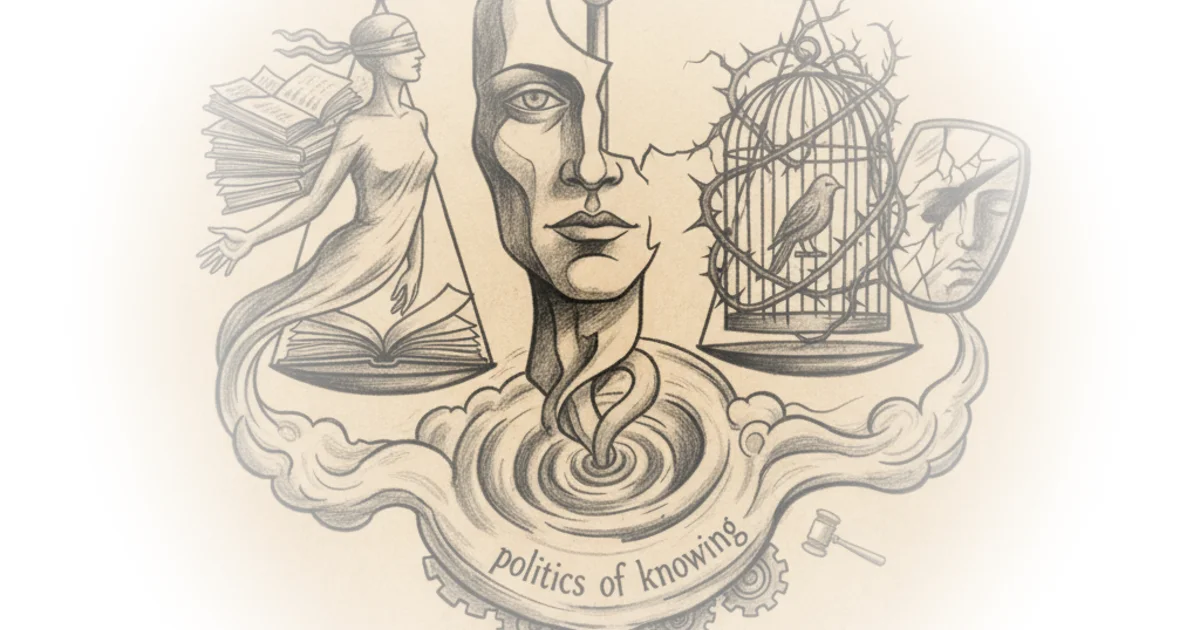
The author connects this to the broader "politics of knowing," suggesting that who gets believed is a matter of power. When we fail to listen to marginalized voices, we aren't just being rude; we are actively participating in a system that distorts our collective understanding of reality. Easwaran notes that this virtue acts as a "regulator in the politics of testimonial practice," though he admits "ultimately that its powers are limited." This honesty about the limits of individual virtue is refreshing; it acknowledges that while personal character matters, systemic change is also required.
Failures of any of these virtues can lead to what she calls epistemic injustice.
The Bottom Line
Easwaran's strongest move is reframing the crisis of misinformation as a crisis of character rather than a crisis of information volume. The argument's biggest vulnerability is the difficulty of scaling "virtue" in a digital age designed to bypass our critical faculties. However, the takeaway is clear: in an era of noise, the most valuable skill is not the ability to find facts, but the cultivated habit of knowing who to trust. We must stop asking "what is the evidence?" for every claim and start asking "what kind of listener am I?" to ensure we are not the ones perpetuating injustice.