Good Times Bad Times makes a startling claim: Hungary's seemingly impervious political fortress is not crumbling from external pressure, but from a betrayal within its own walls. The author argues that the rise of Peter Majar, a former insider turned fierce rival, represents a historic fracture in Viktor Orbán's "illiberal democracy," driven by economic collapse and a shattered social contract. This is not just another election cycle; it is a potential regime change born from the very system Orbán built to be unshakeable.
The Architecture of Illiberalism
The piece begins by dissecting the ideological foundation of Orbán's rule, distinguishing it sharply from Western liberal democracy. Good Times Bad Times writes, "In the classical western sense, democracy is inseparable from liberalism. Majority rule is constrained by fundamental safeguards." The author argues that Orbán rejected these guardrails, transforming elections into a mechanism to secure an "absolute mandate" rather than a check on power. This framing is crucial because it explains why the system was so resistant to traditional political pressure; it was designed to be immune to it.
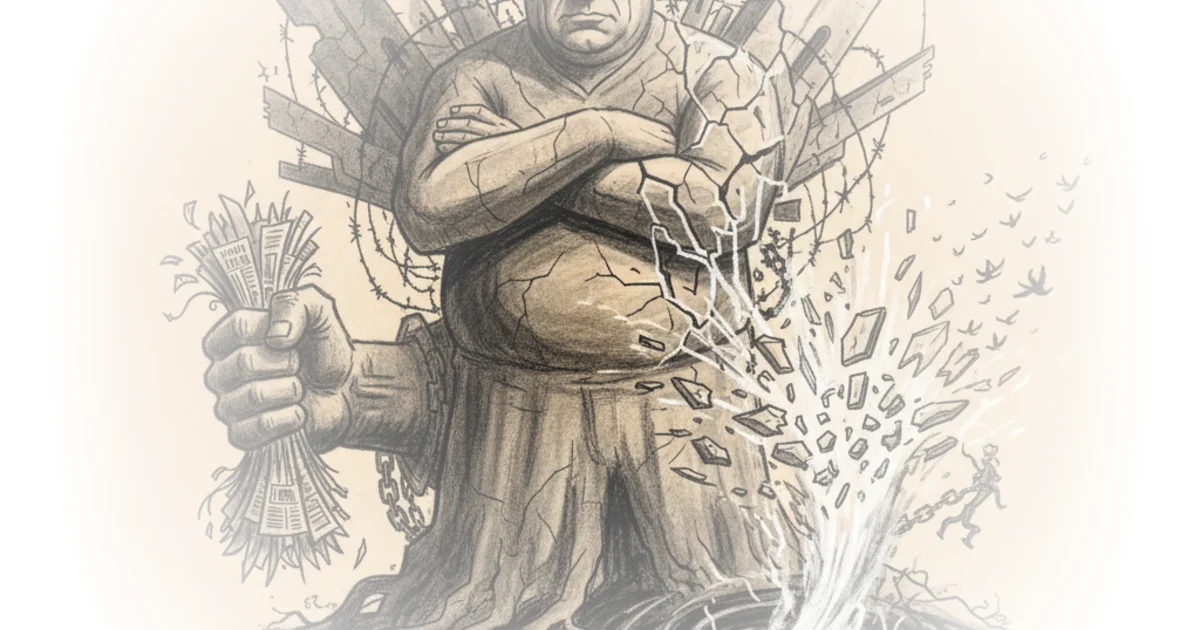
The commentary notes that this philosophy created a "system of national cooperation" where courts, media, and the economy were fused into a single instrument of the ruling party. As the author puts it, "Democracy becomes a tool for acquiring and entrenching power, not a system of values designed to limit it." This is a potent observation. It suggests that the stability Orbán enjoyed for fifteen years was not a sign of popular consensus, but of structural rigidity. However, the author also acknowledges a counterpoint: the European Union's enforcement of rule-of-law benchmarks can appear arbitrary, as seen in the contrasting treatment of Poland versus Hungary, which Orbán's supporters leverage to claim victimhood.
The Economic Unraveling
The narrative then pivots to the material conditions that made the fortress vulnerable. The author details a "deep multifaceted economic crisis" where inflation hit 26% and industrial output stagnated while neighbors like Poland surged ahead. Good Times Bad Times writes, "The same is true for markets. Change often comes suddenly, precisely when most people believe nothing will happen." This analogy to market behavior effectively captures the suddenness of the political shift. The evidence presented—Hungary falling behind Romania and Poland in GDP per capita—provides a hard, quantifiable basis for the political discontent.
The author highlights the government's harsh response to dissent, noting the "revenge law" that stripped teachers of civil servant status. "Orban's government chose confrontation over compromise," the text states, leading to a mass refusal of teachers to sign new contracts. This detail is significant; it shows the regime prioritizing control over social stability, a miscalculation that eroded the trust of the middle class. Critics might argue that global inflationary trends played a larger role than domestic policy, but the author's focus on the specific stagnation of Hungarian industry compared to regional peers suggests a structural failure unique to the government's management.
The Insider Betrayal
The most compelling section of the piece focuses on Peter Majar, the catalyst for the current upheaval. The author emphasizes that Majar is not an outsider, but a former lawyer, diplomat, and executive who knew the system's secrets. "He wasn't just another opposition politician. His status as a man from within gave him something Orban's opponents had long lacked, credibility," Good Times Bad Times writes. This distinction is the article's strongest analytical move. It explains why Majar's movement, Tisha, has gained such rapid traction; he is exposing corruption from the inside, making the regime's defenses of "national sovereignty" ring hollow.
Majar's strategy is described as pragmatic, focusing on unblocking frozen EU funds and fixing healthcare rather than abstract ideological battles. The author notes that his rallies have drawn crowds who "quote, 'We have had enough. We need change. This government is built on lies and hypocrisy.'" This direct quote captures the emotional shift in the electorate. The piece suggests that Majar is successfully bridging the gap between urban liberals and the rural conservative base, a feat previous opposition leaders failed to achieve. Yet, the author wisely notes that Majar must navigate the "Trianon trauma"—the historical wound of lost territory that Orbán has weaponized. Majar's approach of "correction, not revolution" regarding borders may be necessary to win over the countryside, but it risks alienating his nationalist base.
For years, Fides electorate lived inside a carefully maintained alternative reality... That armor finally cracked in February 2024.
Bottom Line
Good Times Bad Times offers a compelling case that Hungary's political transformation is driven by the convergence of economic failure and the unique credibility of a defector from the regime's inner circle. The argument's greatest strength is its focus on the structural nature of Orbán's "illiberal democracy" and how that very structure created the conditions for its own collapse. The piece's vulnerability lies in its optimism about the speed of change; while polls show a lead, the entrenched nature of Orbán's electoral engineering and the emotional power of nationalist rhetoric remain formidable obstacles. The reader should watch closely to see if Majar can translate his momentum into a governing majority before the regime's defensive mechanisms fully activate.