David Lat's latest roundup cuts through the noise of a chaotic legal week by focusing not on the spectacle of political theater, but on the fragile human reality of the judiciary. While the headline-grabbing testimony of the former special counsel dominates the headlines, Lat's most striking observation is that the true story isn't about who won a debate, but about the escalating physical danger facing those who adjudicate the law.
The Special Counsel's Stand
Lat frames the recent testimony of Jack Smith before the House Judiciary Committee as a moment of institutional defense rather than political victory. He notes that Smith had "the first and perhaps only chance [to] make his case in an official forum that he was justified in filing the two sets of charges against Mr. Trump in 2023." Lat observes that the proceedings were "fairly predictable," with Smith maintaining he acted without "fear or favor" while Republicans painted him as a zealot and Democrats attacked the rule of law.
The author's analysis here is grounded in the absence of a gaffe; Lat points out, "I'm not aware of any viral clips of Smith losing his cool or sounding like a moron," classifying the hearing as a "win" for the special counsel simply because he held his ground. However, Lat is refreshingly self-aware about his own biases. He shares a harsh email from a reader who accuses him of being a "card-carrying member of the American Leftist Legal Elite" who needs to "put down your Rules for Radicals playbook."
"While I certainly don't consider myself a 'Leftist,' I recognize that strong supporters of Trump might have a different view of how the Smith hearing went."
This admission of subjectivity is crucial. It prevents the piece from becoming a partisan echo chamber and invites readers to question their own filters. Lat acknowledges that even if one supports the prosecutions, "some of Smith's calls during the course of the litigation can be questioned," specifically citing Jason Willick's argument that Smith was in "First Amendment denial" regarding the scope of gag orders. The nuance here is vital: Lat separates the legitimacy of the charges from the tactical overreach of the prosecution, a distinction often lost in the heat of the moment.
Critics might argue that Lat's focus on the "predictability" of the hearing downplays the unprecedented nature of a former special counsel testifying under such intense political pressure. Yet, by acknowledging the constitutional pushback Smith faced—where judges scaled back orders "to bring it within constitutional bounds"—Lat correctly identifies that the legal system, not the politicians, was the ultimate arbiter of the proceedings.
The Human Cost of Judicial Independence
The tone shifts dramatically when Lat turns to the violence directed at the judiciary, centering the human cost of political polarization. He details the attack on Indiana Judge Steven Meyer and his wife, Kimberly, where a man "shot them both through the door" after claiming to have lost a dog. The facts are stark: the attacker, Thomas Moss, was a defendant in a case before the judge, and prosecutors claim the violence was a plot to "murder Judge Meyer in order to delay Moss's upcoming trial."
Lat highlights the gravity of this event by quoting the judge's response to the horror: "This horrific violence will not shake my belief in the importance of peacefully resolving disputes." The author uses this moment to pivot to a broader discussion on judicial independence, noting that former judges Shira Scheindlin and John Jones III have released new principles to "guide and to strengthen law firms, bar associations, law schools, businesses and nonprofits."
"Judges have stood strong against the threats against them—and Judge Meyer is no exception."
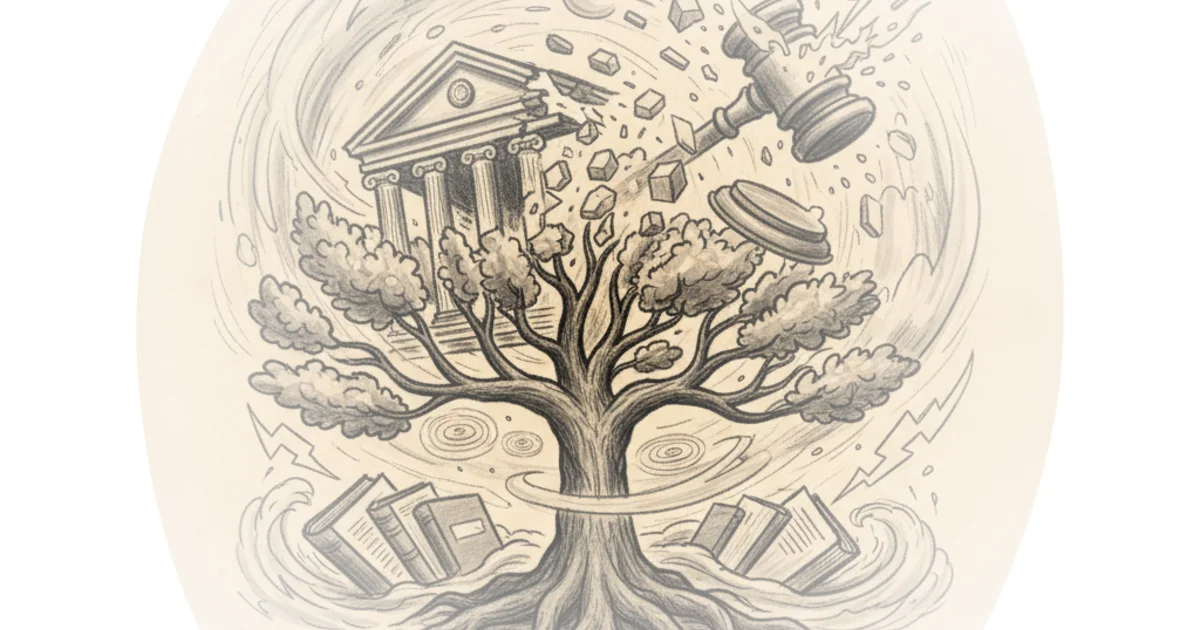
This section is the emotional anchor of the piece. Lat does not treat the shooting as a mere news item but as a symptom of a deeper rot where the rule of law is viewed as an enemy to be destroyed. The juxtaposition of a "deranged animal" insult from social media against the cold-blooded attempt on a judge's life underscores the real-world consequences of dehumanizing rhetoric.
A counterargument worth considering is whether focusing on the personal safety of judges distracts from the systemic issues of case backlogs and political pressure. However, Lat's inclusion of the attack serves as a necessary reminder that the abstract concept of "judicial independence" relies on the physical safety of the individuals who sit on the bench. Without that safety, the principles Scheindlin and Jones advocate for become theoretical.
Institutional Shifts and Personnel
Beyond the immediate drama, Lat tracks the subtle but significant shifts in the legal landscape. He notes the departure of Lindsey Halligan from the U.S. Attorney's Office for the Eastern District of Virginia following a "benchslap of an order" from Judge David Novak, who directed her to stop "representing herself as the United States Attorney." This highlights the friction between political appointees and the courts' insistence on procedural propriety.
Lat also captures the lighter, human moments of the legal world, such as attorney John E. Roberts arguing before Chief Justice John G. Roberts Jr., a coincidence the Chief Justice "humorously acknowledged from the bench." He further notes the appointment of conservative litigator Charles "Chuck" Cooper as the independent monitor for Columbia University's settlement with the federal government, signaling a new phase in the administration's oversight of higher education.
The piece concludes with a somber look at the legal community's losses, honoring figures like Barbara Aronstein Black, the first woman to serve as dean of an Ivy League law school, and Judah Best, a titan of white-collar defense. These tributes serve as a reminder of the enduring institutions that persist despite the current turbulence.
"Judges across the country face a disturbingly high number of threats related to their judicial service."
Lat's decision to end with these obituaries and the job market update creates a full circle: the legal profession is losing its giants, facing physical threats, and yet continues to hire and adapt. It is a portrait of a system under stress but not broken.
Bottom Line
David Lat's commentary succeeds by refusing to get lost in the partisan fray of the special counsel's testimony, instead using it as a springboard to examine the fragility of the judicial system itself. The strongest part of the argument is the pivot from political theater to the physical reality of the attack on Judge Meyer, which reframes the week's news from a political contest to a test of democratic resilience. The piece's biggest vulnerability is its reliance on the reader's pre-existing knowledge of the players, but for a busy, informed audience, this brevity is a feature, not a bug. The takeaway is clear: while the political battles rage on, the true story is whether the courts can survive the violence aimed at them.