Cory Doctorow delivers a blistering diagnosis of modern American power structures by reframing the nation's most destructive political and economic forces not as failures of policy, but as the ultimate success of a centuries-old confidence trick. While mainstream analysis often fixates on individual scandals or market fluctuations, Doctorow argues that the entire system is designed to make victims feel like isolated failures rather than participants in a coordinated con.
The Architecture of the Big Con
Doctorow anchors his argument in Bridget Read's chronicle of multi-level marketing schemes, using them as a mirror for broader societal deception. He writes, "no one is selling any product to end-users and no one knows it," exposing the hollow core of these enterprises where participants lie to themselves and each other about their success. This framing is particularly potent because it shifts the blame from individual gullibility to systemic design. The author illustrates how these schemes thrive on isolation, noting that "each pyramid scheme victim thinks that they're the only failure in the whole bunch," a psychological trap that prevents collective realization of the scam.
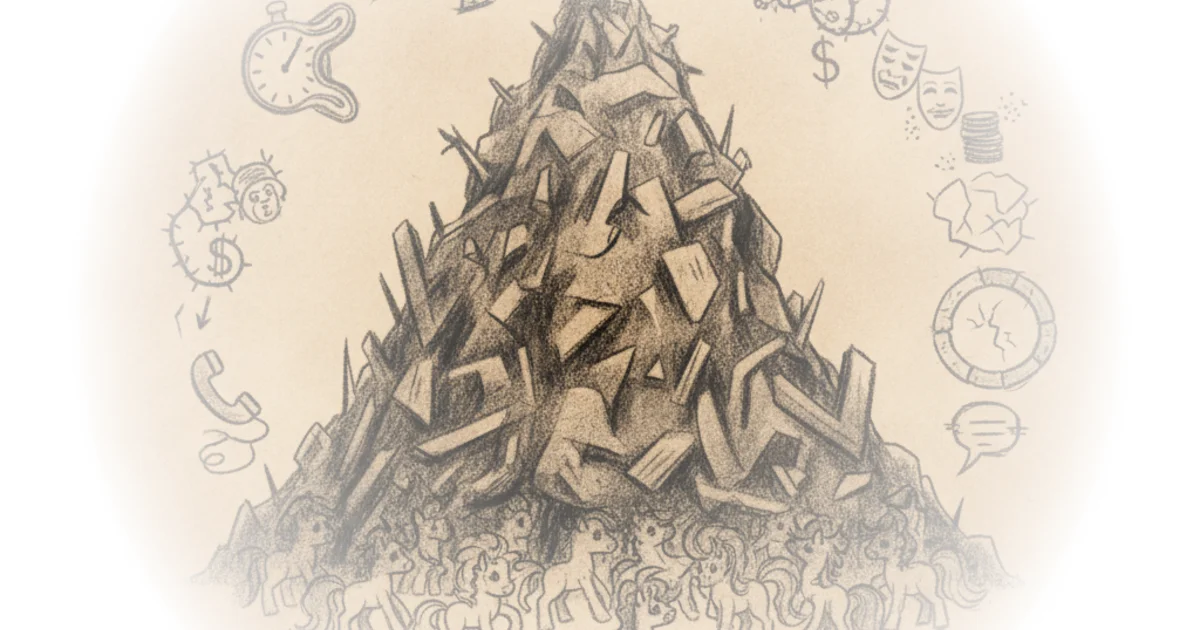
The commentary draws a direct line from these commercial swindles to the highest levels of government. Doctorow points out that the political class is often funded by the same machinery, citing how the Ford administration intervened to protect Amway founders who had become powerful lobbyists. He asserts, "The political class running America are pyramid scheme swindlers, funded by pyramid scheme money." This historical connection is crucial; it suggests that the current dysfunction isn't an anomaly but a feature of a system where dynastic wealth and regulatory capture have merged for decades. Critics might argue that equating complex geopolitical policy with a direct-sales scam oversimplifies the mechanisms of state power, yet Doctorow's focus on the mechanism of deception—creating a false reality for the victim—holds significant analytical weight.
In the big con, dozens of skilled actors are putting on a play for an audience of one: you.
The Illusion of Success in Tech and Finance
The piece expands its scope to include technology giants and financial figures who rely on similar illusions. Doctorow dismantles the narrative of self-made wealth by highlighting how figures like Elon Musk have survived through massive government subsidies rather than pure market success. He writes, "Musk would have been broke several times over but for a string of massive government bailouts and subsidies," challenging the meritocratic mythos that underpins their public image. Similarly, he addresses the current AI boom, noting that CEOs are privately admitting to job losses while publicly claiming everything is fine, creating a scenario where "boardroom rubes simply can't believe that all these people could be in on the con."
This section effectively captures the cognitive dissonance of the modern economy. Doctorow argues that the belief that "once a pile of shit gets big enough, there must be a pony under it somewhere" is the core investment theory driving these bubbles. He uses a 1954 Bugs Bunny cartoon to illustrate this absurdity, where the gangster convinces himself that a massive explosion in an oven couldn't have killed his friend because "would I throw a lighted match in there if my friend was in there?" The analogy lands hard: we are watching powerful figures convince themselves and others that their trillion-dollar bets on the metaverse or AI will inevitably yield results, despite mounting evidence of failure. As Doctorow puts it, "Neither Zuck nor Musk nor Trump has the charm of Bugs Bunny," suggesting that while the trick is clever, the lack of genuine value will eventually be exposed.
The Wake-Up Call
The article concludes by suggesting that the moment of collective realization is approaching. Doctorow notes that the "wait, is everyone else also failing?" awakening is spreading from Amway victims to CEOs wondering why their AI strategies aren't working. He writes, "At a certain point we're all going to look at each other and say, 'It was all bullshit, wasn't it?'" This prediction serves as both a warning and a source of hope; the con only works as long as the participants believe they are alone in their failure.
The historical context provided by Doctorow regarding the Nixon-Ford era intervention on behalf of Amway adds necessary depth, reminding readers that these dynamics have been active for half a century. Just as the prosecution of high-profile figures in New York revealed layers of fraud hidden behind public personas, this piece argues that the entire economic landscape is built on similar foundations of deception.
Bottom Line
Doctorow's most compelling contribution is reframing systemic economic failure not as bad luck or poor management, but as a deliberate "big con" where every stakeholder is complicit in maintaining the illusion. While the comparison between multi-level marketing and national policy may strike some as reductive, it offers a powerful lens for understanding why so many Americans feel trapped by systems that claim to serve them while extracting their wealth. The strongest takeaway is the psychological mechanism of the con: the isolation of the victim prevents the collective action needed to dismantle the scheme.