Lucian K. Truscott IV does not merely critique the rise of artificial intelligence; he reframes the entire technological boom as a symptom of a deeper, more dangerous human pathology: an insatiable greed that seeks to transcend human limitations through eugenics and automation. While the industry touts efficiency, Truscott argues we are witnessing the creation of a "master race" not of robots, but of the ultra-wealthy who view human life as an obstacle to their own expansion.
The Theft of Human Experience
The piece opens with a deceptively simple observation about language. Truscott notes that when AI "scrapes" data, it is not learning from the world, but stealing from those who lived it. He writes, "Almost every answer you receive from an AI platform has been stolen from someone who went out and lived a life and wrote down words to describe how they lived it and what they learned." This distinction is crucial. The author argues that AI lacks the capacity for genuine experience; it merely rearranges the artifacts of human experience without understanding them.
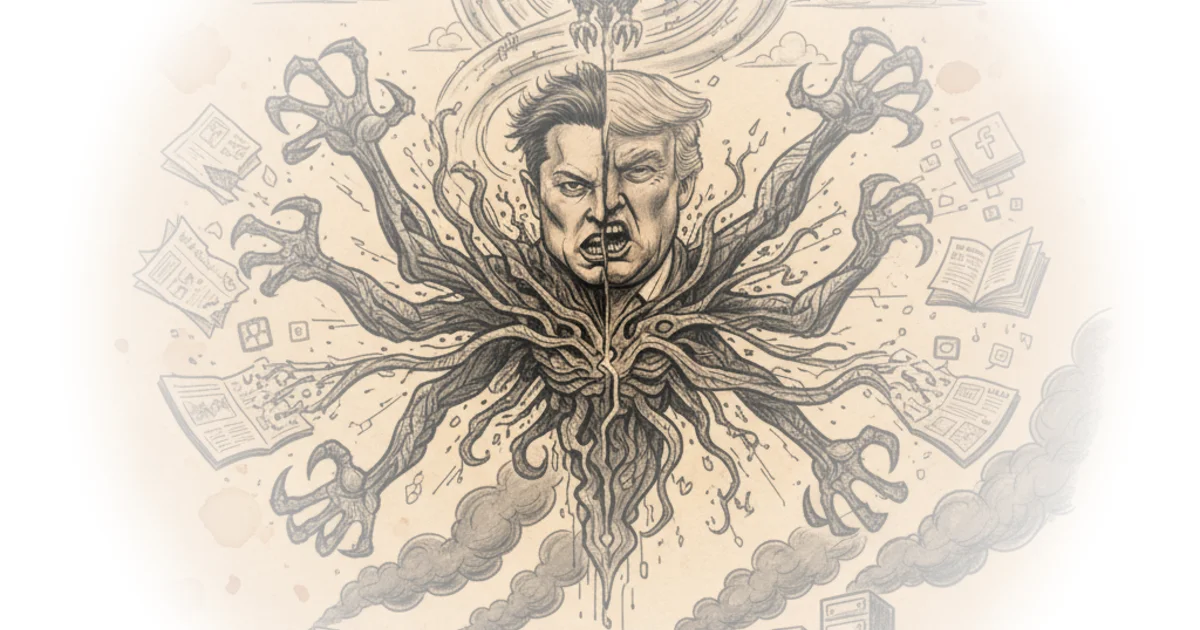
The core of the argument rests on the idea that AI is "writing about writing," a hollow echo of human creativity. Truscott contrasts this with numerical analysis, where AI excels because it deals in quantifiable patterns rather than the messy, subjective reality of human life. "AI does not experience the world and write about it. AI collects writing about the world," he asserts. This framing effectively strips away the mystique of "intelligence" and replaces it with a legal and ethical question of theft. Critics might note that the technology does generate novel combinations, but Truscott's point is that the source of the value remains the human struggle and observation that was scraped without consent.
"AI treats numbers differently... AI is able to look at photographic information and express it as numbers and 'see' the numbers in ways that are difficult for humans to do because of the hugeness of the amounts of data involved."
The Architecture of Greed
Truscott pivots from the mechanics of data to the motivations of the men building these systems. He traces the trajectory of Elon Musk from OpenAI to xAI, suggesting that the shift from "open" research to a "closed" machine was driven entirely by profit. "Musk told a story that the reason for his break with OpenAI was about ideological bias, but it was really all about money," Truscott writes. The author connects this financial ambition to the broader trend of automation, drawing a parallel to the auto industry where "the people who invested in them, got richer every time a worker lost a job and a profit margin went up."
The commentary here is sharp, linking the current AI boom to a century and a half of industrial displacement. However, Truscott argues the scale is unprecedented. "We went nearly two centuries without a single billionaire. Now we have thousands of them, and we have centi-billionaires," he observes. This historical context is vital; it suggests that the current concentration of wealth is not just a market anomaly but a structural shift toward a new feudalism. The author implies that the drive for trillion-dollar salaries is not about innovation, but about hoarding resources in a way that mirrors the most extreme historical precedents.
The Eugenics of the Elite
Perhaps the most provocative section of the piece is where Truscott connects the obsession with AI to a biological obsession with genetics. He describes Musk's compound in Austin, Texas, as resembling "something out of The Handmaid's Tale," where the billionaire seeks to "reproduce himself with what amounts to a race of Elons." This is not just a critique of wealth, but of a specific, dangerous ideology. Truscott explicitly links this to the historical pursuit of a "master race," noting, "Do you recall who else is obsessed with genetics?" He draws a chilling parallel to the Lebensborn program, a Nazi initiative that sought to breed a "pure" Aryan race, suggesting that the modern tech elite are attempting a similar, albeit high-tech, version of eugenics.
The author recounts a specific incident where Musk brought his son, "Lil X," into the Oval Office. Truscott describes the scene as "inhuman," noting that Musk ignored the child's attempts to get his attention, treating the boy as a prop for a media performance. "Musk put Lil X there not affectionately... but to shut him up," the author writes. This anecdote serves as a microcosm for the broader argument: the elite view human connection as secondary to their public image and genetic legacy. The administration's focus on "cleansing" the country of those with "bad genes" is presented not as a political outlier, but as the logical conclusion of this worldview. While some might argue that Musk's parenting style is a private matter, Truscott uses it to illustrate a public philosophy that devalues the individual in favor of a curated lineage.
"His ambition is so enormous that he wants to reproduce himself with what amounts to a race of Elons."
The Inhuman Future
Truscott concludes by contrasting the human condition with the inhuman ambitions of the tech elite. He argues that the desire to escape to Mars or to build a perfect genetic line is a rejection of the very nature of being human. "Perfection is a series of mistakes that collects incremental bits of wisdom in a process that never ends," he writes. "Progress is never quite getting where you want to go. You end up where life takes you. That's how you know you're human."
The author draws a parallel between Musk's ambitions and Vladimir Putin's war in Ukraine, framing both as "egomaniacal ambitions" that seek to consume entire nations or worlds for personal gain. "AI, and the men who are running the companies with AI platforms, are not satisfied with being human," Truscott argues. This is the piece's strongest moral claim: that the drive for total efficiency and control is fundamentally anti-human. The author suggests that these dreams of a "master race" will ultimately fail because they are built on a foundation of "airless idiocy." The argument holds weight because it refuses to separate the technology from the human values driving it, insisting that a system built on greed and eugenics cannot lead to a better future.
Bottom Line
Truscott's most powerful contribution is his refusal to treat AI as a neutral tool, instead exposing it as the ultimate vehicle for a specific, toxic form of human greed and a modern iteration of eugenicist ideology. The piece's greatest vulnerability lies in its reliance on character assassination of specific figures, which risks distracting from the systemic policy failures that allow such concentration of power. However, the historical parallel to the pursuit of a "master race" provides a necessary, terrifying context for understanding the stakes of this technological revolution. Readers should watch for how the rhetoric of "genetic optimization" and "efficiency" begins to enter mainstream policy discussions, as this is where the theory becomes law.