In a season saturated with performative gratitude, Jenn Zuko delivers a sharp, necessary correction: true thankfulness cannot coexist with forced compliance or the erasure of legitimate grievance. This isn't a holiday sermon on counting blessings; it is a structural critique of how the demand for gratitude is weaponized to keep workers, families, and the marginalized subservient. Zuko argues that when "gratitude" becomes a platitude, it transforms from a genuine emotion into a tool of oppression that stops action and demands we "make do" instead of "make better."
The Burden of Forced Thankfulness
Zuko opens by dismantling the biological determinism often used to justify our emotional states. Referencing the neurobiologist Robert Sapolsky, she notes the argument that human lives are "mostly an outcome of biology plus math," where our long lifespans intersect with the "mathematics of chaos." Yet, Zuko pushes back against this fatalism, asserting, "I feel like I have way more of a choice than this, Sapolsky be darned." Her point is clear: while biology sets the stage, the expectation to be thankful regardless of circumstance is a social construct, not a biological imperative.
She illustrates this with a harrowing personal anecdote from her youth, where expressing uncertainty about a gift—a wooden jewelry box—resulted in a ten-minute screaming match from a relative. The lesson she learned was not about generosity, but about the coercion of emotion. "I was thankful for the gift, and it wasn't my fault I didn't want it," she writes, highlighting the absurdity of being punished for an honest reaction to an unwanted object. This story serves as the microcosm for her broader thesis: "I hate being forced into a performative show of it."
Critics might argue that Zuko conflates genuine appreciation with the social lubricant of politeness, suggesting that a degree of performative gratitude is necessary for social cohesion. However, her distinction between "lip-service" and "real" feeling suggests that the cost of that cohesion is often the silencing of individual boundaries.
Being grateful shouldn't replace any form of ambition or of working to make things better, or even the fleeting thought that I might deserve a little more.
The Economics of Gratitude in Academia
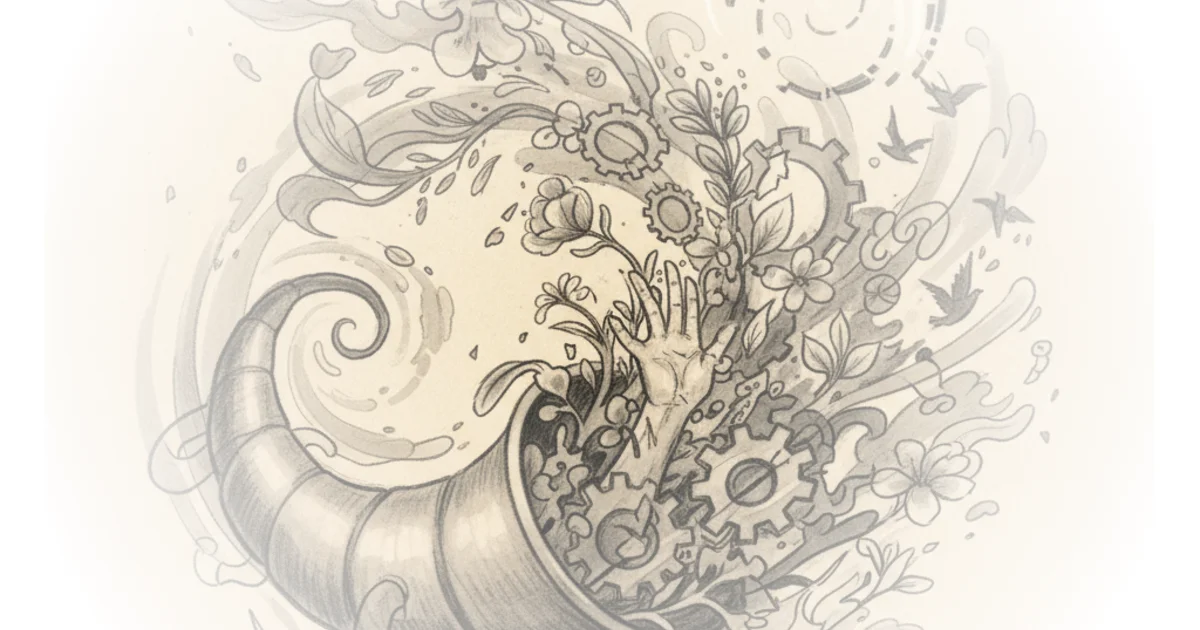
The commentary shifts from family dynamics to the institutional exploitation of the academic sector. Zuko draws on her twenty-plus years as an adjunct professor to expose how the "cult-like smothering blanket of two-faced gratitude" keeps workers in dire conditions. She describes a system where faculty are taught to "scrabble and covet even the rottenest scraps, and thank our administration for administering them." This framing resonates with the historical concept of the "cornucopia," often used to symbolize abundance, yet here it is revealed as a hollow symbol for those scraping by on poverty wages with no health insurance.
Zuko challenges the narrative that one should be grateful simply for having a job, asking, "Should I feel gratitude for a tiny wage I can't live on? For no health insurance? For being blamed for the state of education today?" Her answer is a complex "both/and." She admits, "I'm both very thankful and also absolutely not." This duality is her most potent argument: acknowledging the privilege of employment does not require the erasure of the injustice of the compensation. When she finally stopped thanking a university for "screwing me over," the institution was shocked, revealing how deeply ingrained the expectation of subservience is.
The parallel she draws to the theater world further cements her point about systemic abuse. In both fields, workers are told, "How dare I demand more? How audacious am I, for asking for what my work is worth?" The demand for gratitude, she argues, is a mechanism to prevent workers from recognizing their own value and organizing for better conditions.
From Passive Platitudes to Active Tallying
In the final section, Zuko moves from critique to reconstruction. She rejects the "passive platitudes" of the holiday season in favor of an "active tally" of what she truly values. This list is specific, grounded, and devoid of the guilt often associated with wanting more. She thanks her partner, her stepchildren, the artists in her community, and even specific foods like "cheese, wine, patê, whiskey."
This section serves as a counter-narrative to the "toxic positivity" discussed by Barbara Ehrenreich in Bright-Sided. Zuko writes, "I don't have to be thankful for all of it, but those parts I thank them for are true, important, and from the heart, not just lip-service." By separating gratitude from obligation, she creates space for ambition. "Greed isn't good, but neither is gratitude, necessarily," she posits, suggesting that when gratitude becomes a stopping point, it hinders growth. Instead, she advocates for a mindset where one can appreciate the present while simultaneously fighting for a better future.
When gratitude is a platitude, it's a stunting (or an oppression?)—a stopping of action. We can be both thankful and not.
Bottom Line
Zuko's piece succeeds by refusing to let the holiday season dictate the terms of emotional labor, offering a powerful framework for holding two contradictory truths: that we can be deeply grateful for what we have while fiercely demanding more for what we deserve. Its greatest strength is the refusal to apologize for the complexity of human emotion, though it risks alienating readers who view gratitude as a moral absolute rather than a conditional feeling. As the year ends, the takeaway is clear: true thankfulness requires the freedom to say "no" to the things that harm us, not just a forced "yes" to the things we are given.