This piece challenges a foundational myth of modern culture: that rock and roll was an inevitable global force that simply failed to take root in France due to local resistance. Justin E. H. Smith argues instead that the French musical landscape was not a passive recipient of American influence, but an active, trauma-borne fortress protecting its own indigenous forms against the encroachment of the Atlantic order.
The Courage of Transfiguration
Smith opens by reframing the artist's role not as one of superior talent, but of sheer nerve. He suggests that the true distinction between a performer and the rest of us lies in the willingness to abandon safety. "Artists... are not distinguished exclusively or primarily by their talent, but by their courage," Smith writes. This is a compelling entry point because it shifts the focus from technical skill to the psychological risk inherent in creation.
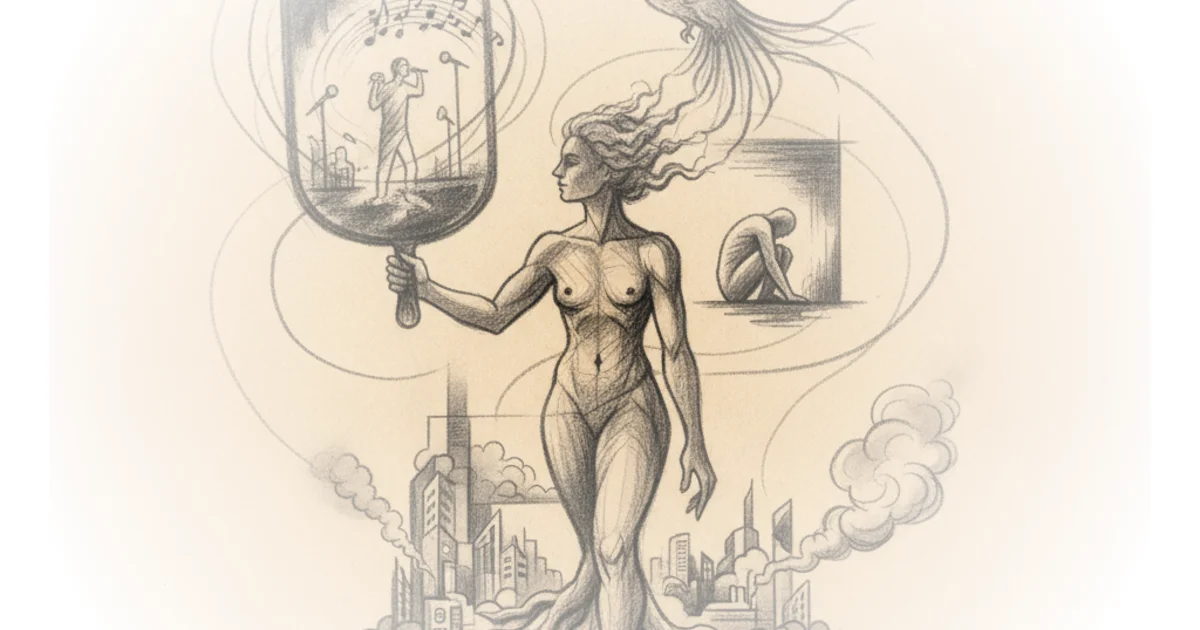
He uses Jacques Brel as his primary case study, noting that nothing in Brel's early life—his work in a cardboard factory or his Catholic charity work—predicted his explosive artistic emergence. Smith describes this shift vividly: "And then in his mid-twenties he exploded... I mean he exploded in song, and he exploded, too, through artistic transfiguration." The author draws on medieval logic to explain this rupture, suggesting Brel "explode[d] their premises through contradiction" the ordinary world that tried to contain him. This framing is effective; it treats the artist's break from reality not as a mental breakdown, but as a deliberate, high-stakes maneuver.
Artists are not distinguished exclusively or primarily by their talent, but by their courage.
The War That Never Ended in Song
The commentary then pivots to a historical analysis that feels essential for understanding the "French exception." Smith posits that while the Anglosphere used rock and roll to suppress memories of World War II, France could not afford such amnesia. He observes that Anglophone youth culture "disdained the past altogether... but the culture that sprang up from within the war itself" lingered in France because the trauma was too fresh.
Smith contrasts the American imposition of a new history with the French need to process an old wound. He notes that while the Marshall Plan's cultural wing featured "Elvis in uniform, kitsch caricature of Fräulein," French popular culture was engaged in something far more serious: "processing historical trauma, a vicious wound from its most dear twin nation." This is a powerful reframe of the post-war cultural divide. It suggests that the dominance of chanson réaliste and the relative absence of rock were not failures of taste, but necessary mechanisms for national healing.
He illustrates this with Brel's "Fernand," a song about a funeral procession in Paris that feels like Berlin under occupation. Smith writes that the lyrics suggest we are "under occupation" when the singer notes, "Dire qu'on traverse Paris / Et qu'on dirait Berlin." This specific detail grounds the abstract argument in the visceral reality of the era. By contrast, he points to Barbara's 1964 hit "Göttingen," which celebrated Franco-German reconciliation and is often credited as a cultural vanguard for the European Union. Smith argues that while the English-speaking world was busy reconstructing under a new empire, France was preserving its ancient continental identity.
Critics might note that this dichotomy between American triumphalism and French trauma risks oversimplifying the complex ways rock music did eventually infiltrate French youth culture, even if it remained secondary to chanson. However, Smith's insistence on the emotional weight of the war provides a necessary corrective to narratives that treat cultural adoption as merely a matter of market forces.
The Simulacra of Rock Francais
The most biting section of the piece dismantles the idea that the "yé-yé" movement represented a genuine French embrace of rock. Smith dismisses this era as a "cargo-cult imitation of outre-Manche style," arguing it was more akin to American bubblegum pop than the rebellious spirit of British skiffle or American blues.
He singles out Johnny Hallyday, often called the "French Elvis," as a figure who participated in the art form only in a "Baudrillardian sense." Smith writes that Hallyday's career was built on a fantasy: "he made no real contribution at all to the musical tradition that came from there, and that entirely made his simulacral career." The author is ruthless here, describing Hallyday's aesthetic as resembling a French restaurant chain with "old Standard Oil pumps" and tales of riding Harleys in the American Southwest.
Smith extends this critique to Francis Cabrel, calling one of his songs perhaps "one of the worst songs ever recorded" because it offers empty shout-outs to blues masters without wrestling with their influence. He invokes Harold Bloom's concept of the "anxiety of influence," noting that strong poets must wrestle with their forebears. Smith concludes that French rock stars had a "unidirectional" relationship to American music, similar to how some American philosophers relate to Parisian intellectuals—superficial and detached.
The spirit of rock failed even to penetrate the student protests of May, 1968, whose French soundtrack was principally built up around jazz.
This point is particularly striking when considering the global narrative that 1968 was a rock revolution. Smith reminds us that in France, the counterculture had already indigenized jazz—citing Django Reinhardt's gypsy jazz and Miles Davis's work on Ascenseur pour l'échafaud—making it a more natural vessel for rebellion than the imported blues structures of rock.
Bottom Line
Justin E. H. Smith delivers a provocative, historically grounded argument that reframes French musical resistance not as backwardness, but as a sophisticated defense of national identity against American cultural hegemony. The piece's greatest strength is its refusal to treat music as mere entertainment, instead analyzing it as a vital archive of post-war trauma and political strategy; however, its dismissal of the "yé-yé" era risks ignoring the genuine, if derivative, energy that French youth found in those sounds. For the busy listener, this commentary offers a new lens: the next time you hear a French song from the 1960s, listen not for what it lacks compared to American rock, but for what it is trying so desperately to preserve.