Most people assume the banana on their breakfast table is a simple agricultural product, but Sam Denby reveals it is actually a triumph of industrial logistics that defies the laws of nature. This piece doesn't just explain how fruit gets to the store; it exposes a fragile, high-stakes supply chain where a single delay in a tropical port or a miscalculation in a refrigerated container can rot millions of dollars of inventory. For the busy professional, the takeaway is a stark reminder that the ubiquity of fresh produce is not a given, but a daily miracle of coordination that the executive branch and private corporations must constantly engineer.
The Banana Paradox
Denby begins by dismantling the assumption that tropical fruits are inherently easier to manage than temperate ones. While grapes and apples are bound by strict seasonal windows, the banana's advantage is its ability to grow year-round in the tropics. However, Denby argues that this biological advantage creates a massive distribution bottleneck. "The year-round production is simple. Distribution is not," he writes, setting the stage for a deep dive into the infrastructure required to move perishable goods across oceans.
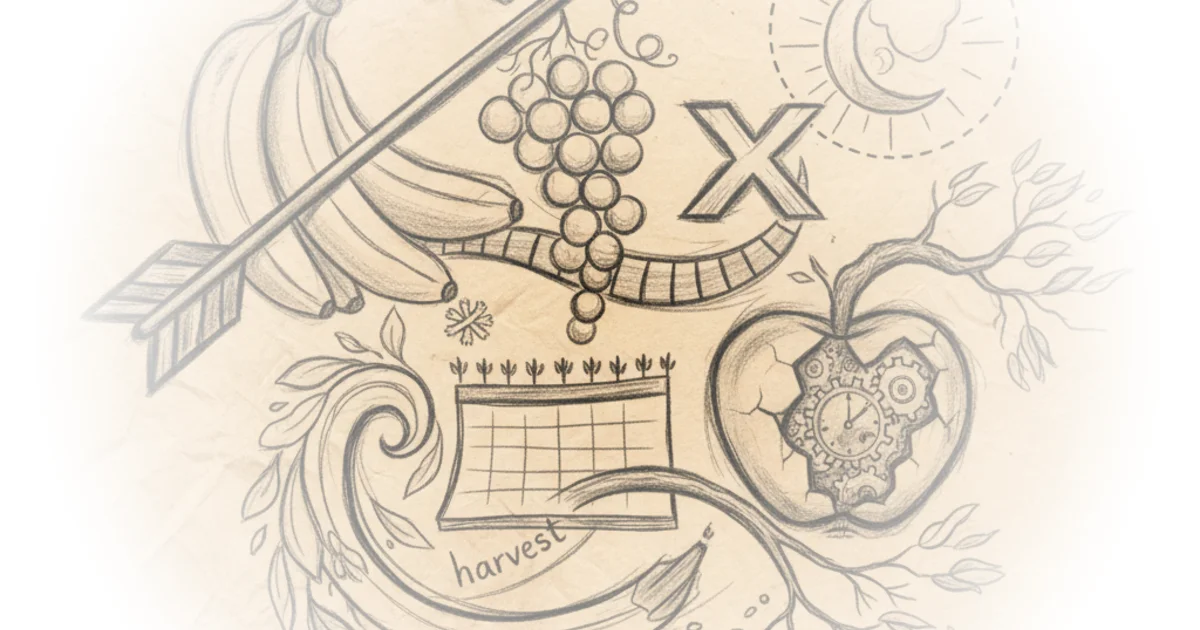
The article details a highly choreographed routine in Ecuador, where thousands of independent plantations harvest on a strict Tuesday or Wednesday schedule to feed a specific corporate machine. Denby describes the physical labor vividly: "Teams of two men and arrows head out into the fields... One cuts the stem with a machete. The other grabs it and places it onto their shoulder." This manual precision is immediately followed by a sophisticated chemical intervention. Before the fruit ever leaves the plantation, a waxy coating is applied to the stems to slow the emission of ethylene, the hormone that triggers ripening. Denby notes the high stakes of this step: "If a banana turns yellow in the transport process, it will be rejected from import into the US since it increases the risk of also including pests."
"The year-round production is simple. Distribution is not."
The core of Denby's argument here is that the global banana market cannot rely on standard shipping methods. Because Ecuador lacks the frequent container ship traffic found in major Asian trade routes, and because standard ships lack the necessary power hookups for the vast majority of their refrigerated containers, the industry giant Dole has taken a radical step. They own their own fleet. "Rather, Dole operates their own cargo ships," Denby explains, highlighting a vertical integration that is rare in modern logistics. This allows them to bypass the inefficiencies of Costa Rica's tiny Pacific ports, utilizing ships equipped with their own cranes to load directly at less developed facilities. The result is a nine-day journey from harvest to the port of San Diego, a route chosen specifically to avoid the congestion of Los Angeles and Long Beach.
Critics might argue that this level of corporate control over the supply chain creates a monopoly risk, potentially squeezing out smaller exporters who cannot afford their own fleets. However, Denby's framing suggests that without such massive capital investment, the year-round availability of fresh fruit in the US would simply be impossible.
The Apple's Long Winter
Shifting from the tropics to the temperate zones, Denby contrasts the banana's logistical challenges with the apple's storage challenges. Apples are harvested only in the fall, yet they are sold year-round. The solution, Denby reveals, is not better transportation, but better preservation. The apple industry has turned storage into a science of "freezing time."
Denby introduces the concept of controlled atmosphere rooms, where oxygen levels are dropped to under 3% to effectively put the fruit to sleep. "Within them, apples are effectively put to sleep as the temperature is dropped to just above freezing," he writes. This technology allows a variety like the Cosmic Crisp, developed by Washington State University, to remain fresh for up to a year. The logistical complexity here is immense; producers must test starch and sugar content weeks before harvest to decide exactly when to pick the fruit based on projected demand months in the future.
The article highlights the scale of this operation at Stemold Growers, a facility so massive it stretches the length of seven football fields. Here, an automated fleet of robotic pallet carriers manages 13,000 pallets, constantly reorganizing inventory to ensure the oldest, most mature fruit is moved first. "The system pulls the oldest pallets with the quickly maturing products to loading stations during the day and reorganizes the cues during the night," Denby observes. This automation is not just about efficiency; it is the only way to manage the sheer volume of fruit that must be held in stasis to bridge the gap between harvest and the next growing season.
"Keeping an apple fresh for up to a year calls for more than a robust variety or a robust cold chain. It requires freezing time, at least from the apple's perspective."
While Denby focuses on the technical marvels of this system, a counterpoint worth considering is the energy cost of maintaining these massive, climate-controlled facilities year-round. The environmental footprint of keeping millions of apples in a state of suspended animation is significant, a trade-off that consumers rarely see on the price tag.
The Global Chessboard
The piece concludes by touching on grapes, a fruit that cannot be stored for months like apples and must be grown in specific seasons. To solve this, the industry has turned to the Southern Hemisphere. Denby points to the Maule Valley in Chile, where the harvest season is the exact opposite of the US. This global arbitrage allows grapes to appear on American plates year-round, but it relies on a delicate balance of timing and transport that spans the entire globe.
Denby's framing effectively illustrates that the fruit bowl is not a static collection of local goods, but a dynamic, global system. Whether it is the banana's race against ripening or the apple's battle against time, the underlying theme is the same: human ingenuity has managed to override natural cycles, but only through immense, invisible infrastructure.
Bottom Line
Sam Denby's analysis is a masterclass in revealing the hidden complexity behind mundane consumer goods, proving that the logistics of fruit are as critical to the modern economy as any financial market. The strongest part of the argument is the clear distinction between biological possibility and logistical reality, showing that availability is a manufactured state, not a natural one. The biggest vulnerability in this system remains its fragility; a disruption in a single port or a failure in a refrigeration unit can cascade through the entire supply chain, a risk that becomes more acute as global trade tensions rise.