Brad DeLong amplifies a chilling hypothesis from Brian Klaas: artificial intelligence will not democratize intelligence but rather calcify a new hierarchy where the cognitively prepared soar while everyone else atrophies. This is not another breathless prediction of job displacement, but a sobering look at how automation might permanently degrade human critical thinking for those who lack the discipline to use it as a tool rather than a crutch.
The Autopilot Trap
DeLong introduces Klaas's argument by grounding it in a catastrophic real-world failure. He writes, "The pilots... were unprepared when the machine failed," referencing the Air France Flight 447 disaster where reliance on autopilot left crews unable to handle manual flight when sensors malfunctioned. This historical anchor is crucial; it moves the conversation from abstract theory to life-or-death consequences of cognitive offloading.
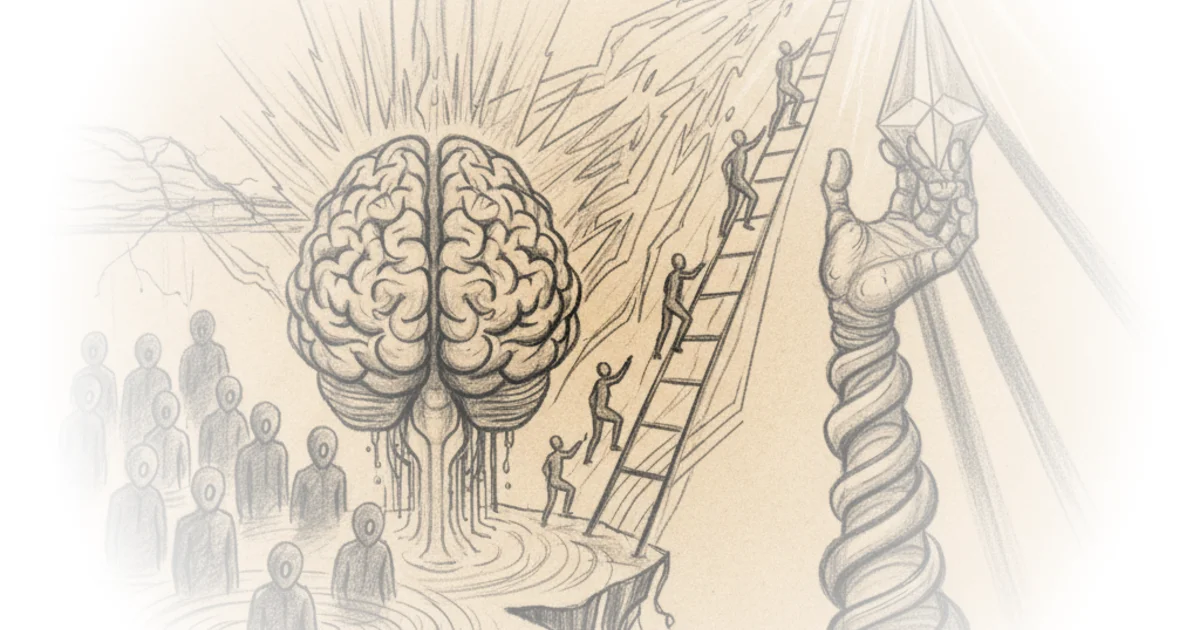
DeLong paraphrases Klaas's observation that we are already seeing this in mundane skills, noting how London cab drivers who memorize maps retain enlarged hippocampi while GPS-dependent generations lose spatial memory. The argument gains weight when DeLong cites emerging data: "A 2026 study shows evidence that when people use AI to help them with a tasks, they become less persistent, give up more quickly when learning something, and have reduced overall performance." This suggests the risk isn't just about making mistakes, but about losing the very muscle required to struggle through complex problems.
Critics might argue that early studies on Large Language Models are still preliminary and that human adaptability has historically overcome technological disruption. However, DeLong emphasizes that this specific technology targets the process of thinking itself, not just the output, making the atrophy risk unique compared to previous industrial revolutions.
Use it, or lose it.
The Cognitive Gym
The piece's most potent metaphor arrives when DeLong explains Klaas's "cognitive gym" analogy. He writes, "Artificial intelligence can provide a function that's a bit like humanity's cognitive gym... AI can act like an amplifier, further driving a decisive wedge between two groups of people." The framing is elegant: the technology itself is neutral, but its effect depends entirely on the user's baseline capability.
DeLong highlights the danger of the "lower floor" AI creates. He notes that "mediocre outputs are now absurdly easy to create," allowing those satisfied with average work to stop exercising their minds entirely. Conversely, for the skilled, "artificial intelligence has also raised the ceiling of possibility." DeLong illustrates this with the example of a mathematician who can use AI to explore "stubborn problems faster... allowing her to focus more time on the truly difficult mathematical frontiers of knowledge."
This distinction between substitution and complementation is where the economic analysis shines. DeLong explains that for some, AI replaces thought (substitution), leading to decline; for others, it augments thought (complementation), leading to exponential growth. He writes, "For the mathematician... artificial intelligence doesn't offload their critical thinking; it amplifies their intellectual effectiveness." The implication is stark: we are heading toward a bifurcation where the gap between the cognitively elite and the rest of society widens not just in wealth, but in fundamental human capacity.
The Illusion of Competence
DeLong warns against the seductive trap of looking capable without being so. He describes users who act like "a lazy steroid user who may be tempted to use a forklift to lift weights," producing outputs that "pass as polished prose (but is bereft of original intellectual nutrients)." This visual effectively captures the disconnect between appearance and reality in an AI-saturated world.
The commentary also touches on global inequality, noting that while AI offers a "better tutor than they could ever hope to pay for previously" for ambitious individuals in developing nations, it cannot overcome structural barriers. DeLong quotes Stephen Jay Gould's reflection on talent wasted in "cotton fields and sweatshops," warning that the net social effect of AI may be "a world of more severe economic inequality... ushering in the Silicon Valley tech bro's ultimate fantasy of a permanent underclass." The argument here is that technology alone cannot fix systemic poverty; it will likely accelerate the divergence between those with the resources to leverage it and those without.
Critics might note that this view assumes a static educational system, whereas schools could theoretically adapt to teach AI literacy as a core critical thinking skill. Yet DeLong remains skeptical, suggesting that market forces and advertising models are actively pushing users toward passive consumption rather than active engagement.
Bottom Line
DeLong's curation of Klaas's work offers the most compelling framework yet for understanding the long-term societal risk of AI: it is not about machines taking over, but about humans voluntarily handing over their agency. The argument's greatest strength is its focus on the process of cognition rather than just the product, revealing a vulnerability that current policy debates largely ignore. However, the piece leaves readers with an unresolved challenge: if we know this divide is forming, what specific systems can we build to force the cognitive engagement necessary to prevent it?