Matthew Yglesias cuts through the noise of the current housing debate with a provocative, counter-intuitive claim: that the administration's desire to prop up home prices is not a wealth-building strategy, but a recipe for national poverty. While political rhetoric often frames housing scarcity as a necessary defense of the middle class, Yglesias argues that this worldview is a dangerous economic fallacy that conflates asset inflation with genuine prosperity. For a busy reader trying to navigate the gap between policy promises and economic reality, this piece offers a vital correction to the zero-sum thinking dominating Washington.
The Scarcity Trap
Yglesias begins by dismantling the administration's recent stance, noting that the executive branch has explicitly signaled a preference for higher prices to protect incumbent equity. He writes, "I don't want to drive housing prices down. I want to drive housing prices up for people that own their homes. And they can be assured that's what's going to happen." This blunt admission, Yglesias argues, reveals a political reality often ignored by media pundits: the fear of depreciating assets is far more potent than the desire for affordability. He suggests that for millions of Americans, the narrative that "your unaffordable housing is my lucrative investment" has become a self-fulfilling prophecy of policy paralysis.
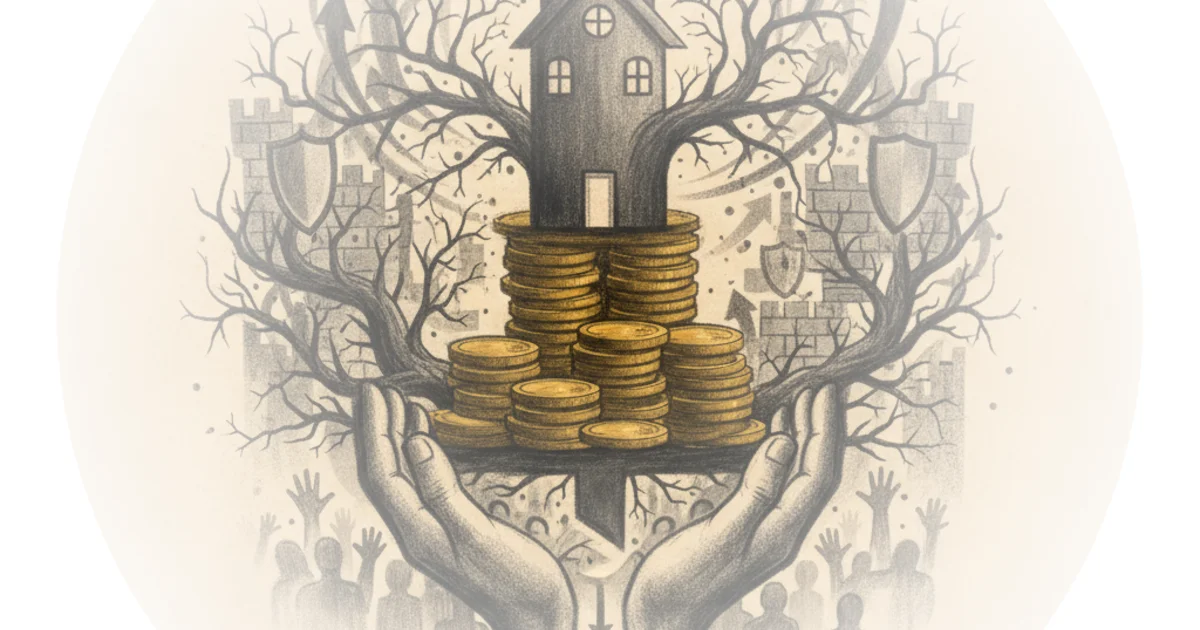
The core of Yglesias's argument is that this protectionism is a "wrongheaded zero-sum worldview." He posits that restricting supply does not simply transfer wealth from renters to owners; instead, it creates a "value-destroying leaky bucket of redistribution that makes people a lot poorer on average." This framing is powerful because it shifts the debate from a moral conflict between classes to a question of aggregate economic efficiency. By treating housing like a finite commodity to be hoarded rather than a service to be provided, the current policy direction actively shrinks the economic pie.
Your accessible starter home is my nest egg collapsing in value. Right? Not really.
The Crowbar Analogy
To make this abstract economic concept tangible, Yglesias employs a striking thought experiment involving metal shovels and ice storms. He describes a scenario where a sudden demand for ice-breaking tools creates a windfall for those who own them, leading to the absurd conclusion that we should ban new tool production to maintain their value. He writes, "Through the magic of supply constriction, something like my trusty ice-smashing crowbar can be transformed from a slowly depreciating durable good into an appreciating asset — an investment commodity that builds wealth over the long term." He then immediately undercuts this logic, noting that "nobody proposes that we do anything like that or believes it would be a sensible way for a country or a city or a state or a region to proceed."
This analogy serves as a brilliant rhetorical device, exposing the irrationality of the housing scarcity argument by applying it to other sectors. Yglesias extends the logic to the automotive industry, recalling how the pandemic-era car shortage inflated used car values. He points out that while this was a "financial windfall" for owners, "nobody proposed permanent quantitative limits on the sale of new cars in order to bolster car wealth." The comparison highlights a critical blind spot in current housing policy: we accept that growth and new supply are good for cars and technology, yet we treat housing as an exception where stagnation equals security.
Critics might argue that housing is unique because it is a basic human need and a primary vehicle for retirement savings, making the comparison to consumer durables like shovels or cars imperfect. However, Yglesias anticipates this by noting that even in the car market, restricting supply leads to a "poorer society in which the average quality of people's access to transportation services declines," a fate that mirrors the housing crisis perfectly.
The Growth Imperative
The commentary then pivots to the broader economic implications, arguing that the fear of new development is a misunderstanding of how wealth is created. Yglesias writes, "The point, in both the trivial case of banning new crowbars and the dramatic case of banning new companies, is that these moves would be bad for economic growth, and people generally benefit from a growing economy." He challenges the notion that protecting existing homeowners requires sacrificing the future, suggesting instead that a growing economy is the only sustainable path to broad prosperity.
He addresses the specific anxiety of landowners, acknowledging that zoning reform creates uncertainty about local land values. "If you did zoning reform throughout the Boston-D.C. corridor, I'm not sure you could actually predict the price impact on specific neighborhoods," he admits. Yet, he reframes this uncertainty not as a reason to halt progress, but as a natural consequence of a dynamic economy. He argues that the right approach is to view upzoning as a "pro-growth policy measure" where "Americans will end up with more square footage per capita. It will create jobs and tax revenue." This perspective aligns with the broader economic principle that supply constraints are a drag on productivity, a concept often overlooked in the heated political discourse surrounding the zero-sum game of housing.
A society where people struggle to obtain housing and durable goods isn't a wealthy society; it's a poor one.
Bottom Line
Yglesias's strongest contribution here is the dismantling of the "scarcity as wealth" myth, exposing it as a degrowth spiral that harms the very homeowners it claims to protect. The argument's greatest vulnerability lies in the political difficulty of overcoming loss aversion, a hurdle he acknowledges but perhaps underestimates in terms of the speed of reform. The reader should watch for how the administration's rhetoric shifts from protecting prices to managing the inevitable economic drag of these policies, as the gap between political promises and economic reality widens.