Naomi Kanakia delivers a startling confession that upends the hierarchy of the literary world: the "serious" fiction taught in universities is not a universal standard of quality, but a specific, rule-bound genre that many of its own practitioners misunderstand. By contrasting the rigorous, self-aware ecosystem of science fiction with the often-mythologized realm of post-war American literary fiction, Kanakia exposes a blind spot in how writers and critics evaluate what matters. This is not just a memoir of reading habits; it is a structural critique of why the literary canon feels so exclusionary to outsiders.
The Genre Blind Spot
Kanakia begins by recounting her deep immersion in science fiction, a field where she mastered the "rules" of the Hugo and Nebula awards ecosystem. She notes that in that world, the path to success is transparent: "Because sci-fi awards are determined by the popular vote, they need to arouse a strong, immediate reaction, just so they can appeal to as many people as possible." This clarity allowed her to appreciate the craft, even when the stories were sentimental. In contrast, she found the literary world confusing because it masqueraded as a universal standard rather than a genre with its own specific constraints.
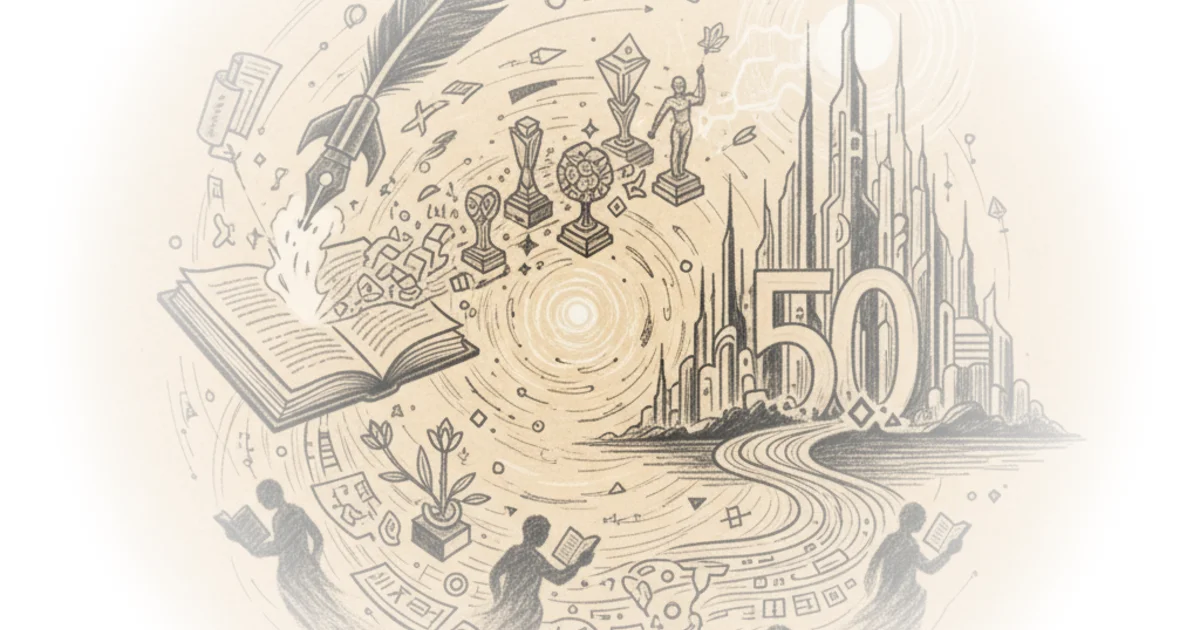
She argues that the literary establishment has convinced itself that it is the sole guardian of "true" art, creating a false continuity with the past. "Literary fiction sells itself as being a continuation of the tradition embodied by the canon," Kanakia writes, noting that this narrative led her to believe she only needed to read the great European and pre-war American masters to understand the craft. This framing is compelling because it identifies a specific intellectual arrogance: the belief that one can skip the immediate past. Kanakia realizes now that "postwar American literary fiction is a genre of its own. It's not just 'fiction that is good'—postwar American literary fiction is a particular tradition that's not necessarily senior to any other genre of fiction."
This realization reframes the entire reading list of the modern writer. Just as a science fiction fan understands that the field has its own history distinct from general literature, Kanakia suggests that a literary writer must respect the specific lineage of the mid-20th century. The oversight is significant; by ignoring this "genre," writers miss the evolution of the form. It is worth noting, however, that the literary world's resistance to this categorization stems from a genuine desire to elevate the work above commercial constraints, a stance that, while noble, often leads to the very insularity Kanakia critiques.
"I think basically I felt resentful of the literary world... Not reading authors like Carver was my way of condescending right back."
The Canon and the Classroom
The piece takes a sharp turn into the mechanics of the Master of Fine Arts (MFA) system, which Kanakia identifies as the primary engine of this confusion. She observes that the academic environment reinforces a narrow mental map of literature that stretches linearly from Shakespeare to Philip Roth, skipping the messy, genre-specific developments of the last seventy-five years. "When you do an MFA program, all the professors are into the canon," she writes, explaining that this creates an echo chamber where the distinction between "literature" and "literary fiction" is erased.
This institutional blindness has tangible consequences for how writers are trained. Kanakia points out that literary writers often hesitate to recommend specific contemporaries like John Cheever or Raymond Carver because they assume everyone is already reading the "world's most important literature." This assumption creates a gap in knowledge that Kanakia, with her science fiction background, was uniquely positioned to spot. She contrasts this with the sci-fi community, where the advice to read widely is explicit and actionable, citing Michael Moorcock's famous directive to "stop reading everything in those genres and start reading everything else."
The argument here is that the literary world's lack of self-awareness is a handicap. By treating their specific cultural moment as the inevitable culmination of history, they fail to see the "rules" they are playing by. "They are so hemmed up in the walls of this world, that they don't necessarily see that they're working in a particular form that has its own rules," Kanakia asserts. This is a powerful observation, though one might argue that the literary canon's resistance to "genre" classification is precisely what allows it to maintain its claim to universality—a claim that, while perhaps illusory, serves a cultural function.
The Eight-Hundred-Page Problem
In the final section, Kanakia shifts to a practical analysis of how we consume these stories, specifically the trend of massive, posthumous compendiums. She notes that these collections often fail because they ignore the original context of the work. "The stories were written to be read one at a time, in Esquire or The New York World or The New Yorker or Weird Tales," she explains. The magazine ecosystem demanded that every story be a standalone seduction, a "first tale" that had to win the reader over immediately.
When these stories are bunched into eight-hundred-page volumes, the rhythm breaks. Kanakia finds that "the more-commercial writers tend to produce better eight-hundred-pagers" because they viewed their work as entertainment and wrote with a consistency that survives the marathon read. Conversely, she finds it "so much harder to read eight hundred pages of Hemingway" because the volume includes "real clunkers" that were never meant to be read in such proximity. This critique of the "complete works" format is a vital contribution to the conversation about literary consumption, suggesting that the curation of anthologies often serves the market more than the reader's experience.
"Each story is a seduction: you care about this voice, you care about this style, you want to finish this story."
Kanakia's conclusion is that structure is the most transferable element of writing, more so than voice or style. She traces a lineage from O. Henry through F. Scott Fitzgerald to John O'Hara, finding that the "underlying techniques are still sound" even if the magazine ecosystem that birthed them has vanished. This pragmatic approach to influence—stealing structure rather than mimicking voice—offers a refreshing alternative to the often derivative nature of contemporary literary fiction.
"You can't learn much from Hemingway... Imitating Carver will not get you anywhere in this world, because half the writers in America are imitating him."
Bottom Line
Kanakia's most potent argument is that the literary world's refusal to acknowledge its own genre-specific rules has created a culture of confusion and exclusion. By applying the rigorous, self-aware lens of science fiction fandom to the "serious" literary canon, she reveals the arbitrary nature of the hierarchy that separates "high" art from "genre" fiction. The piece's greatest strength is its willingness to admit that the "canon" is not a natural law but a constructed narrative, and its biggest vulnerability lies in potentially underestimating the unique, non-commercial aspirations of the literary tradition it critiques.