Zichen Wang delivers a rare, high-stakes portrait of political metamorphosis, arguing that the election of Cheng Li-wen as chair of the Kuomintang is not merely a personnel change but a fundamental reimagining of cross-Strait relations. In a landscape often defined by rigid ideological trenches, Wang identifies a surprising pivot: a former independence activist now leading the party most associated with mainland engagement, promising to trade political warfare for a "pride of lions" built on compassion. This narrative matters now because it suggests a potential de-escalation mechanism at a moment when the Taiwan Strait is described as being in "grave danger of war."
The Arc of Transformation
Wang frames Cheng's rise as a unique historical anomaly, noting that few politicians have traversed the full spectrum from "pan-green independence activism to leading the island's principal pan-blue party." This is not just a career switch; it is a strategic recalibration of the party's identity. Wang writes, "What makes Cheng distinctive is not only her transformation but her clarity of tone." By highlighting her background—studying law at National Taiwan University, Temple, and Cambridge, and her early roots in the student democratization movement—Wang establishes her credibility as a bridge figure rather than a relic.
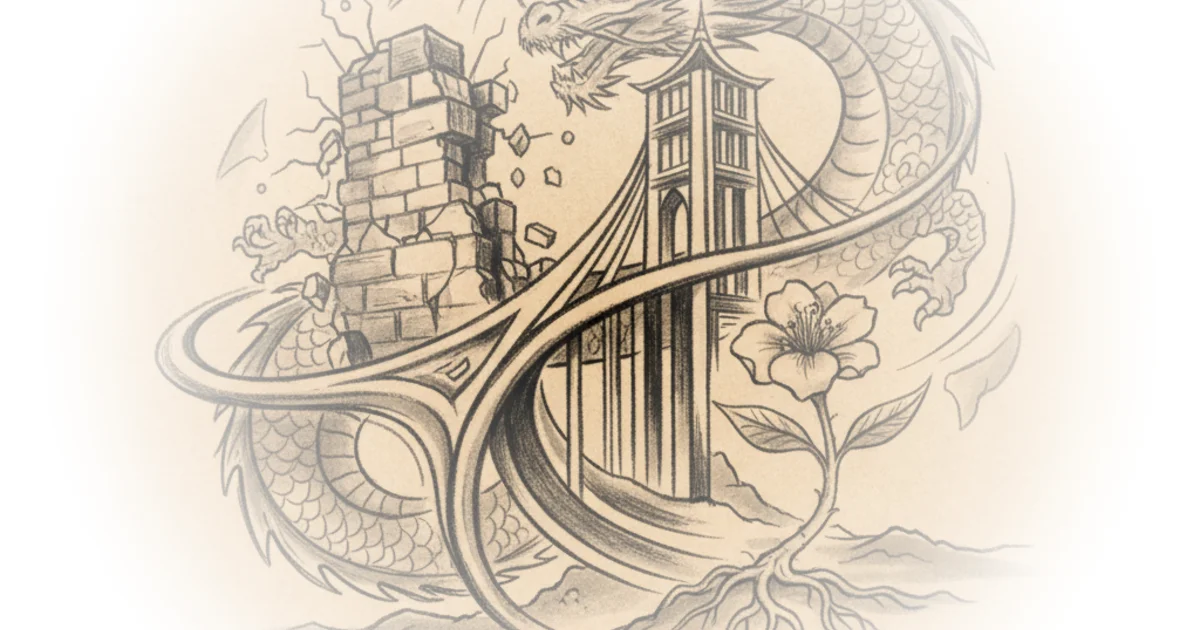
The author suggests that Cheng's dual identity, calling herself both Taiwanese and Chinese, is a deliberate move to lower the temperature of the discourse. "She has also embraced a dual identity... casting herself as a bridge rather than a barricade across the Strait," Wang observes. This reframing is crucial. It moves the conversation away from the existential threats of sovereignty and toward the pragmatic necessities of peace and economic stability. However, a counterargument worth considering is whether a party deeply entrenched in local factions and business networks can truly shed its historical baggage so quickly, or if this is merely rhetorical repackaging for a weary electorate.
In an age of political fatigue within Taiwan's major parties, Cheng's rise to the helm of the Kuomintang in late 2025 feels like more than routine succession.
A New Rhetoric of Goodness
The core of Wang's analysis rests on the content of Cheng's inauguration speech, which the author presents as a stark departure from the usual political vitriol. Instead of attacking the opposition's policies with technical jargon, Cheng invokes moral imperatives and spiritual analogies. Wang notes that Cheng explicitly models her vision after Tzu Chi, the massive Buddhist humanitarian organization, stating, "I have always taken Tzu Chi as an object to learn from; it is undeniable that it is Taiwan's brightest name card in the whole world."
This is a bold strategic choice. By redefining the Kuomintang's acronym—"K stands for Kind, for goodness; M stands for Mindfulness, for right mindfulness; T stands for Team, for team"—Cheng attempts to strip the party of its martial history. Wang writes, "My friends, during the election I said that we must turn the Kuomintang from a flock of sheep into a pride of lions." Yet, the definition of a "lion" here is paradoxical: "We are not a pack of wolves, we do not use violence to control violence, we do not become a second DPP." The argument is that true strength lies in protecting the weak and fostering a "new order" based on fairness, rather than dominating through aggression.
Critics might note that this moral high ground risks alienating the party's traditional base, which has long relied on hardline nationalism to distinguish itself from the ruling Democratic Progressive Party. Furthermore, the speech's intense focus on the ruling party's alleged "judicial hunting" and "political oppression" suggests that the underlying political warfare is far from over, even if the rhetoric has softened.
I believe that only love can prevail over hatred; I believe that only goodness can defeat evil.
The Stakes of the Strait
Wang does not shy away from the grim reality facing the region. The commentary underscores the urgency of Cheng's mission by quoting her assessment of the current climate: "The Taiwan Strait is in grave danger of war, and the whole world is watching closely." Wang argues that the KMT's new direction is a direct response to the "fierce and major changes" in global trade rules and the internal erosion of democratic norms under the current administration.
The author highlights Cheng's fear that the "economic miracle" is being hollowed out and that the ruling party is using the judiciary as a weapon. "Today the ruling party controls most of the media and keeps spreading rumors, smearing people, and creating unnecessary confrontation and hatred," Cheng is quoted as saying. Wang interprets this not just as political mudslinging, but as a systemic threat to the island's stability. The implication is that without a shift toward "engagement with confidence," the spiral into danger is inevitable.
This framing is effective because it connects domestic political dysfunction with international security risks. However, it also places a heavy burden on a single political figure to solve deep structural issues. As Wang points out, Cheng inherits a party "anchored in business networks and local factions," while younger voters demand a more assertive democratic age. The challenge is to make "renewed intimacy with the mainland... a source of reassurance rather than fear."
Bottom Line
Zichen Wang's piece succeeds in humanizing a complex geopolitical shift, arguing that Cheng Li-wen's transformation from activist to party chair offers a plausible, albeit risky, path away from conflict. The strongest part of the argument is the detailed examination of how Cheng is repurposing the KMT's legacy through the lens of humanitarianism, a move that could resonate with a war-weary public. Its biggest vulnerability lies in the assumption that moral rhetoric can overcome decades of institutional polarization and the deep-seated fears of the electorate. The world will be watching to see if this "pride of lions" can actually rebuild a new democratic order or if it remains a hopeful aspiration in a time of grave danger.