William Blake, the Mystic Next Door: An Interview with Mark Vernon
A forgotten poet returns to challenge how we think about imagination, perception, and what it means to be truly alive.
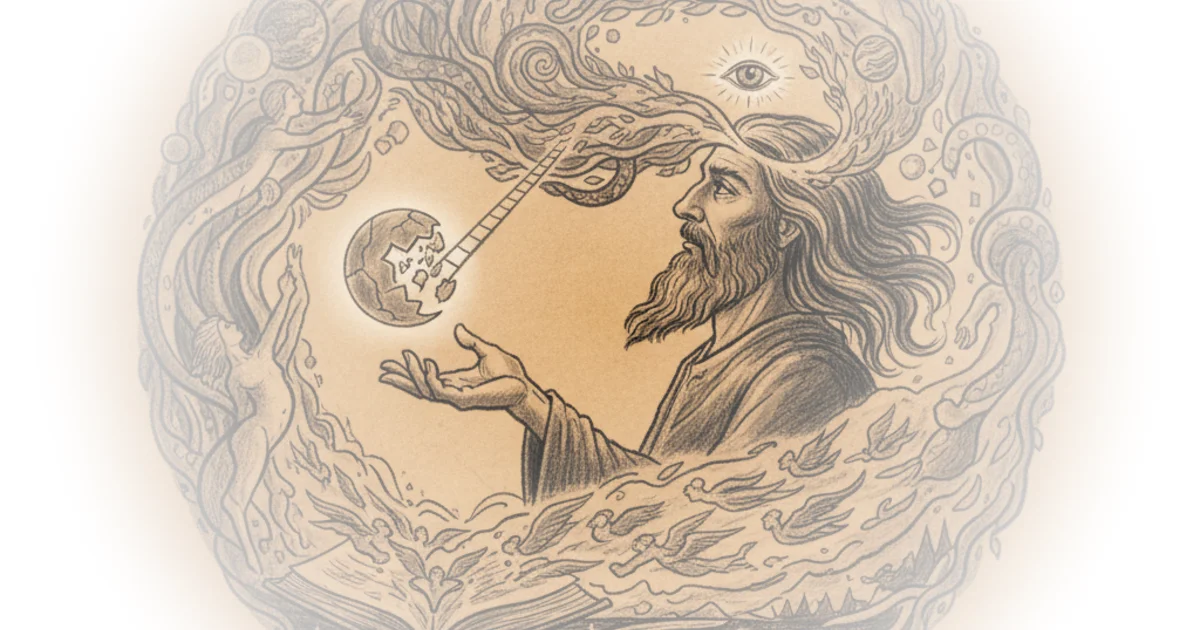
The Local Mystic
Mark Vernon lives in South London. He walks the same streets where William Blake saw angels in a tree on Peckwater Rye—a spot now surrounded by houses but still remembered as the place where one of history's most remarkable mystics encountered the divine. There's even a pub called the Angel Oak with a mural depicting that moment.
Vernon calls Blake "my local mystic"—a figure who wrote in English, didn't require learning Middle German to read Eckhart, and walked the streets he walks. But beyond the personal geography, there's something deeper: Blake offers a way of seeing that most modern psychology has lost.
Why Blake? Why Now?
Blake is one of the most important mystics since the Reformation. He saw angels in trees, spoke of holding infinity in a grain of sand, and believed everything alive required active engagement with the divine—not passive observation.
But here's what draws Vernon: most biographies medicalize or psychologize Blake away. Writers diagnose him with conditions that remove anything challenging—hyperfantastic imagery floods, aphantasia where images don't exist, temporal lobe epilepsy from religious experiences. These explanations simplify him into someone whose vision was merely symptom, not prophecy.
Vernon wanted something different. He wanted to take Blake at his word.
"I give you the end of a golden string, only wind it into a ball. It will lead you in at heaven's gate built in Jerusalem's wall." — William Blake
That's not poetic flourish. That's instruction.
The Psychotherapy Problem
Vernon brings something unusual to this reading: he's both a psychotherapist and a former Anglican priest. He has a PhD in ancient Greek philosophy, degrees in physics and theology, and has worked in psychiatric hospitals where people live imaginative lives that often trap them rather than liberate them.
He argues that modern psychology—born roughly a century after Blake—tried to turn inner life into something private. It became what's happening inside your head. You project out, you introject, but you're fundamentally isolated.
The idea that interiority connects us to the whole world—that we are part of something exceeding ourselves—isn't major part of modern psychology at all.
Blake writes before all that. He brings what Vernon's clients often need: not just management of inner life, responses to things, how past affects present—but awakening in a bigger sense.
Taking Blake Literally
One of the most intriguing aspects of Vernon's approach is his refusal to soften Blake into someone understandable by contemporary categories. When Blake says his texts came from the divine, Vernon doesn't interpret this as metaphor.
"The imagination has us," Vernon writes—not the other way around. For Blake, that's the divine presence: what traditional Christianity would call the Logos. The great pulse running through all things, creative and dynamic.
Blake calls Jesus "the imagination." And his imagery and poetry are designed to catalyze that same energy in readers. Not as passive observation but as active participation.
The Visual Revolution
What makes Blake unique among Romantic poets is his priority of the visual. His texts often exist in conversation with images he painstakingly produced—paintings, illuminated books, visual works that demand to be seen not just read.
Blake gets specific: we must learn to see not with the senses but through them. He's partly making a point about British empiricism—figures like John Locke who said data falls onto the tabular razor of the mind and then there's inner jigory pokery and we make models projecting out hoping they're adequate.
No, Blake says. The senses are a threshold or portal. What we do is lean into what's happening already—see more through not just with the senses.
When you orbit in proximity to someone for whom that was true, it starts to become true for you as well.
Critics and Questions
Not everyone agrees. Some Blake scholars would argue his visions are better understood through the lens of mental health—that seeing angels might be better explained as symptom than prophecy. Others suggest the concept of "divine imagination" is too easily co-opted by New Age thinking that s Christian orthodoxy.
But Vernon argues that's precisely what Blake offers: not mysticism for the faint, but a radical redefinition of perception itself. Everything would appear to man infinite if the doors of perception were cleansed.
Bottom Line
This interview reveals why Vernon's book "Awake" matters: it takes Blake at his word rather than through diagnostic lenses. The biggest strength is his argument that imagination isn't something we possess—it's something that possesses us. The vulnerability? That framing might sound like religious conversion language to secular readers, and the practical application of that vision remains unclear.
But for listeners seeking something beyond psychology's buffered self—the private interiority that disconnects us from everything larger—this interview offers a door opening fractionally wider than most.