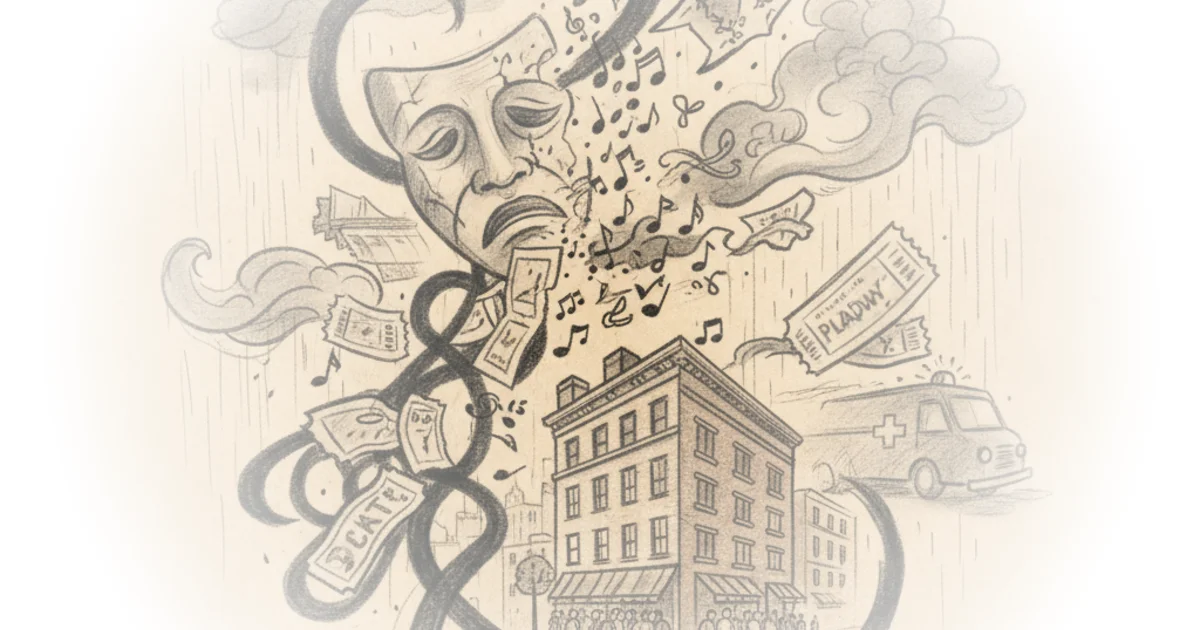
Woody Allen turned 90 and published his first novel. Noah Rinsky, writing for the Metropolitan Review, uses the occasion to survey the full arc of Allen's career -- from his nightly residency at Elaine's restaurant on 88th and Second Avenue, through the fifteen-year masterpiece run that ended in August 1992, to the diminished output and cultural exile that followed. The result is one of the more honest and unsentimental assessments of Allen's legacy to appear in recent memory.
Rinsky opens with a cinematic set piece at Elaine's, conjuring the early 1990s version of Allen at the peak of his cultural power. The filmmaker held court at table six, played poker with Gay Talese and George Plimpton until dawn, and traded insults with Elaine Kaufman herself. This was the Allen who had produced an unbroken string of acclaimed work:
Annie Hall, Manhattan, Interiors, Stardust Memories, Radio Days, Broadway Danny Rose, Crimes and Misdemeanors, Zelig, Hannah and Her Sisters, and Husbands and Wives -- not a flop among them and several considered masterpieces of cinema.
Then came the allegations, and everything shifted. Rinsky does not equivocate about the scale of the reputational collapse.
These days, Woody Allen might be the closest thing the internet has to a stock-image diddler. He's the Colonel Sanders of "coming to a playground near you."
The tone is deliberately provocative. Rinsky is not endorsing this characterization so much as documenting it, capturing the way public opinion calcified long before any legal resolution.
The Novel as Self-Portrait
The heart of the essay concerns Allen's new novel, What's With Baum?, and whether its protagonist, Asher Baum, amounts to anything more than a thinly veiled Allen surrogate. Rinsky's brother puts the skepticism bluntly when shown a copy of the book: "Lemme guess, the main character's neurotic and loves jazz."
Baum is a Jewish writer with allergies, trapped in a bad marriage, living in the countryside he despises. The parallels to Allen's relationship with Mia Farrow are unmistakable. Allen told the New York Times Magazine in 1991:
I could go on about our differences forever. . . . She doesn't like the city and I adore it. She loves the country and I don't like it. She likes simple, unpretentious restaurants; I like fancy places.
Thirty-four years later, the same complaints resurface in fiction. Rinsky notes that Allen writes of Baum: "Baum had always hated the country. Everything about it: the ticks and spiders; the raccoons, cute but with rabies; the poison ivy; the sound of crickets and cicadas. He hated the isolation." The grudge has outlived the relationship by decades.
What makes the novel unsettling, according to Rinsky, is a sequence in which Baum gropes a journalist who praised his work, then gradually admits it through layers of denial. The exchange with his agent crystallizes the self-pity:
"Rape? She says I raped her?" "I definitely don't [think you did], Asher, but what the hell does it matter what I think? In today's culture an accusal is as good as a conviction."
Rinsky finds this chilling precisely because it is charming at first. Allen has always excelled at making his proxies likable enough to get away with ugly behavior.
Freedom as First Principle
The essay's most interesting argument concerns what actually drives Allen. It is not art, Rinsky contends, but personal freedom -- an uncompromising commitment to following his own impulses regardless of consequence. The marriage to Soon-Yi Previn was not an aberration but the logical culmination of a life spent refusing to be constrained.
For Woody, the highest order of existence has not been art, but rather personal freedom. Allen's uncompromising pursuit of Soon-Yi was the logical final transgressive act in a life of heedlessness.
Rinsky frames this as simultaneously courageous and possibly monstrous. Allen could have preserved his reputation and his artistic opportunities by being the recluse he later claimed to be. Instead he pursued what he wanted and accepted the consequences. Whether that constitutes selfishness or romance, Rinsky concedes, is genuinely unclear. The marriage has lasted three decades.
There is a counterpoint worth raising here. Rinsky's framing of Allen's choices as a kind of existential authenticity -- being "absolutely true to himself" -- risks romanticizing behavior that harmed real people. The essay acknowledges this tension without fully resolving it, and the reader is left to wonder whether "personal freedom" is really the right lens for a man whose freedom was exercised at the expense of those with far less power.
The Decline in the Work
Rinsky draws a sharp line between the pre-1992 and post-1992 filmography, with one notable exception: 1997's Deconstructing Harry, which he calls "an underrated Allen masterpiece, a fiery, urgent reaction to Allen's own humiliation." Everything else after the allegations represents a steep drop.
Going to see a new Woody Allen movie becomes less of a cultural event and more a question of: Is this one actually good? Because the last one was a pile of shit!
The observation about the apartments is particularly sharp. In the early films, Allen shot inside real spaces -- Farrow's actual Upper West Side apartment for the Thanksgiving scene in Hannah and Her Sisters. By 2019's A Rainy Day in New York, the settings have inflated to fantasy proportions. Timothee Chalamet's character lives at the Pierre Hotel. Elle Fanning describes him as:
"Quaint . . . searching for his romantic dream from a vanished age."
The early films satirized recognizable types. The later ones, Rinsky argues, depict nobody real enough to satirize.
One could push back on the neatness of this division. Rinsky dismisses Bullets Over Broadway as a clunker, which is a minority opinion -- the film received seven Academy Award nominations and remains well regarded by critics. The post-1992 decline, while real, is not quite as total as the essay suggests.
Bottom Line
Rinsky's essay is a lively, unsparing, and occasionally brilliant piece of cultural criticism that refuses to flatten Allen into either a martyr or a monster. The writing is muscular and confident, the scene-setting at Elaine's is first-rate, and the analysis of What's With Baum? is more perceptive than most book reviews manage. The final verdict on the novel and its author lands with exactly the right mixture of affection and ruthlessness:
Woody Allen has developed his craft at a level that has earned him the right to repeat himself, and it's a delight that he's still around. The same Woody Allen who directed Crimes and Misdemeanors and Annie Hall is coming out with new work and it's still the same! . . . It's just that Woody hasn't learned a goddamn thing.
That last line could serve as an epitaph for Allen's entire late period. The compulsion to create remains. The willingness to examine what drives it does not. Rinsky captures both truths without flinching from either one.
{Cough, clears throat}. Chapter one. It’s 1991 in Manhattan. Cue a Gershwin piano trill, followed by sirens; open on an old lady getting her purse snatched. An ambulance whizzes by. Gray skies and rain; a little group of shivering hookers. Oh yeah, the roaring ’90s. But this isn’t Midtown. No, no, we’re in the crosshairs of 88th Street and Second Avenue. One building has a line outside. We zoom in on the awning — it’s Elaine’s, the glamorous literary canteen. The camera takes us inside, tracking. Tucked into a little table — not in the back, never in the back; only loser tourists and hack writers sit in the Siberia of that crowded restaurant — but along the right row, visible from the entrance, below the sconces and crooked picture frames, is Woody Allen’s table. Table six. Imagine it! A wintry night, and the tourists outside gripping their Frommers, and the candlelit table that sits empty until Woody Allen arrives. Mia Farrow is there, too, picking at cold tortellini, but she doesn’t stay long. Not because she’s angry — no, none of that stuff has happened yet; Farrow just doesn’t like to stay out late, and leaves hours before her famous boyfriend, who lives alone on the opposite side of the park. Woody spends the rest of the night chewing burnt steak, drilling red wine, and shuffling cards for Gay Talese and George Plimpton at a late-night poker game that wraps at dawn.
Allen was a fixture at Elaine’s every night for 10 years, and would trade barbs with Kaufman, the thick-wristed owner who talked like a yenta but punched rather more like a Belfast prizefighter. Kaufman and Woody were like relatives, which made Allen a prince in the kingdom of New York’s top haunt for mayors and movie stars, where Jackie Kennedy made her first public appearance at 2 a.m., several months after the assassination of her husband, and where Woody Allen was introduced to Mia Farrow.
Cast your mind back to the time before The Allegations, and you realize that, right up until that point, Allen was in the midst of an unstoppable 15-year run: Annie Hall, Manhattan, Interiors, Stardust Memories, Radio Days, Broadway Danny Rose, Crimes and Misdemeanors, Zelig, Hannah and Her Sisters, and Husbands and Wives — not a flop among them and several considered masterpieces of cinema. Woody Allen was drowning in Oscars and cultural ...