Mike Petrilli confronts a paradox that defies conventional wisdom: high school graduation rates have soared to historic highs, yet the credential they confer may be losing its meaning. This piece cuts through the celebratory noise of educational attainment to ask a uncomfortable question that policymakers have largely ignored: are we graduating students who can barely read? The analysis is notable not just for its data, but for its willingness to challenge the reform movement's own legacy of "getting everyone across the finish line."
The Illusion of Progress
Petrilli begins by acknowledging the undeniable statistical gains of the last two decades. He notes that the percentage of young Americans without a high school diploma dropped from 14 percent in 1997 to just 5 percent in 2016. For Hispanic students, the drop was even more dramatic, falling by a factor of three. Yet, he immediately pivots to the shadow side of these numbers. "There's a debate in academe about how much these attainment gains amount to real progress versus 'degree inflation,'" Petrilli writes. He argues that while the data looks good on paper, the underlying reality is far messier, driven by systemic incentives to lower standards rather than raise achievement.
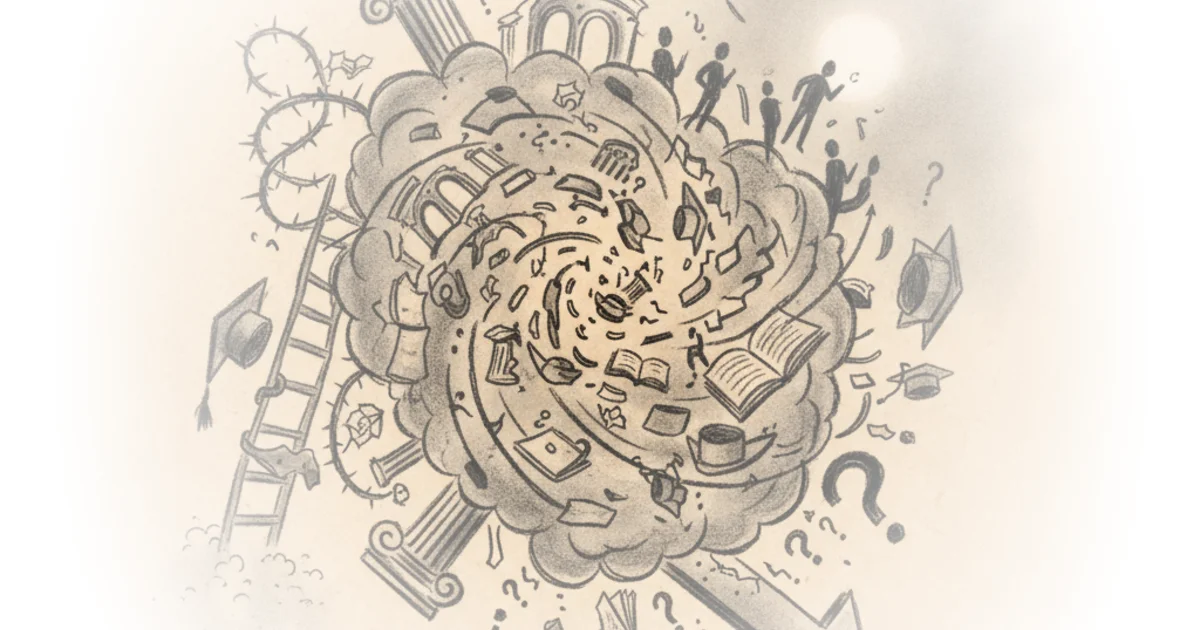
The author points to specific mechanisms that have eroded rigor, such as "dubious credit recovery programs" and the widespread elimination of exit exams. He cites a devastating analysis by Jessika Harkay which found that "Many Young Adults Barely Literate, Yet Earned a High School Diploma." This statistic is the piece's anchor: one in four young adults is functionally illiterate, yet more than half hold a diploma. Petrilli suggests that the very policies designed to hold schools accountable under the No Child Left Behind Act inadvertently created a perverse incentive structure. "The law of unintended consequences kicked in, with the focus shifting from 'beefing up the value of the diploma' to 'getting everyone across the finish line,'" he explains. This historical context is crucial, reminding us that the current crisis of credential devaluation was baked into the accountability systems of the early 2000s.
The focus shifted from 'beefing up the value of the diploma' to 'getting everyone across the finish line.'
Critics might argue that Petrilli is too harsh on the removal of exit exams, noting that research often shows these tests do little to improve achievement while increasing dropout rates. However, the author's point is not that we should reinstate punitive testing, but that we cannot pretend the current system produces a universally rigorous credential. The trade-off between keeping kids in school and ensuring they learn is real, but pretending the diploma still signals a baseline of literacy is a dangerous delusion.
The Political Trap
The commentary then shifts to the political difficulty of addressing this issue. Petrilli observes that while the weakening of standards might hurt future earnings and leave colleges with unprepared students, it is politically toxic to propose tightening requirements. "It's arguably never been easier to graduate from high school in America than it is today. Are we OK with that?" he asks. The author suggests that in a populist moment, any proposal that feels like "eat your spinach" is a non-starter. This framing is sharp; it identifies a gap between what the data suggests is necessary and what the electorate will tolerate.
The piece also touches on the broader landscape of education reform, weaving in comments from other voices to illustrate the current friction. Chad Aldeman and Karen Vaites are cited for challenging political narratives that dismiss Southern states' educational progress, noting that low-income students in Louisiana and Mississippi often outperform peers in states like New Jersey. Meanwhile, Ben Austin expresses frustration that teachers unions seem to be dictating policy, reminding readers that past Democratic presidents "won in part because they had the courage to challenge [Democratic] party orthodoxy on behalf of the American people." These interjections serve to ground the abstract debate about diplomas in the gritty reality of political maneuvering and union influence.
Innovation and Equity
Amidst the critique of the status quo, Petrilli highlights promising models that balance rigor with access. Eva Moskowitz is featured for her praise of Florida's Schools of Hope program, which ties funding to performance and requires districts to open unused space to high-performing charters. "Florida now requires districts to open unused public school space to high-performing charters," she explains, adding that support is contingent on moving students from the lowest ranks to the top tier. This performance-based approach offers a potential blueprint for maintaining standards without sacrificing scale.
On the topic of advanced education, the piece presents a compelling case for early identification and universal screening. Tarek Grantham argues that without data proving equitable results, the advanced education movement lacks credibility. He demands, "Show me the data that represents an increase of XY underserved students and more equitable enrollment of all students." This call for evidence-based advocacy is a necessary corrective to the often ideological debates surrounding gifted programs. Homero Chavez provides a powerful counter-example to the idea that advanced programs are only for the affluent. His district in Arizona, serving a predominantly Mexican-descent, low-income population, has helped thousands of students earn college credits before finishing eighth grade. "The key components to our program have been early identification of talent, advanced programming (frontloading), a shift away from the scarcity mindset," Chavez notes. These examples prove that high standards and equity are not mutually exclusive, provided the right support systems are in place.
Show me the data that represents an increase of XY underserved students and more equitable enrollment of all students.
The discussion also touches on the role of technology, with John Bailey testifying on the potential and perils of AI in education. Bailey warns of "academic integrity and over-reliance," while Matt Gandal urges policymakers to consider the "AI Vulnerability Assessments" needed for the future workforce. These forward-looking points remind us that the definition of literacy and readiness is evolving, and the diploma must adapt to reflect new realities.
Bottom Line
Petrilli's most significant contribution is his refusal to accept the binary choice between high graduation rates and high standards; he forces the reader to confront the possibility that we have achieved the former by sacrificing the latter. The argument's greatest vulnerability lies in its political realism: while the diagnosis is likely accurate, the proposed path forward—raising the bar in a populist climate—remains uncharted and perilous. The reader must watch how the tension between "getting everyone across the finish line" and ensuring the finish line actually means something plays out in the next decade of education policy.