Slavoj Žižek returns to the desert of the real not to offer comfort, but to dismantle the very architecture of our certainty. In this dense exploration of Kantian philosophy, the author argues that the most profound truths of human existence—freedom, ethics, and value—are not found in answers, but in the irreducible gaps between opposing realities. This is not a dry history of ideas; it is a radical re-framing of why we feel trapped between the mechanical laws of nature and the terrifying burden of our own choices.
The Parallax of Trauma and Reality
Žižek begins by dissecting the psychological impasse regarding childhood trauma, using it as a mirror for Kant's epistemological struggles. He draws on the work of Jean Laplanche to show how we are caught between two impossible truths: the brutal reality of actual abuse and the psychological necessity of fantasy. As Slavoj Žižek writes, "The ultimate irony is that the dismissal of seduction as fantasy passes today for the 'realistic' stance, while those who insist on the reality of seduction end up advocating all kinds of molestations, up to satanic rites and extraterrestrial harassments."
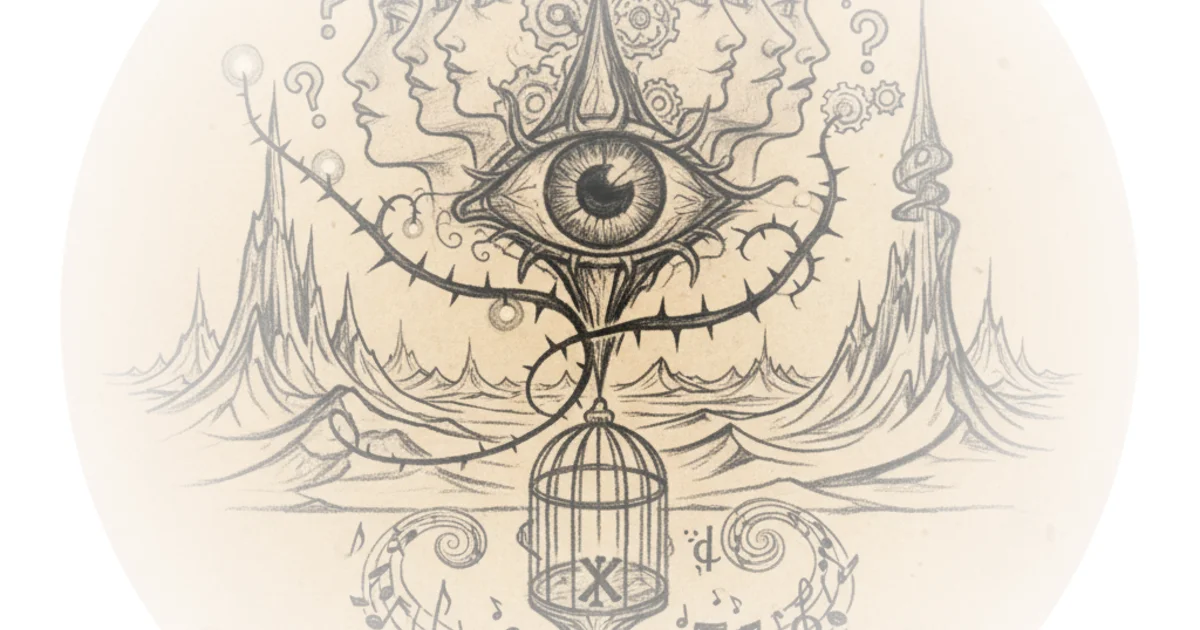
The author suggests that the truth lies neither in the event nor in the mind, but in the structural space between them. He defines this space as a "transcendental structure" where the child is confronted with an "enigmatic message" that arrives "too soon" to be understood yet defines their future. This framing is powerful because it refuses to let us retreat into simple causality. It forces the reader to accept that some aspects of human experience are fundamentally indeterminate. Critics might argue that this philosophical abstraction risks minimizing the concrete, physical reality of abuse victims, yet Žižek insists that the "fact of seduction" is precisely this paradoxical location between the too-soon and the too-late.
Seduction is, rather, a kind of transcendental structure—the minimal a priori formal constellation of the child confronted with the impenetrable acts of the Other.
The Inhuman Core of Freedom
The commentary then shifts to a re-reading of Kant's distinction between negative and indefinite judgments, a move that radically alters our understanding of the "inhuman." Žižek explains that saying someone is "not human" implies they are outside humanity (like an animal), while saying they are "inhuman" implies a terrifying excess that is actually inherent to being human. As Slavoj Žižek puts it, "'He is inhuman' means something thoroughly different, namely the fact that he is neither strictly human nor strictly inhuman, but marked by a terrifying excess which, although it negates what we understand as 'humanity,' is inherent to being human."
This is the crux of the Kantian revolution: the core of subjectivity is not the light of reason, but a "Night of the World" where madness and freedom explode from within. The author argues that true freedom is not a property of a soul existing beyond the physical world, but a function of the gap itself. If we could see the "Thing-in-itself" (the noumenal reality) directly, we would lose our freedom entirely. Slavoj Žižek writes, "God and eternity in their awful majesty would stand unceasingly before our eyes... The moral worth of actions... would not exist at all. The conduct of man... would be changed into mere mechanism."
This argument lands with a heavy weight: our autonomy depends on our ignorance. We are free only because we cannot see the full, deterministic consequences of our actions. If we knew the price of evil with absolute clarity, we would be forced into a mechanical calculation, acting out of fear rather than duty. A counterargument worth considering is that this view romanticizes ignorance; one could argue that true moral maturity requires seeing the consequences clearly and choosing good anyway. However, Žižek's point is that such a choice would no longer be a "free" act in the transcendental sense, but a programmed response to a known variable.
The Economic Gap and the Failure of Synthesis
Bringing this philosophical lens to economics, Žižek highlights Kojin Karatani's reading of Marx, who treats the conflict between classical political economy and neo-classical theory as a Kantian antinomy. The author notes that value must originate both in production (labor) and in circulation (exchange), and that trying to reduce one to the other is a mistake. As Slavoj Žižek writes, "Post-Marx 'Marxism'... lost this 'parallax' perspective and regressed into the unilateral elevation of production as the site of truth against the 'illusory' sphere of exchange and consumption."
The piece argues that modern critical theory has failed because it tries to explain away the persistence of capitalism by blaming "ideological manipulation" or "consumerist seduction." Instead, Žižek suggests the system persists because of an insurmountable gap in its very structure. He quotes Karatani to illustrate this: "The price... signifies the pious wish to convert the iron into gold... If this transformation fails to take place, then the ton of iron ceases to be not only a commodity but also a product."
This reframing is crucial for understanding why economic crises are not just policy failures but structural inevitabilities. The system relies on a "salto mortale" (a mortal leap) that never fully succeeds. By focusing on the gap rather than the synthesis, the author exposes the fragility of the entire economic edifice. It suggests that the solution is not to find a better theory of value, but to acknowledge the irreducible tension that drives the system forward.
Our freedom persists only in the space IN BETWEEN the phenomenal and the noumenal.
Bottom Line
Žižek's most compelling contribution here is the assertion that freedom and value are not hidden truths waiting to be discovered, but functions of the gap itself. The argument's greatest strength is its refusal to offer a comforting synthesis, forcing the reader to dwell in the discomfort of contradiction. Its biggest vulnerability is the sheer density of its abstraction, which may alienate readers seeking concrete policy solutions. The reader should watch for how this "parallax view" applies to current crises where no single narrative can explain the chaos, from economic instability to the nature of trauma itself.