Rick Beato doesn't just interview guitarists; he dissects the very anxiety that keeps them silent. In a conversation that feels less like a transcript and more like a masterclass in professional survival, Beato and guitarist Tim Henson confront the brutal reality that even virtuosos face the "pit of the stomach" panic when life interrupts practice. The piece is notable not for the gear talk, but for its radical admission: the old rule that you must play slow to play fast is a myth, and the only way to regain speed is to actually play fast, flaws and all.
The Myth of the Eternal Virtuoso
Beato opens by dismantling the illusion that professional musicians are always "on." He notes that despite his fame, he hasn't had a guitar in his hands for a gig since 1991, forcing him to "relearn how to play the guitar from scratch." This vulnerability is the article's hook. Beato writes, "When I was sessioning 10 hours a day, I had guitars in my hands 10 hours a day and I, you know, I didn't have to practice. Now I have to practice." This reversal of fortune is the core tension of the piece. It reframes the modern musician not as a machine of endless output, but as a human being fighting against the entropy of a busy life.
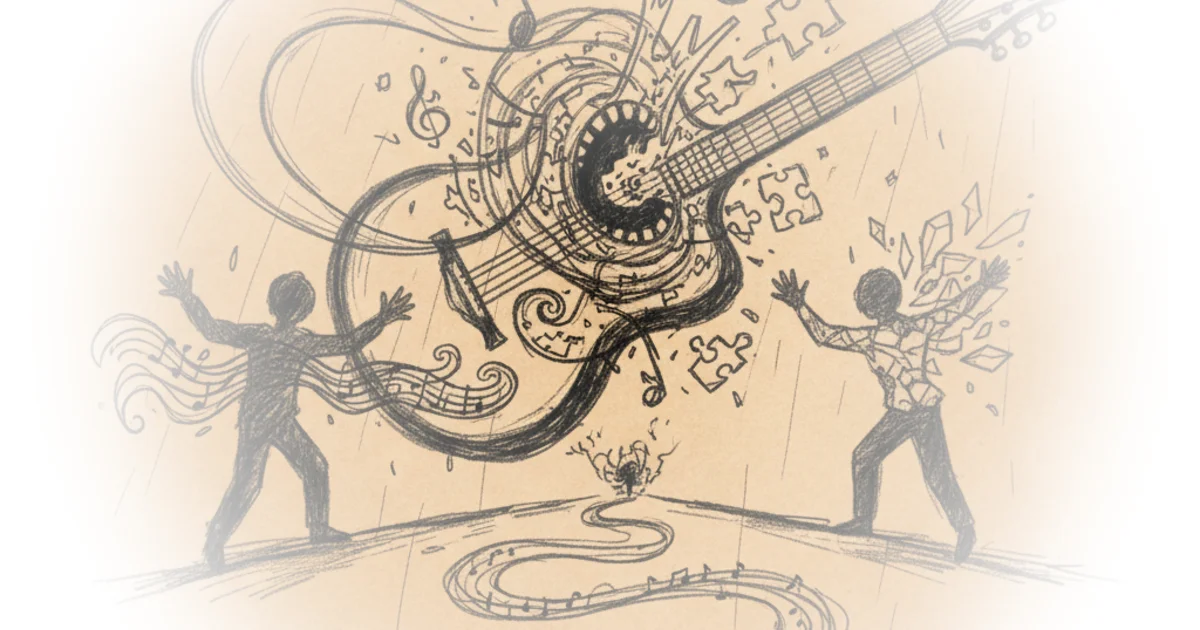
The commentary here is sharp because it rejects the romanticized narrative of the artist who never stops creating. Instead, Beato and Henson admit that "life gets in the way of playing the guitar," a sentiment that resonates deeply with the audience. They describe a cycle of panic followed by strategic improvisation. Henson admits to feeling that panic before a gig with Larry Carlton, a moment that humanizes the legend. As Henson puts it, "Okay, I know how to deal with that," before diving into a specific chord progression to find a workaround. This is not a tutorial on perfection; it is a tutorial on resilience.
"There was NO WAY to prepare for this... you just have to find workarounds, some places where you composed sections."
Critics might argue that relying on "workarounds" dilutes the integrity of the music, suggesting that true mastery requires total recall. However, the authors counter this by pointing out that even the greats, like Larry Carlton, rely on specific strategies to navigate complex harmonies like the G-sharp minor 7 flat 5. The argument holds up because it prioritizes the musical result over the rigid adherence to traditional practice methods.
Rewriting the Rules of Speed
The most provocative section of the conversation challenges a fundamental tenet of music pedagogy. For decades, the mantra has been "play slow to learn fast." Beato and Henson dismantle this. Beato writes, "Everybody says, 'Oh, you got to play slow to learn to play fast.' It's like, 'Well, you actually have to play fast to play fast.'" This is a significant departure from standard conservatory advice, yet it is grounded in the physiological reality of muscle memory.
Henson supports this by describing his own practice habits, noting that practicing fast is "addictive" and that "if you just do it, do that in five minutes, you'll be doing it better." The logic is that speed is a specific muscle group that atrophies without specific, high-velocity stimulation. This perspective is reinforced by their discussion of gear. They don't just talk about abstract theory; they discuss the tangible tools that enable this speed, such as the Keeley pedals and the specific wattage of the Marshall and AC30 amplifiers. The mention of the AC30 is particularly relevant given its historical role in shaping the British Invasion sound, yet here it is repurposed for modern, high-gain clarity.
The authors suggest that the fear of making mistakes is the real barrier. Beato notes that playing fast is "fraught with flaws and artifacts that we don't want to hear," but insists that the process works. This is a crucial distinction: the goal is not a flawless recording, but the reactivation of the neural pathways required for performance. The conversation shifts from "how to practice" to "how to survive the gig," a more urgent and practical framing for the busy reader.
"It's just a different muscle. If you just do it, do that in five minutes, you'll be doing it better."
The Gear as a Safety Net
While the philosophical discussion is strong, the piece also grounds itself in the specific hardware that allows these musicians to execute their strategies. Beato and Henson discuss their pedalboards with the precision of engineers, mentioning the "Halo core pedal" and the "Noctturn" by Keeley. They explain how stacking gain pedals or using a volume pedal can compensate for a lack of practice. Henson mentions using a "two preset pedal" to switch between ambient and plate reverb, ensuring that the sound remains consistent regardless of the room acoustics.
This focus on gear is not mere consumerism; it is a discussion of risk management. By curating a rig that provides a "bloom and breakup" at low volumes, they ensure that their tone is reliable even when their fingers are rusty. The mention of the "50 watt fry power station" as a master volume control highlights the technical ingenuity required to maintain tone at low volumes, a common problem for modern players who cannot crank their amps to full power. This section reinforces the idea that preparation is not just about the hands, but about the entire signal chain.
Bottom Line
Rick Beato's coverage succeeds because it strips away the mystique of the professional musician, replacing it with a relatable, actionable strategy for overcoming creative rust. The strongest part of the argument is the rejection of the "play slow" dogma in favor of high-velocity reactivation, a concept that is both counter-intuitive and physiologically sound. The piece's biggest vulnerability is its reliance on the specific context of high-level musicians who can afford to experiment with gear and strategies that might not translate to a beginner's budget. However, the core message remains: the only way to get back in the game is to start playing, flaws and all, and let the music guide the recovery.