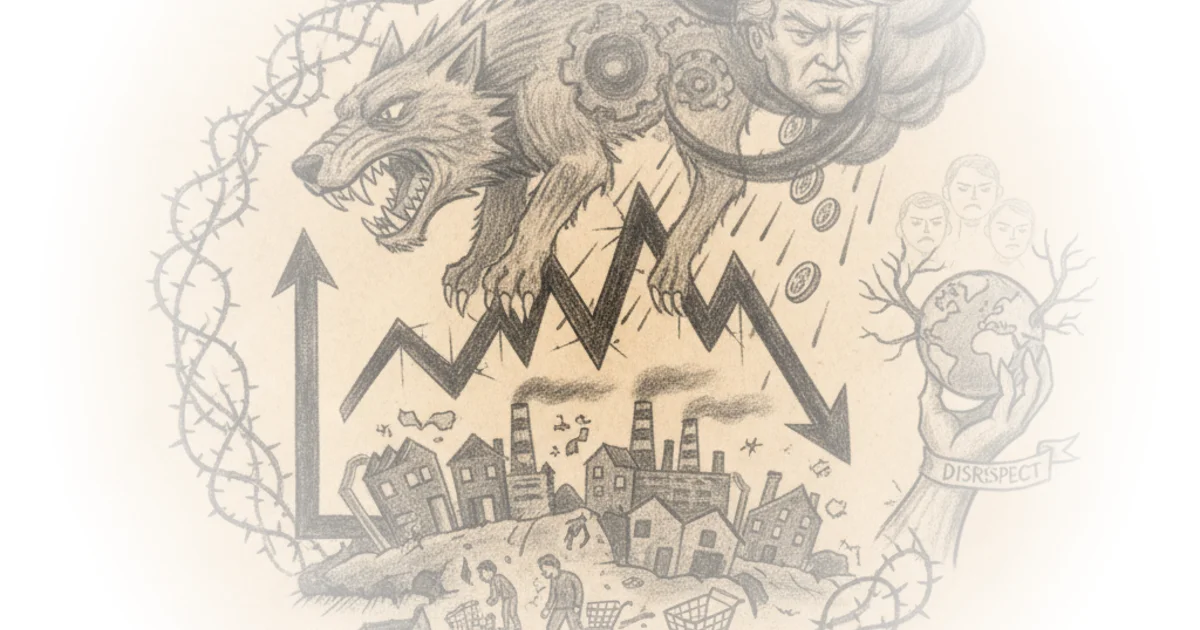
This piece cuts through the fog of cultural grievance to expose a stark economic reality: the current administration's project isn't just about changing values, it is actively engineering poverty while pretending it's a moral upgrade. Brad DeLong, channeling Noah Smith, argues that the attack on Gross Domestic Product is not a genuine critique of economics but a strategic maneuver to neutralize the most obvious objection to protectionism and nativism. For busy leaders trying to navigate the next decade, understanding that "making America poorer" is being sold as a path to spiritual renewal is critical—it reveals that the policy agenda prioritizes ideological purity over material stability for the middle class.
The Strategy of Poverty
DeLong frames Smith's analysis as an X-ray of a reactionary project rather than a standard economic debate. He writes, "The New Right... has mastered the denunciation of modernity—but has no idea of what might constitute a not-completely-unworkable destructive alternative." This distinction is vital; it suggests that the current political energy is driven by negation rather than construction. The argument posits that when policymakers attack GDP, they are often trying to justify policies like restricting trade and immigration that would inevitably shrink the economy.
"The single most important takeaway, in one phrase: making America poorer is not a social-conservative strategy for creating a better America."
DeLong highlights how Smith dismantles the moral high ground claimed by those who argue that economic metrics ignore community or family. The author points out the hypocrisy of blaming "creature comforts" for societal decay while ignoring historical data. He notes, "Richer societies are not, in practice, less communal or more spiritually empty; they are merely... modern." This reframing is powerful because it separates the measurement of wealth from the experience of well-being, a nuance often lost in political rhetoric.
However, critics might note that this defense of GDP can sometimes feel too defensive of the status quo, potentially overlooking how rapid industrial growth has indeed eroded certain local community structures. Yet, DeLong and Smith counter this by pointing to historical evidence where economic expansion coincided with social cohesion. They remind us that the 1950s, often romanticized as a golden age of family and faith, were also the period of the most robust GDP growth in American history.
"It was during this time that Americans got many of the 'creature comforts' that Vance despises—the single-family homes, the cars, the televisions, the lawns, and so on."
This historical parallel is striking. Just as the Family and Medical Leave Act of 1993 later codified a balance between work and family without destroying economic output, the mid-20th century proved that material abundance and strong families were not mutually exclusive. The argument suggests that trying to regress to a pre-modern economy will not magically restore lost social capital; it will likely just remove the resources needed to support families in the modern world.
The False Choice Between Spirit and Wallet
The commentary then turns to the specific policy implications, particularly regarding the opioid crisis and labor markets. DeLong emphasizes that Smith correctly identifies a logical flaw in the administration's narrative: they claim that economic abundance causes spiritual misery, yet ignore how economic despair fuels addiction. "Over-prescription of opioids has clearly reduced GDP, by a massive amount," DeLong writes, citing data that shows the epidemic cost the economy trillions.
This is where the argument gains its sharpest edge. The administration's focus on "spiritual elevation" often ignores the material conditions that make spiritual life possible. As DeLong puts it, "Wealth is not civilization, but it creates the elbow room and the collective societal power necessary for even the possibility of civilization." Without a functioning economy, the resources required to fund community centers, schools, and healthcare vanish, leaving the very institutions meant to foster connection in ruins.
"Economists, far from being the Vancean enemies of civilization he calls them, are the guardians of civilization's possibility."
The piece also touches on the "cargo cult" nature of some right-wing economic thinking—mimicking the rituals of protectionism without understanding the underlying mechanisms that generate prosperity. Just as cargo cults built fake runways hoping planes would land, proponents of this agenda build ideological barriers expecting a return to a mythical past. The reality is that closing borders and restricting trade tends to make nations smaller and poorer, not more spiritually pure.
"If you want to understand what the 'New Right' is really trying to do to American political economy, you could do much worse than to start with its surprisingly bitter little war on GDP it has launched."
This "war" is described as a distraction from the failure of current policies to make middle-class life affordable. By attacking the metric (GDP), they attempt to hide the fact that their policies are failing to deliver the prosperity they promise. The argument suggests that this is a deliberate strategy to reframe poverty as a virtue, making it politically palatable to accept lower living standards in exchange for a vague sense of moral superiority.
Bottom Line
The strongest element of this commentary is its ability to expose the economic consequences of cultural posturing, proving that "spiritual" arguments are often just cover for policies that reduce national wealth. Its greatest vulnerability lies in assuming that all critics of GDP are purely motivated by protectionism, potentially missing genuine concerns about how growth is distributed. Readers should watch whether this administration can deliver on its promises without the economic engine it claims to distrust; history suggests they cannot.