Niko McCarty transforms a 350-year-old biological mystery into a gripping narrative of molecular engineering, revealing that the microscopic world is not just teeming with life, but is a landscape of precision machinery. The piece's most striking claim is that these tiny motors are not merely biological curiosities but are evolutionarily tuned engines, some spinning faster than a jet turbine, solving the fundamental physics problem of locomotion in ways that dwarf human-made efficiency. This is essential reading for anyone who assumes the microscopic world is simple; McCarty proves it is a realm of complex, self-assembling robotics that predates our understanding of physics by centuries.
From "Little Paws" to Molecular Motors
McCarty begins by grounding the reader in the historical context, reminding us that the journey to understanding these machines started with a Dutch cloth merchant's curiosity. He writes, "Leeuwenhoek described these creatures in two letters he sent to the Royal Society in London for publication, each replete with charming descriptions: [T]he motion of most of these animalcules in the water was so swift, and so various upwards, downwards and round about that 'twas wonderful to see." This historical anchor is effective because it humanizes the scientific process, showing that the drive to understand the unseen is a timeless human impulse. However, McCarty quickly pivots to the gap between observation and mechanism, noting that while Leeuwenhoek saw the movement, he could not see the engine, musing that the creatures might be using "little paws" to move.
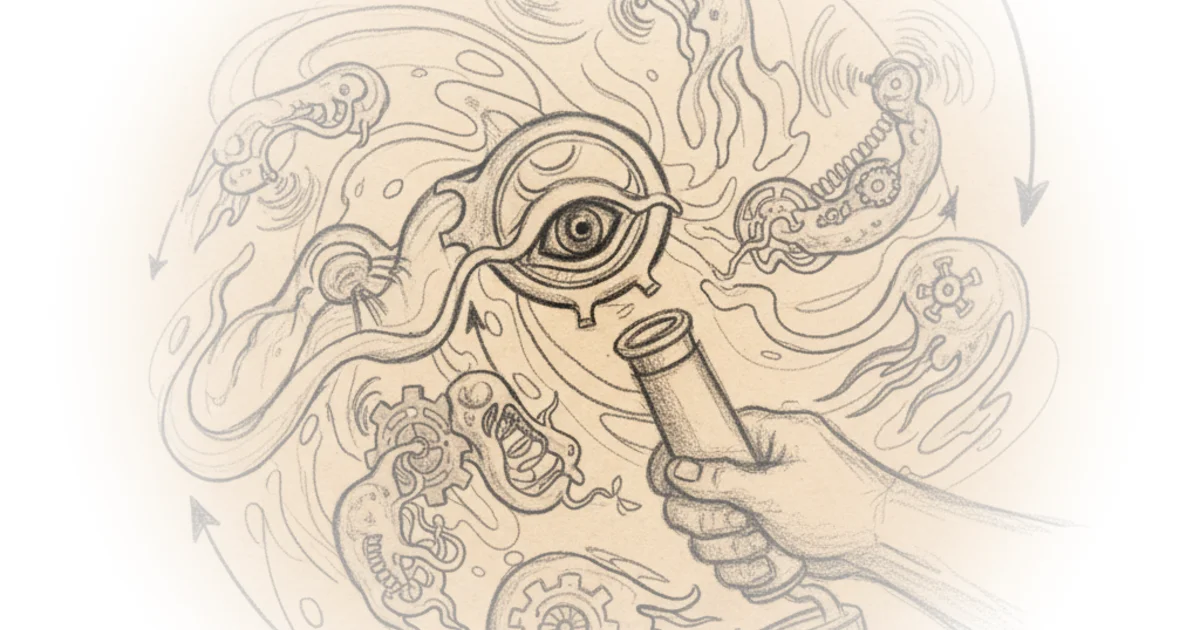
The author argues that the true breakthrough came not just from better lenses, but from the realization that these organisms are powered by proton gradients, not the ATP fuel we often assume powers all cellular activity. As McCarty puts it, "It was long believed that the flagellum spins by burning ATP, an energy-storage molecule abundant in cells. But in 1977, researchers in Colorado did a clever experiment that disproved this." This reframing is crucial; it shifts the reader's understanding of cellular energy from a simple battery model to a dynamic flow of ions. The evidence holds up well, particularly when McCarty highlights the staggering efficiency of these motors, stating, "It takes about 50 protons to power one revolution of a stator, with more than 90 percent of available energy being converted into mechanical work." This comparison to combustion engines, which lose most energy to heat, underscores the elegance of biological design.
It's as if the flagellum were built by vomiting forth parts of itself.
The Self-Assembling Machine
The commentary then delves into the structural complexity, where McCarty's writing shines by demystifying the assembly process. He explains that the flagellum is not a static object but a dynamic construction site where proteins are threaded through the cell and lock into place at the tip. "Every protein in the flagellum fits perfectly to its neighbors," he writes, emphasizing the precision required for this self-assembly. This section is particularly strong because it connects the microscopic to the macroscopic through relatable analogies, such as comparing the flagellum's length to the tails of grass lizards trailing behind them.
McCarty also weaves in a nod to the broader biological context, referencing the companion deep dive on the universal joint to explain the hook's function. He notes, "The next piece of the flagellum is the hook, a short, curved segment that functions like a universal joint." This connection adds depth without bogging down the narrative, reminding readers that nature often reinvents mechanical solutions found in human engineering. A counterargument worth considering is whether focusing so heavily on the mechanical analogy risks oversimplifying the biological regulation that controls when and how these motors are built. While McCarty touches on the genetic control, the primary focus remains on the structural mechanics, which might leave some readers wanting more on the regulatory biology.
Evolutionary Engineering in the Gut
The piece reaches its climax with a detailed look at Campylobacter jejuni, a pathogen that has evolved a high-torque motor to navigate the viscous environment of the human gut. McCarty writes, "One of the most striking variants, in my eyes, belongs to the microbe, Campylobacter jejuni, which uses its flagellum to drill through the viscous mucus of our intestines." This framing is powerful because it connects abstract molecular biology to a tangible human experience: food poisoning. The author details how researchers used cryo-electron microscopy to reveal that this bacterium has 17 stators compared to the 11 in E. coli, positioned further out to maximize leverage.
The argument here is that evolution is not a random process but a precise engineering challenge, with organisms adapting their molecular machinery to specific niches. "The end result of more engines, pushing from farther out, is three times the torque," McCarty explains, illustrating how nature optimizes for function over form. This evidence is compelling, supported by the recent structural biology revolution that allows us to see these adaptations in high resolution. However, critics might note that while the mechanical advantage is clear, the trade-offs of such high-torque motors—such as increased energy consumption or vulnerability to specific antibiotics—are not fully explored. The piece focuses on the triumph of the design rather than the potential vulnerabilities it creates.
Bottom Line
McCarty's greatest strength lies in his ability to make the invisible visible, transforming a dry structural biology paper into a story of evolutionary ingenuity and mechanical wonder. The piece's biggest vulnerability is its slight neglect of the clinical implications of these findings, which could be a missed opportunity for readers interested in medical applications. Ultimately, this is a masterclass in science communication, proving that the most complex molecular mechanisms can be understood through the lens of engineering and history.