This essay cuts through the noise of modern political theory by asking a question most ideologues refuse to face: how much of our political behavior is actually hard-wired, and how much is a choice? Cyril Hédoin doesn't just review a new book on evolutionary psychology; he dissects the dangerous seduction of using "human nature" as a shield against progress, while simultaneously warning that ignoring our biological roots leads to societal collapse. For a reader tired of utopian schemes that ignore reality and reactionary fatalism that denies change, this is a necessary recalibration of what politics can and cannot do.
The Limits of Design
Hédoin begins by stripping away the romanticism often attached to political theory. He defines politics not as a grand moral crusade, but as a technical, albeit messy, endeavor. "Politics should not coerce people in the name of progressive fantasies, nor in the name of an elusive human nature," he writes. This is a crucial distinction. The author argues that politics is essentially "the art of (re)designing society by choosing and altering the rules that justify coercive interferences with people's lives." It is a design problem, but one fraught with the risk of "hubris"—what the French call "la folie des grandeurs."
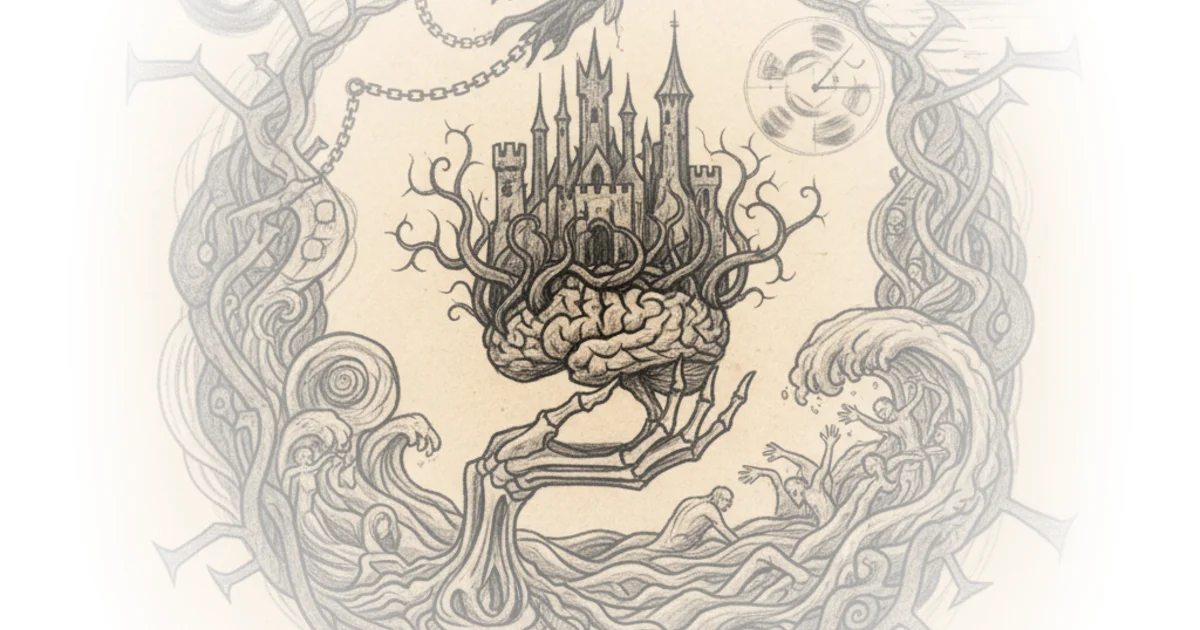
The piece gains its strength by acknowledging that humans are not blank slates. Hédoin notes that unlike other animals, humans possess a "highly developed capacity to plan," yet this very capacity creates a specific danger: "human politics forgets and turns against its naturalistic origins." He points to historical failures, such as the kibbutz system, as evidence that attempting to destroy institutions rooted in our evolutionary history—like the family or tribal loyalty—can lead to "dramatic decline in birth rates" and social disintegration. This framing is effective because it validates the intuition that some things are difficult to change without resorting to the claim that they are impossible to change.
Politics is not practiced in a biological and social vacuum. Political design must properly account for human motivations and provide the right incentives.
Critics might argue that this focus on constraints risks becoming a self-fulfilling prophecy, where leaders refuse to attempt necessary reforms simply because they fear biological pushback. However, Hédoin is careful to distinguish between what is difficult and what is impossible, urging a "realist approach" rather than a defeatist one.
The Trap of Evoconservatism
The essay takes a sharp turn when it addresses the intellectual trend known as "evoconservatism," championed by figures like Nicholas Wade, Jonathan Haidt, and Eric Posner. Hédoin identifies the core of their argument: that morality evolved in a specific ancient environment (the "environment of evolutionary adaptation") and is therefore inherently "exclusivist," favoring kin and tribe over strangers. He summarizes their logic: "attempts to make morality more 'inclusive' by extending its authority beyond the circle of genetic and, eventually, cultural relatives are doomed to failure."
Hédoin dismantles this by exposing the slide from empirical observation to normative conjecture. He agrees that our ancestors evolved in small groups, but he rejects the idea that this makes inclusivity "artificially engineered" and unsustainable. "The scientific state of the art suggests that humans have evolved a high level of cognitive plasticity that allows them to 'switch' from one form of morality to another depending on environmental cues," he writes. This is the piece's most vital intervention. It suggests that our moral circle isn't a fixed genetic cage, but a flexible response to our surroundings.
He introduces a compelling economic metaphor to explain why inclusivity often fails in practice, not because of biology, but because of scarcity. "Inclusivist morality is a luxury good," Hédoin argues, noting that people are only inclined to extend moral concern beyond their immediate kin "when they feel safe and have their basic needs satisfied." This reframes the debate from a battle of nature versus nurture to a question of socioeconomic conditions. When resources are scarce, competition rises, and the "inner/outer group distinction" hardens. When security is high, the capacity for broader morality expands.
The main point of contention between evoconservatives and 'evoprogressives' is about the actual degree of cognitive plasticity, something that can be empirically assessed.
A counterargument worth considering is whether this "luxury good" theory places too much faith in economic growth as a prerequisite for moral progress. It risks implying that the poor are naturally more tribal, a claim that could be used to justify neglecting the marginalized rather than empowering them. Yet, Hédoin's point remains that political design must account for these incentives; you cannot simply legislate away the fear that drives tribalism.
The Danger of Certainty
The final section of the essay serves as a warning against the very certainty that evoconservatives claim to possess. Hédoin reminds us that our understanding of "human nature" is limited and subject to revision. He warns that "arguments from evolution always run the risk of essentializing features of the natural and social world and of creating a false sense of immutability and certainty." History is littered with the wreckage of such certainties, from racial hierarchies to eugenics.
He quotes Raymond Aron to drive home the need for skepticism: "[i]f tolerance is the daughter of doubt, we should teach people to doubt models and utopias, and to reject prophets of salvation and disasters." This is a call for intellectual humility. Whether the claim comes from the right (that we are naturally tribal) or the left (that we can be perfectly rational), Hédoin insists that "politics turns into a secular religion, where nature is substituted for God" when we stop questioning our assumptions.
The author concludes with a pragmatic heuristic: keep the stakes of politics low. "The more politics touches existential aspects of our lives, the more we may expect disagreement and conflicts," he observes. The solution is not to abandon politics, but to make it "polycentric" and limit the power of any single design to impose its will on the whole. Politics should be about managing conflict, not solving the human condition.
Politics should not coerce people in the name of progressive fantasies, nor in the name of an elusive human nature.
Bottom Line
Hédoin's strongest contribution is his rejection of the false choice between biological determinism and radical social engineering; he offers a third path where politics is constrained by reality but empowered by our capacity for change. The argument's biggest vulnerability lies in the practical difficulty of creating the "safe" conditions required for inclusivity to flourish without already having a functional political system in place. Readers should watch for how this "luxury good" framework is applied to current crises, as it offers a powerful lens for understanding why moral appeals often fail in times of economic distress.