Anne Helen Petersen reframes the viral trend of lavishly decorated college dorm rooms not as a simple case of consumerist excess, but as a symptom of a deeper, more anxious shift in how families navigate the transition to adulthood. While the internet is quick to mock the monogrammed signs and velvet throw pillows, Petersen argues that these elaborate spaces reveal a fundamental change in the parent-child contract, one where independence is no longer the primary metric of success.
The Aesthetic of Control
Petersen begins by acknowledging the sheer scale of the phenomenon, noting that what was once dismissed as influencer content has become a mainstream parental project. She writes, "I had no idea how pervasive this trend had become until last summer... Suddenly all kinds of dorm room groups with names like 'Dorm Room Mamas' started popping up." This observation is crucial because it moves the conversation away from isolated incidents of wealthy parents to a broad cultural movement. The evidence she presents—Facebook groups filled with mood boards, matching bedding, and storage solutions—suggests a collective effort to curate a child's environment with a level of precision previously reserved for luxury hotels.
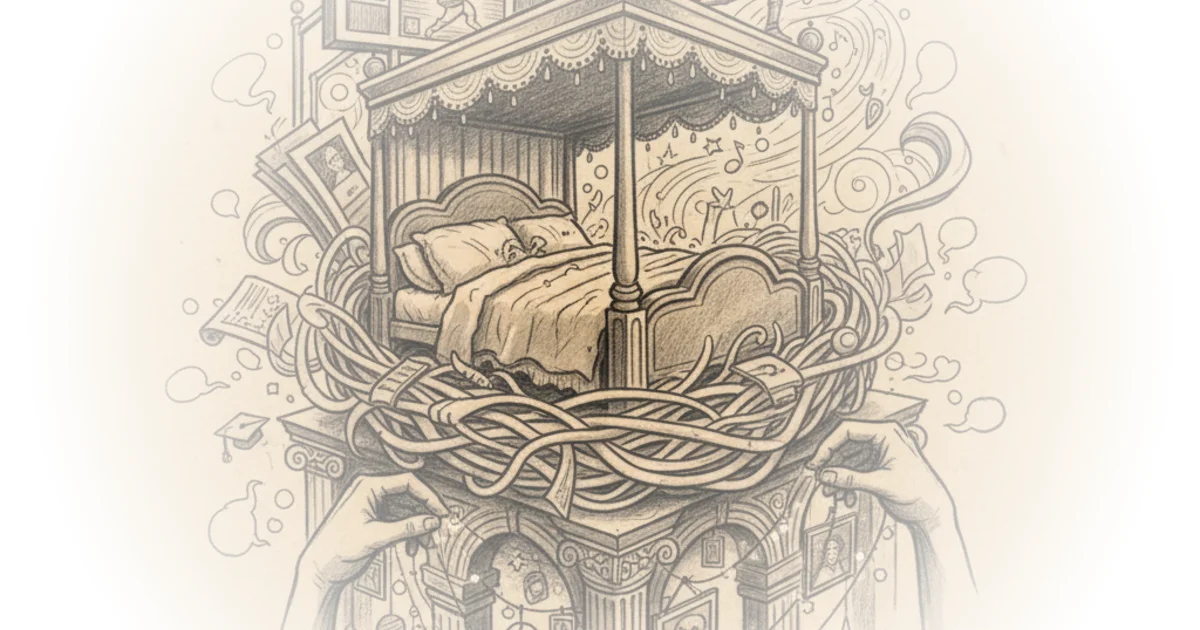
The author contrasts this with her own experience in 1995, describing a room filled with "odds and ends we'd thrifted, foraged from our family basements, and made ourselves." She argues that the modern dorm room, by contrast, lacks the "scrappy, 'I'm figuring out who I am as I go' sensibility" that defined her generation. This framing is effective because it highlights the loss of a specific type of agency. When every surface is covered in matching wallpaper and every item is purchased rather than scavenged, the student's ability to imprint their identity on their space is diminished before they even arrive.
"Our dorm room was our first grown-up, semi-independent space and we truly made it our own, in all its mismatched, low-budget glory."
Critics might argue that Petersen romanticizes the struggle of the past, ignoring that modern students face higher stress levels and that a comfortable environment could be a necessary buffer against mental health crises. However, Petersen anticipates this by distinguishing between providing comfort and providing a curated aesthetic. She notes that while parents are right to care about their children's well-being, the current trend often conflates material abundance with emotional security.
The Anxiety of Letting Go
The core of Petersen's argument lies in the psychological drivers behind these makeovers. She suggests that the obsession with dorm decor is a proxy for the intense anxieties parents feel about their children's safety, social standing, and future success. "I think what struck me is how invested and concerned today's parents are not just about their kids' safety... but also their material comfort, to which I think my parents devoted almost zero brain cells," she writes. This shift from basic safety to hyper-specific comfort reflects a broader cultural trend where parents feel responsible for managing every variable in their children's lives.
Petersen points out that this dynamic is often invisible to the parents themselves. "None of us want to believe we're the helicopter parents, but we've been so entrenched in an intensive parenting culture, we don't even recognize that we're doing it at times." This self-awareness is the piece's most powerful element. It challenges the reader to look past the judgment of "rich parents" and recognize that the impulse to control the environment is a universal reaction to the fear of the unknown. The dorm room becomes a stage where parents perform their continued relevance and control.
Furthermore, the author questions the definition of independence that has long been the gold standard of American parenting. She observes that many parents take pride in dropping their children off with minimal contact, viewing it as a sign of successful detachment. "It's all very 'I walked two miles to school, uphill both ways, through knee-deep snow,'" she notes, capturing the performative nature of this "tough love" approach. Petersen suggests that this rigid adherence to independence might actually be counterproductive, arguing that "maybe it's not such a bad thing for our young adult children to depend on us a bit."
The Slippery Slope of Care
Petersen traces the trajectory from practical care to over-involvement, asking readers to consider where the line is drawn. She poses a series of escalating questions: "is making sure our kids have a roll of paper towels and a trash can to toss them in helicopter parenting? No? Well, what about if we add in a cozy throw blanket... and a new set of towels?" This rhetorical device effectively illustrates the "slippery slope" without resorting to alarmism. It forces the reader to confront the fact that the line between caring and controlling is often blurred by good intentions.
The author also touches on the role of the institutions themselves. She notes that modern residence halls are often nicer than the apartments her generation lived in, featuring movie rooms and game spaces. Yet, she argues, "our kids grew up in a culture where it's not enough to have nice shared spaces to use and enjoy; we've also helped them feel entitled to a lot of personal comfort in their own, private spaces." This insight adds a layer of institutional critique, suggesting that universities have inadvertently fueled this trend by creating environments that compete with the home, prompting parents to try to outdo the institution with even more personalized luxury.
"We need to lead the way on creating a new path, a new set of expectations."
Petersen concludes by calling for a reimagining of the parent-child relationship in young adulthood. She advocates for a model where dependence is not stigmatized and where parents learn to "step back into our lives." This is a difficult pivot, as it requires parents to relinquish the role of project manager for their children's lives. The argument is compelling because it offers a path forward that acknowledges the validity of parental love while challenging the methods of its expression.
Bottom Line
Petersen's analysis succeeds by moving beyond the surface-level mockery of expensive dorm rooms to expose the deep-seated anxieties driving the trend. Her strongest point is the identification of the "slippery slope" from practical care to over-involvement, which resonates with any parent navigating the transition to adulthood. The argument's vulnerability lies in its potential to overlook the genuine mental health benefits of a supportive environment for some students, but her call for a balanced approach to independence and connection remains a necessary corrective to the current culture of intensive parenting.