Adam Tooze reframes the current global trade crisis not as a simple case of unfair Chinese subsidies, but as a collision between two export-driven economic models—a phenomenon he terms "mercantilist-on-mercantilist violence." This piece is essential because it moves beyond the familiar rhetoric of currency manipulation to expose a deeper structural rot in European industry: an over-reliance on shareholder payouts rather than reinvestment. For busy leaders watching their own margins compress, Tooze offers a startling diagnosis that shifts the blame from Beijing's policy choices to Berlin's corporate complacency.
The Laughter That Changed Everything
Tooze opens with a vivid scene from Premier Li Qiang's address at the Summer Davos in Dalian, where an unusual sound broke the rigid silence of the hall. "For the Premier’s speech the venue is always packed... You can hear a pin drop. What you don’t expect, is laughter." This moment was not mere humor; it was a calculated diplomatic signal. The Premier quipped that China is "too poor" to pay the massive subsidies often attributed to its export dominance, a line that "conveyed a rather different message than that offered by the official text."
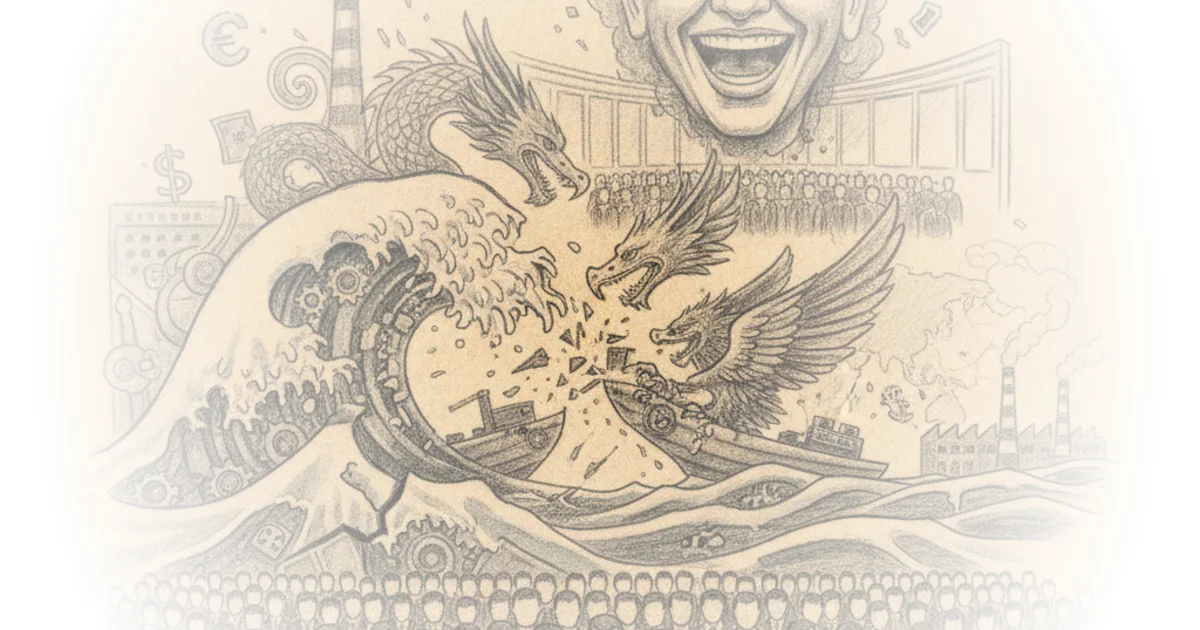
By highlighting this ad-libbed laughter, Tooze effectively dismantles the assumption that Beijing's success is solely bought with cash. He argues that while subsidies exist, the real engine is the relentless energy of Chinese entrepreneurs and engineering teams. This framing forces Western observers to confront a harder truth: the competition is not just about government checks, but about industrial execution.
"China shock 2.0 has apparently made a deep impression not just in Beijing, but also in Berlin... The shift in China’s trade balance with Europe is truly dramatic."
The author notes that while the first "China Shock" of the early 2000s was about low-wage manufacturing overwhelming Western competitors, the current iteration is different. It targets high-value sectors, specifically automobiles and green energy. Tooze points out that sixty percent of the $27 billion swing in Germany's trade balance with China between 2021 and 2025 is accounted for by vehicles alone.
Critics might argue that dismissing the role of currency undervaluation entirely ignores significant macroeconomic data, but Tooze counters this by citing evidence that Chinese export unit values are rising alongside those of Japan and South Korea. The surge, he suggests, is driven by demand for green energy goods and chemical production gaps caused by Europe's high gas prices, rather than simple price dumping.
Mercantilist-on-Mercantilist Violence
The core of Tooze's argument rests on a provocative classification: this is not a developing nation undercutting an industrial giant; it is two surplus economies clashing. "China shock 2.0 is mercantilist-on-mercantilist violence," he writes, noting that while Europe loses to China, its manufacturing trade surplus with the rest of the world remains at historic highs.
This distinction is crucial because it invalidates standard macroeconomic fixes. In a textbook scenario, a massive trade surplus should lead to currency appreciation, which naturally dampens exports and restores balance. However, Tooze explains that in China, "the proceeds from huge trade surpluses are absorbed into official and quasi-official reserve accumulation," preventing the yuan from appreciating.
Furthermore, he highlights a dangerous divergence in price levels. Since 2021, Western prices have risen while Chinese prices hover on the edge of deflation. Because the exchange rate does not compensate for this relative price movement, "the effect is a real depreciation. Chinese goods are even more competitive as a result." This creates a structural trap where standard monetary policy cannot easily correct the imbalance without risking capital flight or deepening domestic deflation in China.
"As Tordoir and Setser put it, complacency is, indeed, the besetting sin of European and particularly German industrial policy."
Tooze turns the lens back on Europe, specifically Germany's automotive sector. He contrasts Beijing's strategic reinvestment with the behavior of Germany's big three automakers, who, despite record profits, prioritized dividends over innovation. In 2023 alone, these firms paid out 31 billion euros to shareholders as Chinese electric vehicles began their market assault.
The author suggests that if Europe wants to survive this shock, it must demand more from its own industries. "Should there not be a requirement set for minimum investment levels? European industry needs saving from itself." This is a sharp critique of the corporate governance model that prioritizes short-term returns over long-term industrial resilience.
The Historical Echoes
To contextualize the stakes, Tooze draws a parallel to the Russo-Japanese War of 1904. He describes the battle at Port Arthur as "arguably the first modern battle of the 20th century," where Japan employed massive howitzers and machine guns to defeat a European power.
This historical reference serves a dual purpose. First, it underscores the violence inherent in industrial displacement. Second, it connects the current economic shock to the rise of Chinese nationalism. The victory of a rising Asian challenger over an established empire "delivered a shock that also helped to trigger the upsurge of modern Chinese nationalism," a sentiment that echoes through Premier Li's feisty address today.
The author warns that doing nothing is not an option. "Spectacular and uncontrolled deindustrialization must count as a serious economic, social and political risk in Europe." However, he also cautions against a knee-jerk protectionist response that could compound global disorder. The solution requires a "judicious combination of protection, incentives and discipline" to shield European industry from both Chinese policy and its own technological short-sightedness.
"If the EU is going to use government policy to shield the industry... is it acceptable for the European car industry to be still paying out ample dividends?"
Tooze acknowledges that while trade defenses are necessary, they must be paired with internal reforms. He notes that Michael Pettis remains skeptical that China will rebalance its economy soon, as industrial development is an end in itself and a critical source of employment for tens of millions of workers.
Bottom Line
Adam Tooze's strongest contribution here is his refusal to let Europe off the hook; he convincingly argues that "China Shock 2.0" exposes a fatal flaw in Western corporate governance as much as it does in Chinese trade policy. The argument's vulnerability lies in its reliance on complex macroeconomic adjustments that may be politically impossible for Beijing to enact, leaving Europe with few good options other than painful industrial restructuring. Readers should watch how the European Union balances the need for immediate protectionism with the long-term necessity of forcing its own champions to innovate.