Dan Carlin has a way of making the vastness of history feel intimate. In this episode, he's announcing his latest project — a deep dive into the Eurasian steppes — and it's clear he's not just informing listeners, he's inviting them into a world they've likely never considered. The title alone, "More Steppe Stories," suggests this isn't a one-off but rather an ongoing exploration of peoples who shaped civilization in ways that most Western histories overlook.
A Newsletter and a History Lesson
Carlin opens with practical matters: a new newsletter via Substack, free email updates for those who want them. He frames the choice simply — bookmark the page if you prefer, join the hardcore if you don't. It's characteristic of how he treats his audience: respectful, non-demanding, offering value without gatekeeping. The language is casual, almost conversational, which makes the historical content feel like a friend sharing something they've just learned rather than an academic lecturing.
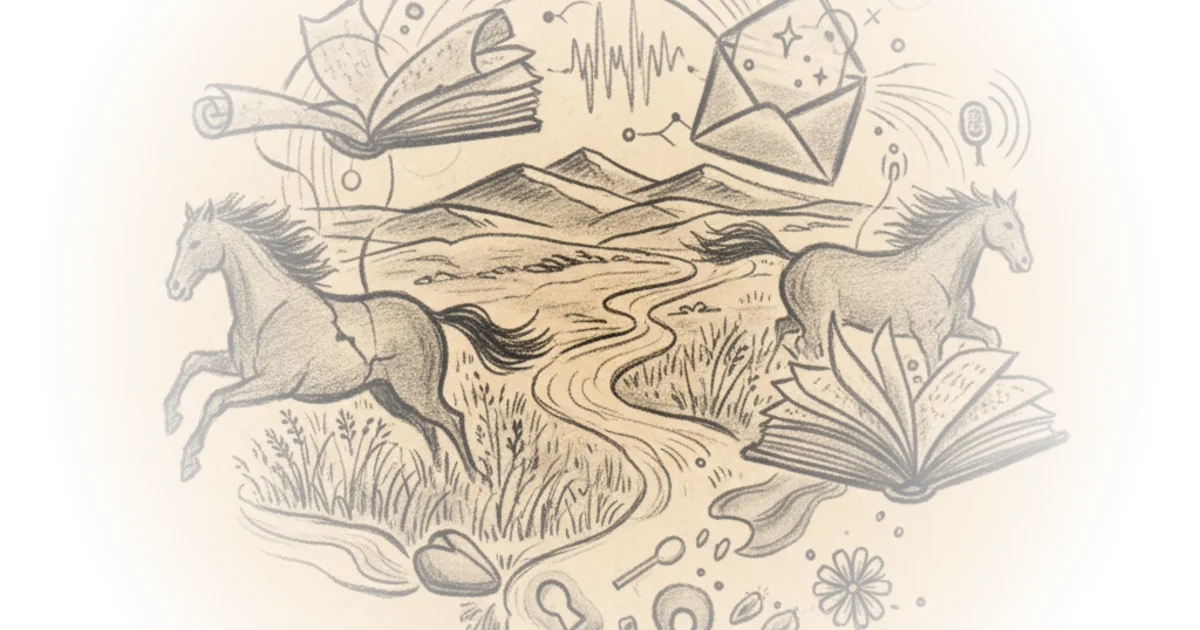
The real hook comes when he pivots to geography. "The Eurasian steppe," he says, "is a geographical feature and it's not the same it changes over the length and breadth of the distances involved." This is the kind of observation that makes listeners stop scrolling. The steppe isn't one plain — it's a sweeping band from Central Europe to the borders of China, touching Manchuria, Northern India, Northern Iran. Carlin names the peoples: Mongols, Turks, Huns, Scythians. The list goes on. These aren't just historical footnotes; they're groups that "have been involved in human history and important events from the get-go."
these people are extremely able and clever and learn rapidly uh what is necessary to survive
This is where Carlin earns his audience's attention. He's not performing expertise for experts — he's building a bridge for people who might have never thought about what made these nomads formidable: growing up on horses, composite bows that wouldn't be matched until gunpowder became commonplace.
The Guest and the Scholarship
Carlin then introduces Professor Kenneth Wharle from Tulane, whose book "Empires of the Step" just released. The interview format works well here — Carlin plays the informed questioner, Harle the expert. He asks about changes in scholarship over "the last three four five decades." The answer reveals something important: archaeology, DNA testing, isotope evidence have transformed what we know.
Carlin paraphrases his own enthusiasm: "I am absolutely overwhelmed by the comprehensiveness of your work I mean the number the number of books that I have that key where everything seems to be in darkness in most of the other." The phrasing is imperfect — he stumbles slightly on "key" and repeats himself — but it captures something genuine about how much has changed. Most histories had little data points scattered across time; now, there's a comprehensive picture.
Harle responds with specifics: Basin mummies proving Indo-European occupation at early dates, inscriptions in Afghanistan revealing Cushon Kings' genealogy, ancient coins clarifying who issued what. The scholarship isn't just filling gaps — it's rewriting the narrative entirely.
Geography as Destiny
The conversation shifts to geography and environment, which is where Carlin's storytelling shines brightest. He asks for a "touchstone point that we can all relate to" — and then makes an analogy to the American Great Plains. The comparison works because it translates unfamiliar Eurasian vastness into something Americans know: mustangs, prairie, the way horses transformed lives.
Carlin describes dividing the steppe into three zones: Western (Volga River to Ural), Central (Kazakhstan, "almost as large as Western Europe"), and Eastern (Mongolian grasslands bounded by Gobi desert). This isn't just geography — it's explanation. He's making sense of a region that most listeners have never considered as a coherent unit.
The climate is crucial. He quotes reports from travelers: Pope's Envoy traveling to the Mongol court had to sleep under his cart in summer because "there's no shade in the high Summer and the temperature can get absolutely brutal." In winter, extreme cold required survival strategies that made hospitality and one's word in transactions essential. IBN Fadlan's account of the Vikings on the Volga describes how these people huddled together through brutal months.
it's a vast region and it's bound to the north by the Taiga the Siberian forest sounds beyond the the tundra the Frozen area to the South you'll encounter various deserts
The Weapon System That Changed Everything
What makes this episode compelling is Carlin's focus on technology. Between four thousand and three thousand BC, people on the steppe learned they could "exploit the grasslands to sustain great herds" — sheep, goats, cows. But it was horse domestication that proved decisive: "that became the Beast of Burden it could be a source of winter meat if necessary and it also became the prime animal used in war."
The composite bow emerges as the real innovation. Once mounted warriors had these bows, they became "absolutely formidable foes." The weapon system wasn't solvable until gunpowder — which meant centuries of dominance that reshaped how settled civilizations related to their nomadic neighbors.
Critics might note that framing nomads primarily through military prowess risks oversimplifying. There's more to these peoples than conquest — art, religion, trade networks, diplomatic traditions all shaped their histories. But Carlin's focus on weapons and survival is effective because it makes the unfamiliar concrete.
The Harshness of Survival
Carlin closes with perhaps his most quotable observation: "there always was scattered agriculture in some of the river valleys" but primarily "the products of their animals it would be skins first dairy products meat which was most valuable." This isn't just economic history — it's survival analysis. The steppe wasn't empty; it was demanding.
The environment bred a population that could endure extremes. His conclusion is stark: "no weaklings survive in this environment all adult males who are free are both hunters and Warriors." It's the kind of statement that makes listeners reconsider what civilization means — not just different peoples, but different ways of living that required different kinds of strength.
Bottom Line
This episode works because Carlin translates genuine expertise into accessible storytelling. His strongest move is connecting geography to survival — showing how environment shaped technology (composite bows) and social structures (warriors). The biggest vulnerability is scope: covering the entire Eurasian steppe in one interview risks flattening distinct cultures into a single narrative. But for listeners wanting entry points into a region that shaped global history, this episode delivers. Watch for Carlin's next deep dive — he's clearly just getting started with these "Steppe Stories."