A White House Chief of Staff breaking her silence to reveal the inner workings of the executive branch is rare; doing so to describe the President's personality as that of an alcoholic and the administration's foreign policy as a reckless gamble for regime change is unprecedented. Jay Kuo dissects this explosive revelation from Susie Wiles, arguing that her candid Vanity Fair interview exposes a chaotic, unguarded administration where policy is driven by impulse rather than strategy.
The Unguarded Guardian
Kuo frames Wiles's interview not as a moment of transparency, but as a catastrophic breach of the traditional "gatekeeper" role that Chief of Staffs are expected to play. Historically, figures like John Kelly in the first term attempted to limit access to the President to curb his worst impulses. Kuo notes that in this new iteration, "Wiles doesn't even try. She lets bad elements like Musk, Vought and Bondi straight through, hands them the keys and effectively says 'have at it.'" This observation strikes at the heart of institutional decay: the person tasked with protecting the office has instead become the primary enabler of its dismantling.
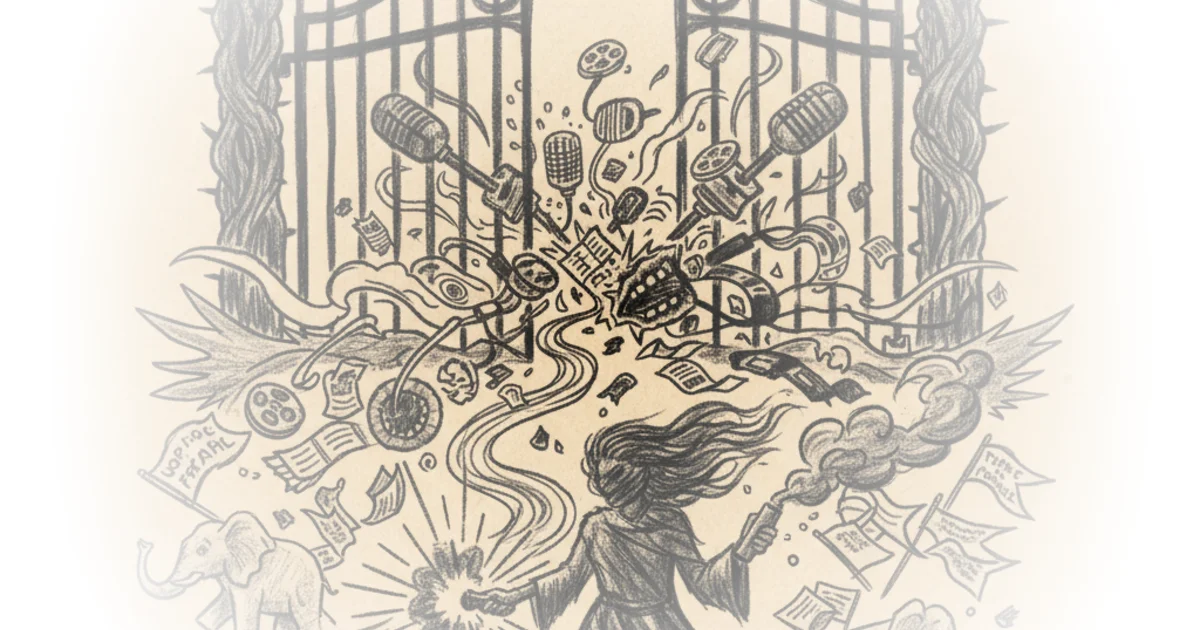
The author highlights the dissonance between Wiles's public defense of the administration and her private admissions. While she later called the article a "disingenuously framed hit piece," Kuo points out the irony that she "admits what she actually said on tape" while claiming context was missing. The piece suggests that the panic within the White House is genuine, with one ally noting the article appeared in "every group chat," leaving staff "shocked and confused." This reaction underscores a fundamental lack of control; the administration is not just facing external criticism, but internal disarray.
"In Trump 2.0, Wiles doesn't even try. She lets bad elements like Musk, Vought and Bondi straight through, hands them the keys and effectively says 'have at it.'"
Critics might argue that Wiles's comments are merely political maneuvering to distance herself from unpopular policies, yet the specificity of her claims—from the Ketamine use of advisors to the specific legal risks of military action—suggests a depth of insider knowledge that goes beyond standard deflection.
The Human Cost of Impulse
Perhaps the most gravity-laden section of Kuo's commentary concerns the administration's approach to foreign policy and the destruction of the United States Agency for International Development (USAID). Kuo does not shy away from the consequences of these actions, noting that Wiles herself was "aghast" at the destruction of USAID, which "directly killed hundreds of thousands of desperate aid recipients and will likely kill millions more." This is not abstract policy; it is a humanitarian catastrophe driven by the philosophy of "all throttle, no brake."
The author details how Wiles realized the scale of the disaster only after immunizations were halted in Africa, leading to frantic calls from relief agencies. Despite this, the administration's drive for speed over due process prevailed. Kuo writes, "Elon's attitude is you have to get it done fast. If you're an incrementalist, you just won't get your rocket to the moon... But no rational person could think the USAID process was a good one. Nobody." This quote encapsulates the dangerous ideology at play: the belief that established safeguards are merely obstacles to be bulldozed, regardless of the human toll.
Furthermore, Kuo exposes the administration's true intentions in Venezuela. While the official narrative focuses on drug interdiction, Wiles confessed that the goal is regime change. "He wants to keep on blowing boats up until Maduro cries uncle," Wiles said. Kuo emphasizes the legal and ethical peril here, noting Wiles's admission that land strikes would require Congressional authority—a constraint the executive branch seems eager to ignore. This reframes the military action not as a tactical victory, but as a potential war crime driven by a leader who believes "there's nothing he can't do."
The Erosion of Norms
Beyond foreign policy, Kuo explores the internal rot of the administration's adherence to democratic norms. The commentary details Wiles's failed attempts to stop the blanket pardons for January 6 defendants, including those who committed violence. "Trump ignored her and pardoned every one of them," Kuo writes, illustrating a system where the rule of law is subservient to personal loyalty and political vengeance.
The author also touches on the administration's relationship with the "unitary executive" theory, a legal doctrine championed by Russ Vought to consolidate power in the presidency. Kuo notes that Vought, a "right-wing zealot" and author of Project 2025, is now in a position to "strangle research and science through the illegal impoundment of billions in appropriated congressional funds." The connection to the historical context of the unitary executive theory is vital here; it is not just a legal argument but a blueprint for dismantling the checks and balances that have long defined the American system.
Wiles's assessment of Vice President JD Vance as a "conspiracy theorist" for a decade further erodes the image of a unified, rational leadership. Kuo points out the absurdity of Vance's response: "Sometimes I am a conspiracy theorist, but I only believe in the conspiracy theories that are true." This exchange, Kuo argues, reveals a leadership team that has lost touch with reality, operating in a world where facts are optional and loyalty is the only currency.
"The president was wrong about that."
This simple admission by Wiles regarding the Epstein files and the false claims about Bill Clinton serves as a microcosm of the administration's broader relationship with truth. Kuo suggests that when the Chief of Staff admits the President is lying about the very files his base cares about, it signals a complete breakdown in the integrity of the office.
Bottom Line
Jay Kuo's commentary succeeds in stripping away the political theater to reveal a White House operating without a brake pedal, where the human cost of policy is an afterthought to the whims of the leader. The strongest part of the argument is the unflinching documentation of how the administration's internal chaos translates into real-world suffering, from halted vaccines in Africa to the threat of war in Venezuela. Its biggest vulnerability lies in the assumption that these revelations will lead to accountability; as Kuo notes, Wiles's strategy may simply be to be a "bystander witness" to the collapse, insulating herself while the regime burns. Readers should watch for how the administration attempts to reframe these admissions as isolated incidents rather than the systemic reality they appear to be.