Wes Cecil's conclusion to this lecture series makes a counterintuitive argument: the institutions we trust to support the arts—government funding, private donors, big systems—are dramatically overemphasized. "The historical evidence for this is very poor at best," he says, pointing to Nazi Germany and Stalinist Russia, where massive spending on art produced more destruction than creation. This is one of those arguments that makes you sit up and think: perhaps the conventional wisdom about arts funding is backwards.
Cecil's core thesis centers on what he calls the individual measure. Drawing from Friedrich Nietzsche, he argues we must be "our own weight, wear and scale" when determining whether art matters. "We are the one that puts it on the scale against the weight," he writes, "and we're the scale we're the thing that we use to measure it by." This is a re-articulation of Socrates' notion that man is the measure of all things—but applied specifically to how we evaluate artistic value. The art doesn't matter historically or to the elite or to the press; it has to matter to us as individuals. If it doesn't, there's a problem.
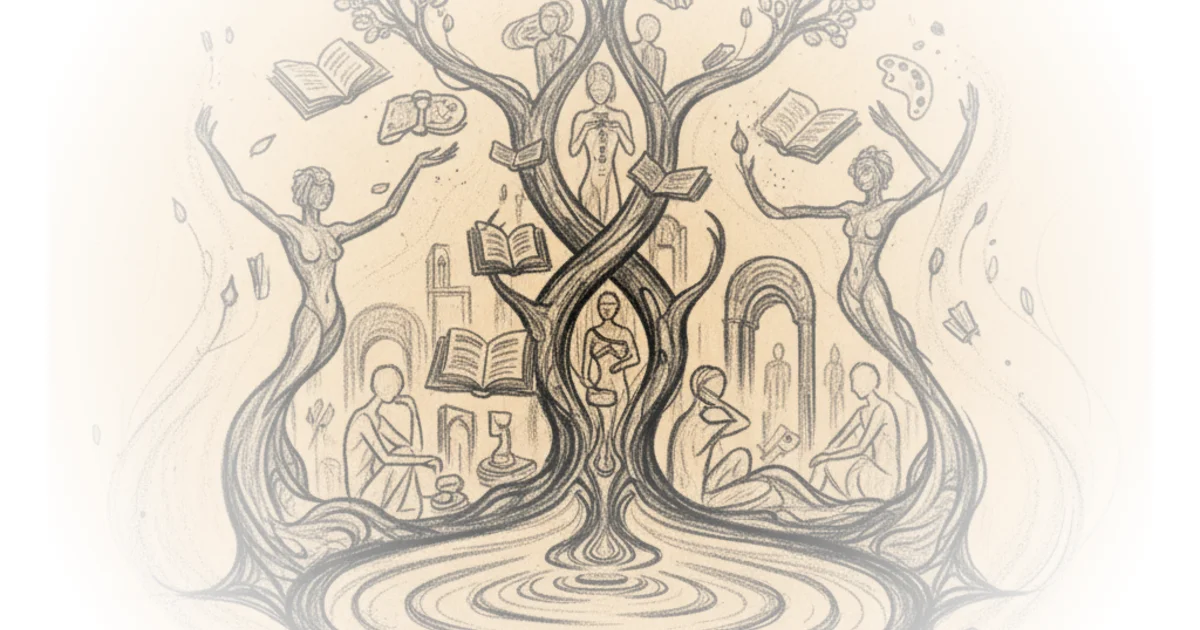
This lands hard because it inverts what we've been taught about arts support. We assume that without institutional backing—government grants, publishing houses, professional galleries—we can't have meaningful art. Cecil suggests the opposite: those institutions actually work against individual expression, structurally discouraging the very thing they claim to support.
"We must be our own weight weer and scale"
The Lost Garden
The most evocative example Cecil deploys is gardening—specifically, the Persian Paradise Gardens that once transformed portions of Isfahan into what he describes as "Paradise on Earth." These weren't merely decorative. They were "populated with scent and food," featuring "shaded spaces with beautifully scented flowers, all the food fresh fruit you can eat" and water. This was art: living, seasonal, changing, impossible to finalize.
Cecil argues this is precisely why gardening exited as an art form. "A garden is never finished—plants grow, they die, it changes in the seasons," he observes. "The notion that something that art a product must be the outcome—this is impossible because it never stops." We now demand fixed products we can distribute and market and sell. Gardens don't meet those criteria, so we've stopped counting them as art.
This critique extends to how we teach music and visual arts. Cecil describes students working backwards from the concert they'll perform in twelve weeks—finding a piece that fits their skill level, not their passion. "It doesn't have anything to do with how much the student loves the music," he says. "It's just this fits." The process of creation is supposed to be what we enjoy; instead we've made it about the product.
Critics might note that this framing romanticizes a pre-modern artistic world and underestimates how contemporary artists actually navigate these tensions. An author in one of Cecil's classes described exactly this dilemma—working within what her editor allows, not what she wants to write—and there's something honest in that tension. But Cecil would say that's precisely the problem: we've normalized measuring up to external standards rather than internal ones.
The Purpose of Art
The strongest section is his historical analysis of what art was supposed to do. "For most of the history of what we call the Humane Arts, this was precisely the purpose," he says. "The purpose of the Arts was to help create in us and in our environment an Earthly Paradise." An Italian writer he cites described the goal as creating people who are themselves cathedrals—carrying the greatness of artistic heritage everywhere they go, transforming spaces through their presence.
This vision is gone. The function of art now is "to entertain, Enlighten, enrich, sell for money"—and we've lost something in that shift. Cecil isn't arguing we should build grand architecture again; he's suggesting we've forgotten why gardens mattered: because they were lived in, inhabited, seasonal, and alive.
Bottom Line
Cecil's strongest move is reconnecting art to the individual measure—what matters to you, personally, rather than what institutions declare. His weakest point is offering little guidance on how anyone should actually resist working backwards from the product in a world that demands measurable outcomes. The tension between personal meaning and institutional validation remains unresolved—which might be exactly where his audience needed to sit with the discomfort.
The Paradise Garden argument is gorgeous but historical; the real challenge is applying it now.