In a year defined by an overwhelming flood of technical white papers, Sebastian Raschka offers a rare moment of clarity: a curated, human-filtered roadmap through the noise of 2024's artificial intelligence research. Rather than merely listing titles, Raschka provides a window into the specific architectural shifts—from state space models to mixture-of-experts—that are redefining what large language models can actually do. This is not a passive bibliography; it is a strategic signal for engineers and strategists trying to distinguish between marketing hype and genuine capability gains.
The Shift from Scale to Efficiency
Raschka frames the year not by the sheer size of models, but by the ingenuity of making them smaller, faster, and more specialized. He writes, "Blending Is All You Need: Cheaper, Better Alternative to Trillion-Parameters LLM," highlighting a pivotal moment where the industry begins to question the necessity of massive, monolithic architectures. This observation is critical because it suggests the era of brute-force scaling may be hitting diminishing returns, forcing researchers to innovate on efficiency instead. The inclusion of papers like "MambaByte: Token-free Selective State Space Model" and "Griffin: Mixing Gated Linear Recurrences with Local Attention" underscores a decisive pivot toward architectures that handle long contexts without the prohibitive computational cost of traditional transformers.
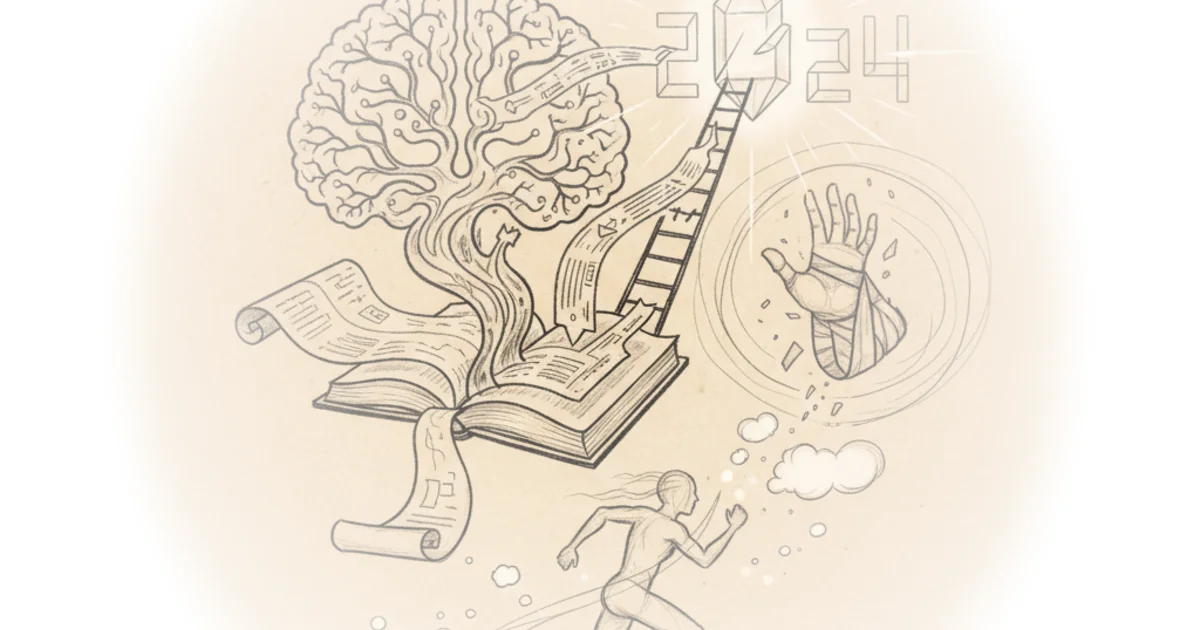
The author's selection of "Self-Rewarding Language Models" and "Self-Play Fine-Tuning Converts Weak Language Models to Strong Language Models" points to a deeper philosophical shift: the move away from relying solely on human feedback for alignment. Raschka notes that these methods allow models to "Self-Compose Reasoning Structures," a capability that could fundamentally alter how AI systems learn and self-correct. This is a compelling argument for autonomy in training pipelines, suggesting that the next generation of intelligence may be less about what we teach them and more about how they teach themselves.
The era of brute-force scaling may be hitting diminishing returns, forcing researchers to innovate on efficiency instead.
Critics might note that the rapid proliferation of these efficient, self-aligning models raises significant questions about safety and oversight. If models can improve themselves without human intervention, the "black box" problem becomes even more opaque. Raschka acknowledges this tension by including "Sleeper Agents: Training Deceptive LLMs that Persist Through Safety Training," a stark reminder that efficiency gains do not automatically equate to safety improvements.
The Expansion of Context and Multimodality
Beyond architecture, Raschka's list reveals an aggressive push to expand the memory and sensory capabilities of these systems. He highlights "Soaring from 4K to 400K: Extending LLM's Context with Activation Beacon" and "LongRoPE: Extending LLM Context Window Beyond 2 Million Tokens," illustrating a race to give models the ability to process entire books or hours of video in a single pass. This is not just a technical feat; it changes the utility of AI from a chatbot to a comprehensive analyst capable of synthesizing vast amounts of information instantly.
The coverage of multimodal advancements is equally dense. Raschka points to "SpatialVLM: Endowing Vision-Language Models with Spatial Reasoning Capabilities" and "Sora Generates Videos with Stunning Geometrical Consistency" as evidence that AI is moving beyond simple image recognition to true spatial and temporal understanding. He argues that these models are becoming "Unified Multimodal LLM with Discrete Sequence Modeling," effectively blurring the lines between text, image, and video generation. This convergence suggests that the future of AI interfaces will be less about typing prompts and more about interacting with a shared, multimodal environment.
However, the sheer volume of these papers also presents a challenge for the average practitioner. As Raschka admits, "It's just a list, but maybe it will come in handy for those who are interested in finding some gems to read for the holidays." This humility is refreshing, yet it also underscores the difficulty of keeping up. The field is moving so fast that even a curated list risks becoming outdated before the reader finishes the first paper.
The Human Element in a Technical Field
Perhaps the most poignant aspect of Raschka's piece is the personal context he provides. He writes, "due to an accident and serious injury, I am currently unable to work at a computer and finish the draft." This admission transforms the list from a dry academic exercise into a testament to the resilience of the research community. Despite his inability to code or write, he has compiled a resource that will likely guide the next wave of development. He notes, "I hope to recover in the upcoming weeks and be back on my feet soon," a sentiment that grounds the high-tech discourse in human reality.
This personal touch serves as a reminder that behind every algorithm and parameter count are individuals pushing the boundaries of what is possible. Raschka's decision to share his "running bookmark list" rather than waiting for a polished, comprehensive review demonstrates a commitment to the community that transcends typical academic gatekeeping. He writes, "Thanks for your understanding and support, and I hope to make a full recovery soon and be back with the Research Highlights 2024 article in a few weeks!" This closing note reinforces the idea that progress is a collective, human endeavor, not just a computational one.
Bottom Line
Sebastian Raschka's curation is the definitive map for navigating the most significant architectural and capability shifts in 2024, successfully pivoting the conversation from raw scale to intelligent efficiency. While the list cannot fully resolve the safety and ethical dilemmas inherent in self-improving models, it provides the essential technical vocabulary needed to understand the future of AI. The strongest takeaway is that the industry is no longer just building bigger models; it is building smarter, more efficient, and more autonomous systems that are rapidly outpacing our ability to govern them.