The Longest Speech With the Shortest Memory
Donald Trump delivered the longest State of the Union address in American history on the 250th anniversary of the Declaration of Independence. It ran one hour and 48 minutes. William Kristol, writing in The Bulwark, chose not to watch it live. Instead, he read the transcript the following morning and came away with a single, devastating observation: what the president never said matters more than anything he did say.
Sometimes what's interesting is what isn't said. And in an address that Trump framed by noting that this year is the 250th anniversary of our independence, one could be struck by the absence of several iconic American ideas.
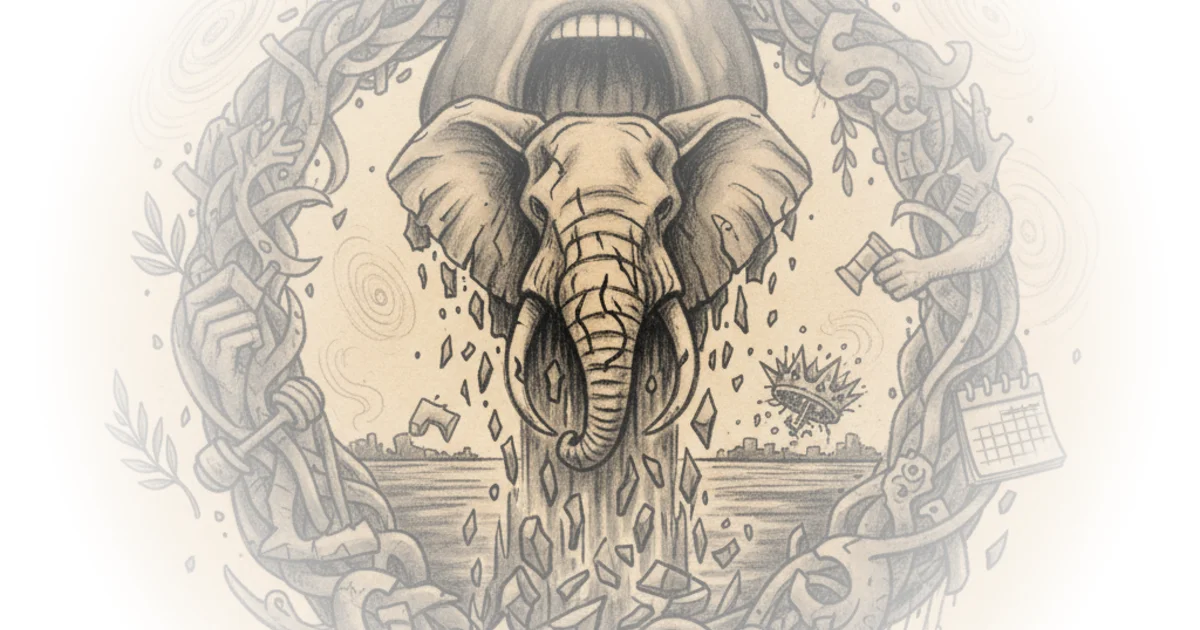
Kristol catalogs the missing words with the precision of an archivist inventorying a burglary. Equality. Rights. The rule of law. The Constitution. Republic. Democracy. These are not obscure terms plucked from political science textbooks. They are the vocabulary of the founding, the language that gives the anniversary its meaning in the first place.
Trump mentioned the Declaration of Independence only once, in passing, despite this being its 250th anniversary.
The omissions form a pattern. The word "justice" appeared twice, but only in the context of punishment. "Opportunity" surfaced once, in a throwaway line about government efficiency. "Immigrants" never appeared at all, even when Trump claimed to support legal immigration.
What He Said Instead
If the founding vocabulary was absent, partisan combat filled the void. Trump referenced Republicans six times and attacked Democrats nine times. He ordered Democratic members to stand and declare their loyalty to a proposition about prioritizing citizens over undocumented immigrants. When they declined, Stephen Miller provided the MAGA interpretation.
The entire Democrat Party disqualified itself from government service in this one exchange.
Kristol frames this as a midterm trap the Republicans are setting for themselves. The "big question" every day between now and November, he argues, is whether Trump did anything to prevent the electoral reckoning bearing down on his party.
Despite its record length, nothing in Trump's excruciatingly bloated and aimless State of the Union address will do a thing to stanch the bleeding of his popular support.
That is a confident prediction, and it may prove too confident. Midterm environments are volatile, and a single foreign policy crisis or economic shock could reshuffle the landscape entirely. Kristol writes with the certainty of a pundit who has been right about Trump's character but occasionally wrong about Trump's political durability. Still, the structural indicators -- approval ratings, generic ballot polls, historical patterns for second-term presidents -- do lean heavily in his direction.
The Names Left Unspoken
The missing abstractions are one thing. The missing people are another. Kristol notes that Trump ignored the Epstein survivors seated in the gallery and never mentioned the unreleased Epstein files his own Justice Department controls. He also never named Renee Good or Alex Pretti, two individuals killed by federal agents sent to Minnesota on Trump's orders.
Our president has no interest in elevating what is distinctive and admirable about America. Nor does he have any interest in addressing instances of gross injustice in America.
The piece also includes Rachel Janfaza's reporting on the gender gap visible in the Olympic hockey teams' divergent responses to the White House. The men's team attended the speech. The women's team did not. Trump had invited the women only after joking that skipping the invitation would get him impeached.
And we have to, I must tell you, we're gonna have to bring the women's team.
A male player responded simply: "Two for two!" Janfaza argues that while the political gender gap among Generation Z is real and widening, the personal animosity is not. The hockey players cheered for each other regardless of which team accepted which invitation.
The Kash Patel Sidebar
Buried further in the newsletter is a detail that deserves its own spotlight. FBI Director Kash Patel's use of bureau jets for personal travel allegedly delayed the evidence response team from reaching a mass shooting at Brown University. Agents had to drive through a snowstorm overnight because both FBI planes were unavailable.
Agents with the FBI's elite evidence response team were delayed in reaching the scene of a mass shooting at Brown University in December because there was no FBI plane available to take them to Rhode Island.
A whistleblower also alleged that Patel's travel caused delays in the investigation of Charlie Kirk's assassination. Patel reportedly told an FBI field office meeting something remarkable about his travel priorities.
If you have golf, hockey, fishing, or hunting and beautiful sights, you're going to see a lot of me.
It is worth noting that these are allegations from a single whistleblower, and the FBI has denied that investigative work was compromised. But the pattern of personal jet use is well-documented at this point, and the optics are brutal regardless of the operational impact.
Bottom Line
Kristol's argument is elegant in its simplicity. A president who frames a speech around the 250th anniversary of American independence and then fails to utter the words "equality," "rights," "democracy," "republic," or "the Constitution" has told the country exactly what he values and what he does not. The speech was not just long and aimless. It was revealing in its absences.
The newsletter packages this observation alongside reporting on the gender gap in politics, a groyper candidate polling well among young Florida Republicans, and an FBI director who treats government aircraft like a rideshare service. Taken together, the picture is of a political movement that has shed the vocabulary and the values of the republic it governs -- and is not especially troubled by the loss.