In an era where digital identity is as fragile as paper, The Hated One makes a startlingly pragmatic case: your survival in a crisis may depend less on canned food and more on a hidden, encrypted micro-SD card. This isn't just another prepper checklist; it is a technical blueprint for preserving your legal existence when physical records burn, flood, or vanish. The piece argues that the modern emergency kit must evolve to include a "digital bugout bag" that offers encryption and portability impossible for paper documents.
The Digital Imperative
The Hated One reframes the traditional Red Cross recommendation for survival kits, noting that while physical copies are standard, "paper documents can easily get destroyed by floods fire and collapse." The author argues that physical papers are uniquely vulnerable to theft and fraud because they lack encryption, whereas a secure digital backup provides a critical fail-safe. "Having a secure digital backup gives you an additional fail save if all else is lost," they write, emphasizing that in a chaotic evacuation, the ability to instantly prove identity can be the difference between life and death.
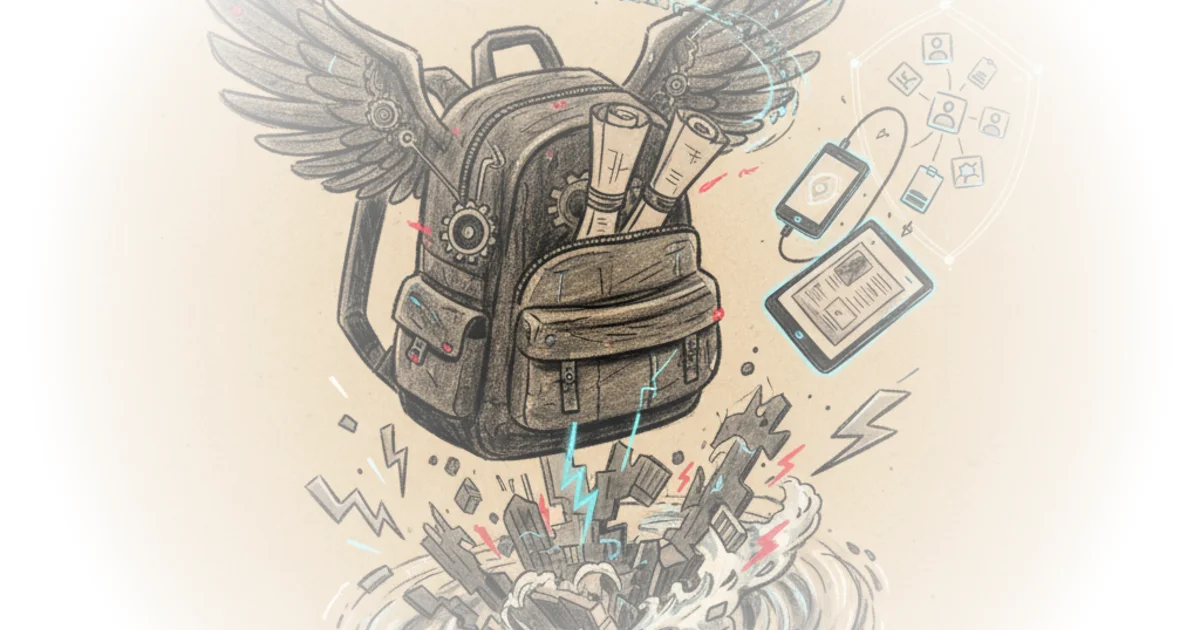
The core of the argument rests on the physical advantages of micro-SD cards over traditional USB drives. The Hated One explains that while USB drives are common, they are bulky and conspicuous. In contrast, a micro-SD card is so small it can be "hidden in a ubiquitous item or zoomed into a piece of clothing to prevent it from being stolen." This focus on operational security—hiding the backup in plain sight—is a distinctive layer of advice often missing from standard preparedness guides. The author suggests placing the card in a waterproof Faraday bag alongside chargers, ensuring protection from both electromagnetic pulses and the elements.
"Out of sight is out of mind."
The Cryptography of Survival
Moving from hardware to software, the piece dives deep into the mechanics of VeraCrypt, a free, open-source encryption tool. The Hated One insists that mere storage is insufficient; the data must be mathematically locked. "Modern encryption algorithms rarely get mathematically broken but it could happen in the future," they caution, recommending a cascading encryption algorithm to future-proof the data against evolving threats. The author's tone shifts here, becoming almost existential as they discuss the necessity of a strong passphrase, suggesting a memorable phrase like "splinter it into a thousand pieces and scattered into the winds" to ensure it cannot be cracked by brute force.
A particularly striking recommendation involves the concept of "plausible deniability" through hidden volumes. The Hated One describes creating a decoy volume filled with junk data that can be surrendered to an adversary, while a hidden volume containing the real data remains undetectable. "If all the security precautions are met your adversary shouldn't be able to prove you have a hidden volume," they explain. This feature is designed for scenarios where an individual might be coerced into revealing their password. Critics might note that this level of paranoia assumes a threat model involving state-level coercion or torture, which may be overkill for the average citizen facing a natural disaster. However, the author's logic holds that in a true crisis, the stakes of losing one's identity are so high that extreme measures are justified.
The author also touches on the psychological toll of this preparedness, admitting, "I have no friends and I don't know if I can keep doing this any longer." This raw vulnerability underscores the isolation that can accompany such intense self-reliance. Despite this, the technical advice remains rigorous: use a password manager like KeePassXC to store credentials, back up two-factor authentication tokens, and ensure that even the backup of the backup is encrypted.
Beyond the Data: The Offline Ecosystem
The commentary extends beyond document storage to the creation of a fully functional offline digital environment. The Hated One recommends downloading specific applications that do not require an internet connection, such as OsmAnd for maps, Trailsims for off-grid navigation, and offline versions of Wikipedia. "Your digital bugout bag should always be ready updated and available," they stress, arguing that in a grid-down scenario, access to information on foraging, first aid, and weather becomes a literal lifeline. The author suggests using a "dumb phone" with multiple SIM cards to ensure connectivity, paired with YubiKey or Nitrokey security tokens for robust authentication.
The piece concludes with a grim but realistic assessment of the user's mindset. The Hated One writes, "hopefully never but you all know you're not hopeful you're just hiding your crippling depression or maybe that's just me." This admission reframes the entire tutorial not just as a technical guide, but as a coping mechanism for a world that feels increasingly unstable. While the focus on depression is personal and perhaps outside the scope of a standard survival guide, it adds a layer of human urgency to the technical instructions.
Bottom Line
The strongest element of this piece is its synthesis of high-level cryptography with low-tech physical concealment, offering a survival strategy that is both mathematically sound and operationally stealthy. Its biggest vulnerability lies in its assumption that the user possesses the technical literacy to verify software signatures and manage complex encryption volumes without error. For the busy professional, the takeaway is clear: in a modern crisis, your digital identity is your most valuable asset, and it requires a level of protection that paper simply cannot provide.