The Coalition Fracture
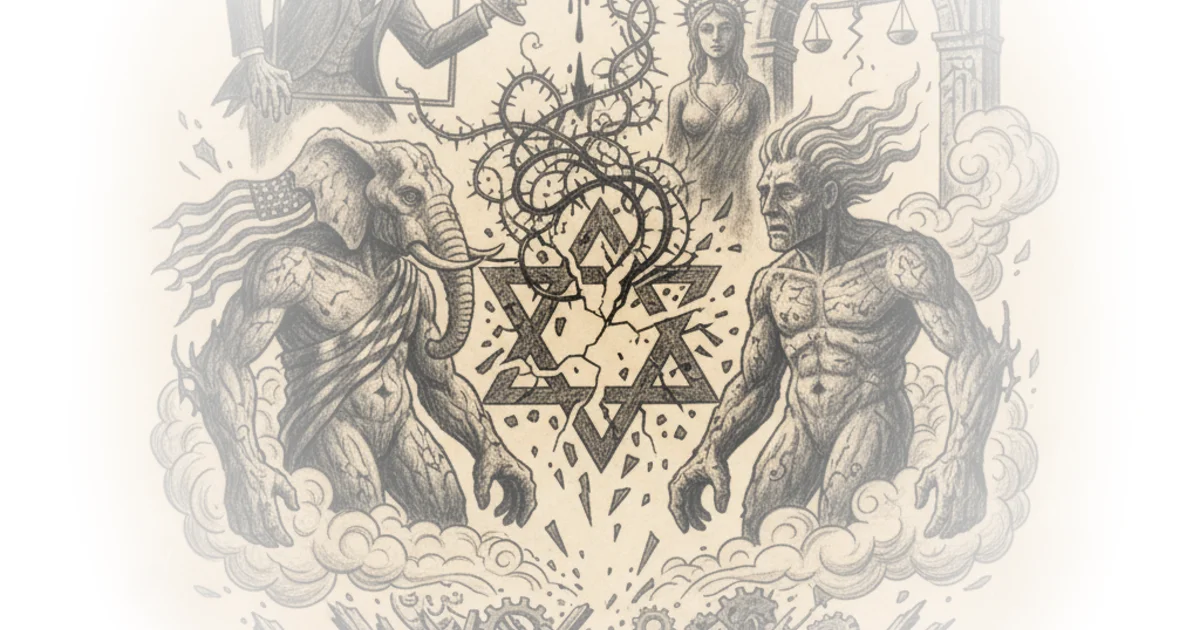
A public commission meeting meant to address antisemitism became the stage where an ideological rift within the conservative movement finally broke into view. What emerged was not merely a personnel dispute, but evidence that a political coalition built on contradictory premises cannot remain stable indefinitely.
The Commission Confrontation
Sarah Longwell, Tim Miller, Bill Kristol document how Carrie Prejean Boller—a commissioner on the White House Religious Liberty Commission—transformed a routine hearing into a confrontation over whether criticizing Israel constitutes antisemitism. As Longwell, Miller, Kristol puts it, "Is anti-Zionism antisemitism? If I don't support the political state of Israel, am I an antisemite, yes or no?"
Prejean Boller repeatedly challenged fellow commissioners to label her antisemitic directly. When one participant asserted that figures like Tucker Carlson and Candace Owens were indeed antisemites, she dismissed the accusation. "There you go again. Everyone's an antisemite, I guess."
The commission's chairman, Texas Lieutenant Governor Dan Patrick, removed Prejean Boller without addressing the substance of her remarks. Patrick stated only that "no member of the commission has the right to hijack a hearing for their own personal and political agenda on any issue." He emphasized: "This was my decision."
Prejean Boller refused to accept the removal. She claimed Patrick lacked authority to dismiss her and accused him of acting within "a Zionist political framework that hijacked the hearing, rather than in defense of religious liberty." She added: "I refuse to bend the knee to Israel. I am no slave to a foreign nation, but to Christ our King."
"I refuse to bend the knee to Israel. I am no slave to a foreign nation, but to Christ our King."
The Coalition Problem
Longwell, Miller, Kristol identify the structural tension: the administration has attempted to satisfy both philosemite conservatives and those expressing antisemitic views while remaining officially neutral in their conflict. As Longwell, Miller, Kristol writes, "MAGA's philosemites and antisemites are unlikely to keep sharing a political coalition for long—and they seem unlikely to let Trump's White House stay agnostic in their fight, either."
The administration's approach has been contradictory. It pursues foreign policy favorable to Israel while refusing moral criticism of Israel's conduct in Gaza. It opposes removing right-wing antisemites from its coalition while aggressively targeting those accused of antisemitism on the left. Longwell, Miller, Kristol note that "White House employees who brag in leaked texts about having a 'Nazi streak' don't even lose their administration jobs; pro-Palestinian foreign students who support boycotting Israel see their student visas canceled and get snatched off the street."
Prejean Boller's challenge forced the issue: "Only the President can remove me, since he appointed me. What will Trump do? Stand for my Catholic Religious Freedom or remove me?"
The Lincoln Contrast
Bill Kristol's contribution shifts to historical reflection, contrasting the current political moment with Abraham Lincoln's legacy. Kristol quotes Lincoln's 1864 remarks to the 166th Ohio Regiment: "It is not merely for to-day, but for all time to come that we should perpetuate for our children's children this great and free government, which we have enjoyed all our lives."
Lincoln emphasized that the struggle preserved "an open field and a fair chance for your industry, enterprise and intelligence; that you may all have equal privileges in the race of life, with all its desirable human aspirations." Kristol concludes: "It is for this the struggle should be maintained, that we may not lose our birthright—not only for one, but for two or three years. The nation is worth fighting for, to secure such an inestimable jewel."
Counterpoints
Critics might note that Longwell, Miller, Kristol understate how both sides weaponize the antisemitism accusation—Israel allies use it to shut down legitimate policy criticism, while genuine bigots hide behind anti-Zionist rhetoric. The authors acknowledge Prejean Boller is "correct about at least one thing" regarding this dynamic, yet the piece offers little guidance on distinguishing legitimate criticism from bigotry.
Critics might also observe that framing this as a MAGA coalition problem ignores how the tension exists across American politics generally. The administration's contradictory posture reflects a broader national uncertainty about how to balance support for Israel with criticism of its government's actions.
Bottom Line
The Religious Liberty Commission incident exposes a fault line that cannot remain hidden: a political coalition cannot indefinitely house both those who view Israel as sacred and those who view it as illegitimate. The administration's attempt at neutrality has collapsed under the weight of this contradiction. Lincoln's vision of preserving free government for future generations stands as a reminder that some coalitions must be rebuilt rather than preserved.