Ryan Grim and Jeremy Scahill have assembled a daily briefing that refuses to let the machinery of war fade into the background noise of political theater. While the headlines often chase the latest executive order or celebrity scandal, their coverage anchors the reader in the visceral reality of human suffering, from a kindergarten in Sudan to the rubble of Gaza. This is not a passive recap; it is a forensic audit of a world where policy decisions are measured in broken ribs and drowned children.
The Human Cost of Geopolitics
The piece opens with a stark juxtaposition: the ongoing Israeli bombardment of Gaza set against the White House's plans for a "Board of Peace." Grim and Scahill do not treat these as separate stories but as intertwined realities of a conflict where diplomatic posturing often precedes further violence. They highlight the sheer scale of the devastation, noting that artillery and airstrikes continue to tear through Gaza City, Khan Younis, and Rafah. The authors zero in on a single, heartbreaking image to illustrate the abstract concept of civilian casualties: "At least one Palestinian woman, Samar al-Shubarsi, was killed... her body lay inside an ambulance while her toddler, born at the start of the war, stood beside the body holding his uncle's hand, staring at his mother 'as if [he was] waiting for her to come back.'"
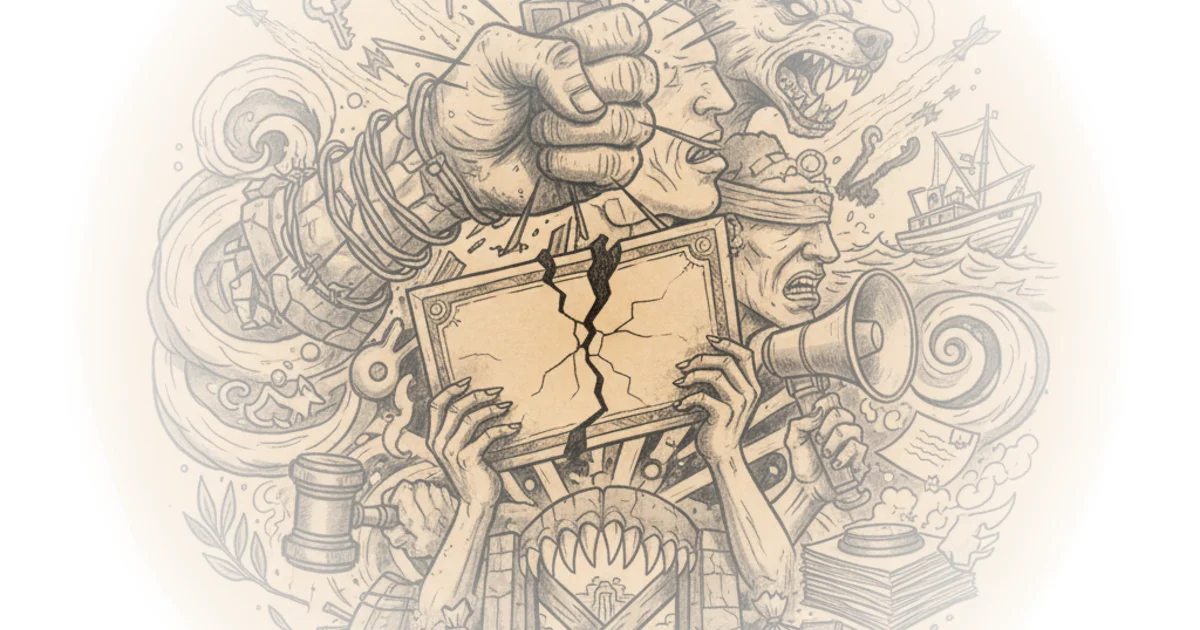
This framing is effective because it strips away the euphemisms of military reporting. By focusing on the child's confusion and grief, the authors force the reader to confront the generational trauma being inflicted. They then pivot to the administration's proposed solution, describing a plan where an "International Stabilization Force" would replace Israeli troops, yet the core equation remains brutal: "The equation will be IDF out of Gaza, but Hamas out of power." This quote reveals the fundamental disconnect in the proposed peace plan—it prioritizes political removal over the immediate humanitarian crisis.
The equation will be IDF out of Gaza, but Hamas out of power.
The coverage does not shy away from the obstruction of aid. Grim and Scahill report that despite ceasefire agreements, the United Nations states that "full respect" of the truce is necessary before workers can even scale up deliveries. The authors argue that the blockade is not an accident but a structural feature of the current strategy, urging the opening of crossings and the removal of restrictive registration rules. A counterargument might suggest that security concerns legitimately complicate aid delivery, yet the authors present evidence of aid being blocked even when ceasefires are nominally in place, suggesting that the political will to facilitate relief is simply absent.
The Architecture of Abuse
Moving from the battlefield to the prison system, the commentary takes a darker turn as it details the treatment of Palestinian detainees. The authors cite the brutal beating of Marwan Barghouti, a prominent political prisoner whose son described the torture in harrowing detail. Grim and Scahill quote the son directly: "They broke his teeth and ribs, cut off part of his ear, and fractured his fingers gradually for their amusement." This is not merely an allegation of misconduct; it is a description of sadism sanctioned by the state.
The piece connects this individual act of violence to a broader pattern, noting that over 100 Palestinian prisoners have been killed since the conflict began, a phenomenon rights groups call "slow-motion executions." The authors also bring in the testimony of Dr. Mu'nis Muhsin, who described his 19 months in a secret underground prison as a nightmare of torture and isolation. This section is crucial because it challenges the narrative of a just legal process, revealing a system where "extreme overcrowding, routine physical assaults by guards, and severely inadequate food" are the norm. Critics might argue that the security situation necessitates harsh measures, but the authors' reliance on official audits from the Israeli Public Defender's Office undermines that defense, showing that even internal oversight documents these abuses.
The Pacific and the Executive's Shadow
The coverage then shifts to the Pacific, where the administration's military doctrine is being tested in the open ocean. Grim and Scahill report on a lethal strike that killed four men labeled "narco-terrorists," but they quickly complicate the narrative by revealing video evidence of a previous strike where survivors were targeted. The authors describe a chilling scene where "two men who survived the initial strike clinging to the wreckage of the boat for an hour before they were killed in a second strike." This detail transforms the event from a standard counter-narcotics operation into a potential war crime, raising questions about the rules of engagement.
The authors also touch on the domestic fallout, noting that Secretary of War Pete Hegseth authorized these strikes on survivors, a move that contradicts the principle of distinction in international law. The piece suggests that the administration's approach to violence is becoming increasingly detached from legal and moral constraints. In a related development, the authors highlight the administration's move to shorten work permits for asylum seekers from five years to 18 months. This policy shift, linked to a shooting in Washington, is framed as a deliberate attempt to "deepen backlogs and push many asylum seekers out of the workforce." The authors argue that this is not just bureaucratic tinkering but a strategic effort to dismantle the safety net for vulnerable migrants.
My father is now 66 years old. My God, where will this generation find its strength?
Global Instability and Resource Wars
The final section of the piece weaves together disparate global events to show a world in flux. The authors report on a peace deal between Rwanda and the Democratic Republic of Congo, brokered in Washington, which they describe as a move to "open the region's critical mineral reserves to American companies." This framing connects the peace deal directly to economic interests, suggesting that the stability of the region is secondary to the extraction of resources. They also note the ongoing violence, with fighting continuing despite the agreement, and the humanitarian crisis in Sudan where 47 civilians, mostly children, were killed in a kindergarten attack by the Rapid Support Forces (RSF). This reference to the RSF, a group with deep historical ties to regional instability, adds necessary context to the violence in Sudan.
The authors also touch on the demographic collapse in Ukraine, where the population has shrunk by six million, and the UK inquiry finding Vladimir Putin culpable for a 2018 poisoning. These stories are presented not as isolated incidents but as symptoms of a global order where human life is increasingly expendable. The piece concludes with a look at the media landscape, noting Netflix's acquisition of Warner Bros, a move that signals the consolidation of power in the entertainment industry while the world burns.
Bottom Line
Ryan Grim and Jeremy Scahill's coverage is a masterclass in connecting the dots between high-level policy and ground-level suffering. Their strongest argument is that the administration's foreign policy is driven by a combination of resource extraction and a disregard for human life, masked by the language of peace and security. The piece's biggest vulnerability is its reliance on a narrative of inevitable decline, which, while supported by the evidence, may leave readers feeling powerless to effect change. The most important thing to watch next is whether the international community will hold the administration accountable for the strikes on survivors and the obstruction of aid, or if the world will continue to accept these atrocities as the cost of doing business.