In a landscape dominated by political theater, Nominal News cuts through the noise to reveal a stark economic reality: the machinery of trade policy is already grinding the global economy toward a unique and dangerous form of stagnation. While headlines focus on the announcement of tariffs, this piece argues that the real story lies in the conflicting models predicting whether these measures will generate revenue or trigger a self-inflicted recession. The editors present a chilling possibility where the mere threat of tariffs could shrink the economy more than the tariffs themselves, a nuance often lost in the daily political churn.
The Mechanics of Sticky Prices
The article begins by grounding the reader in the distinction between simple prediction and causal analysis, a crucial differentiation for understanding economic forecasts. "The focus on causality by economists means that conclusions need to be interpreted very specifically," the piece argues, explaining that a model predicting a GDP drop doesn't fail just because the economy grows; it simply means the economy would have grown even faster without the policy. This framing is essential for busy readers trying to parse conflicting headlines about economic performance.
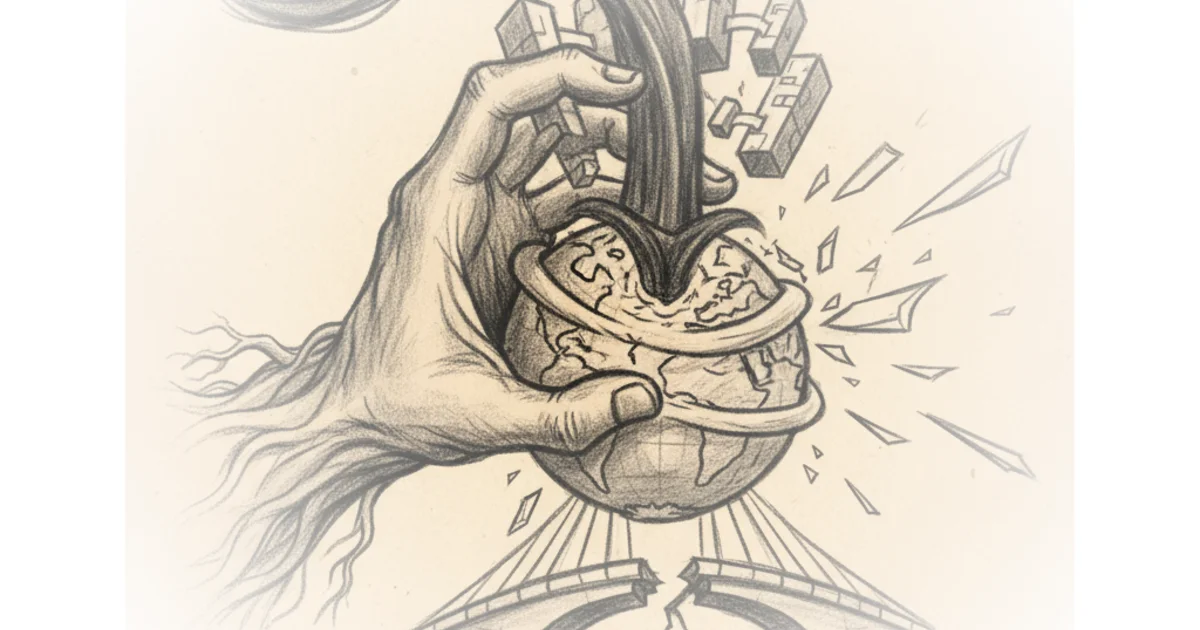
Nominal News then dives into the KSY model, a complex framework that assumes prices and wages are "sticky," meaning they do not adjust instantly to market shocks. "The key tenet of the New-Keynesian model is the assumption that prices (this includes wages) are 'sticky' – i.e. nominal prices (stated prices) do not adjust instantaneously," the editors note. This assumption is not just academic jargon; it explains why firms lay off workers rather than cutting pay during a downturn. The piece effectively uses this to illustrate why tariffs create a "unique situation of falling output and increasing inflation," a phenomenon known as stagflation that typically moves variables in opposite directions.
This creates the unique situation of falling output and increasing inflation. Typically, these two variables move in the same direction.
The analysis highlights a critical trade-off in economic modeling: complexity versus solvability. The KSY model is computationally expensive, requiring massive processing power to solve 24 simultaneous equations across multiple countries. Critics might argue that such reliance on assumptions renders the model detached from reality, but the editors counter that "without them, solving such models would be currently impossible." This defense of modeling constraints is a vital reminder that economic forecasts are tools of approximation, not crystal balls.
The Cost of Uncertainty
Perhaps the most striking finding in the coverage is the impact of uncertainty itself. The article examines a hypothetical scenario where the administration threatens tariffs but never implements them. The result? A 0.7% drop in GDP driven entirely by anticipatory behavior. "In anticipation of the tariff announcements, individuals expect to consume fewer goods in the future due to higher prices," Nominal News reports, noting that this leads to a sudden drop in spending even before a single tax is collected. This suggests that the volatility of policy announcements is a policy in itself, capable of damaging the economy regardless of the final outcome.
The piece also scrutinizes the revenue potential of these tariffs, challenging the notion that they are a silver bullet for federal budgets. "If other countries do not impose their own tariffs, the tariffs can at most generate 1.5% of US GDP, which is approximately $400bln, or approximately 6% of the US Federal budget," the editors calculate. However, this figure is highly contingent on the behavior of trading partners. If retaliation occurs, the revenue is cut in half, illustrating the fragility of relying on tariffs as a primary fiscal tool.
Divergent Models, Divergent Futures
The commentary shifts to the IMCS model, which offers a conflicting perspective by focusing on trade flows across 123 countries rather than inflation dynamics. Unlike the KSY model, which predicts broad economic pain, the IMCS model suggests that without retaliation, the US could see a 1.1% rise in real welfare. "By imposing the tariffs, when other countries do not retaliate, it appears the US benefits with higher real wages and higher welfare by 1.1%," the piece notes. This outcome relies on the idea that tariffs strengthen the bargaining position of domestic workers by reducing foreign competition.
However, the editors quickly pivot to the likely reality of retaliation. "If foreign countries retaliate by imposing optimal tariffs from their perspective, US welfare falls by 1%, while foreign countries only see a 0.05% welfare decline," the article states. This finding underscores the strategic dilemma: the US benefits only if the rest of the world absorbs the pain without pushing back. The piece concludes that the KSY model is likely more accurate regarding inflation and output, while the IMCS model better captures trade volume shifts, yet both agree on a grim bottom line.
Ultimately, whichever way the tariff policy is looked at, the costs of this policy are significant, far outweighing any potential benefits.
Critics might note that the binary choice between these two models oversimplifies the global supply chain, which is far more interconnected than either model fully captures. Nevertheless, the convergence of both models on the high cost of the policy is a powerful indictment of the strategy.
Bottom Line
The strongest element of this analysis is its ability to translate complex computational models into a clear warning: the economic damage of tariffs is not just in the final tax rate, but in the disruption of expectations and the inevitability of retaliation. The piece's biggest vulnerability is its reliance on the assumption that foreign nations will act "optimally" in a retaliatory scenario, a behavioral prediction that history often contradicts. For the busy reader, the takeaway is clear—economic modeling suggests that the current trajectory of trade policy is a net negative for growth, inflation, and global welfare, regardless of the political narrative surrounding it.