Andrew Henry challenges a decades-old academic blind spot with a provocative question: is the Arab world quietly undergoing a secular shift that scholars have been too afraid to see? By weaving together satellite data, linguistic nuance, and on-the-ground activism, Henry moves beyond the simplistic "clash of civilizations" narrative to reveal a complex, often hidden landscape of non-belief. This is not just a story about rising atheism; it is a forensic look at how language, law, and fear shape the very ability to admit one's doubts.
The Blind Spot and the Language Trap
Henry begins by dismantling the assumption that secularization is impossible in Islamic societies. He notes that for years, Western researchers operated under a "lack of imagination," unable to fathom an Arab atheist. This scholarly inertia is best captured by the 1991 claim of Ernest Geller, who asserted, "I think it is fair to say that no secularization has taken place in the world of Islam and that Islam is as strong now than it was 1000 years ago." Henry argues this was a failure of observation, not reality. The author writes, "Something is changing in the religious landscape of Arab countries. Non-religious views are becoming more visible and harder to ignore."
The piece excels when it dissects why this change has been so hard to measure. Henry explains that the very vocabulary used to describe non-religion is loaded with theological judgment. In Arabic, the word for religion, din, implies debt and obligation, while kufr (unbelief) means to "cover or conceal" the truth. Consequently, "rejecting those obligation is called kufr... it's about turning away from what is seen as rightful duty." This linguistic framework creates a massive barrier to honest surveying. As Henry puts it, "If the only words to describe yourself imply devian or heresy, would you use them in an interview with a sociologist?"
The terminology is not just tricky; it is a minefield where the wrong label can mean social death or legal peril.
This analysis is crucial because it reframes the data. When surveys show low numbers of atheists, it may not reflect true belief but rather the inability to safely self-identify. Critics might argue that relying on self-reported data in such high-stakes environments is inherently flawed, but Henry counters this by introducing a novel methodology: measuring religiosity from space. By tracking nighttime light activity during Ramadan in Egypt, researchers found a strong correlation between satellite imagery and self-reported fasting, suggesting that despite the fear, the survey data holds surprising weight.
The Data Paradox: Tsunami or Ripple?
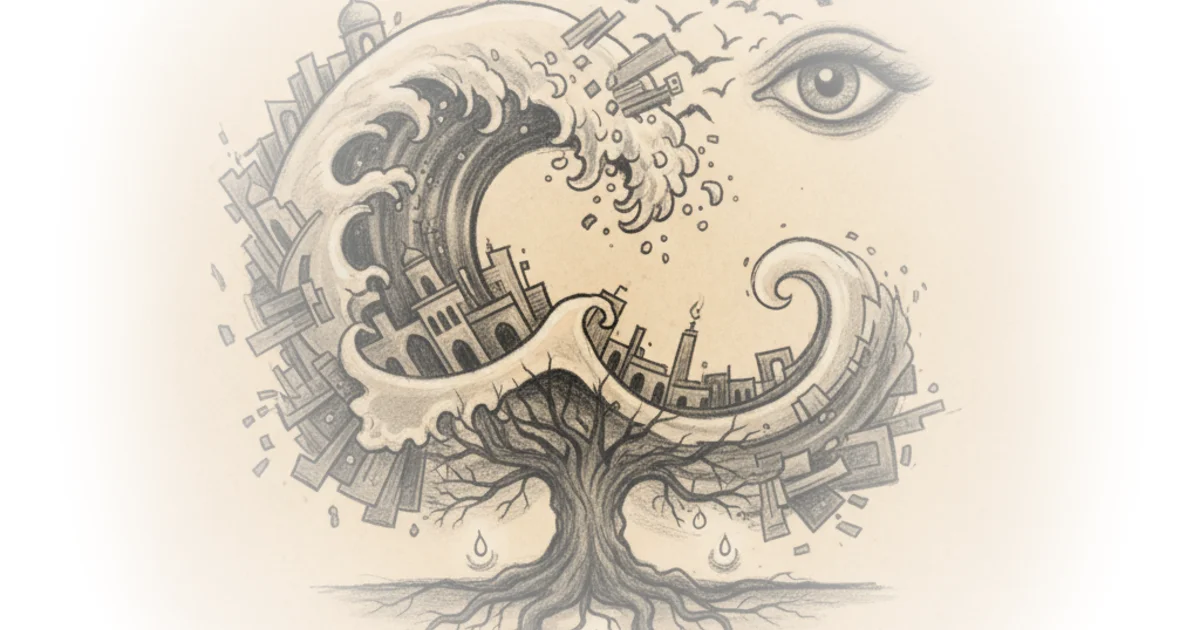
The article navigates a tricky statistical terrain. A major BBC and Arab Barometer partnership found that non-religious identification rose from 8% to 13% between 2013 and 2019, with youth rates hitting 18%. Henry describes the reaction of some observers: "The Egyptian journalist Kala Diyab described it as a tsunami of atheism." However, Henry immediately tempers this hyperbole, asking, "Now, whether it's really a tsunami or just a ripple is up for debate."
The nuance here is vital. Recent 2023 data suggests a reversal, particularly among youth in Tunisia and Morocco, where non-religious identification has dropped significantly. Henry notes, "As of 2023 in Tunisia, 18 to 29-year-olds are 15 points less likely to say they are non-religious than in 2020." This volatility challenges the narrative of a linear march toward secularism. The author argues that "claims that non-believers are a constantly growing group in Arab society since the 2010s rest on shaky empirical grounds."
This fluctuation likely stems from the political climate. In countries where the state cracks down on dissent, public expressions of non-religion can recede. The article highlights that while Tunisia saw a spike in non-religious identification, it also saw a resurgence of religious conservatism in recent years. This aligns with historical patterns seen in the region's relationship with secularism, where periods of openness often trigger a conservative backlash. Henry writes, "Instead of a sharp increase in non-religion, it seems that there are some shifts in the data and survey data always comes with limitations."
Geography of Fear and Freedom
The most compelling section of the commentary contrasts the lived reality of non-believers across different national borders. The legal and social stakes vary wildly. In Saudi Arabia, a 2014 royal decree classified atheism as terrorism, yet Henry reports a "vibrant atheistic underground" where "We non-believers have meetings and groups in a lot of Saudi cities." This duality—legal death versus social life—defines the experience for many.
Conversely, in Tunisia and Lebanon, freedom of conscience is constitutionally protected. Here, activism has moved from the shadows to the street. Henry details how the Tunisian Freethinkers emerged after the 2011 uprisings to challenge discriminatory laws, such as those regarding inheritance. The author describes a pivotal moment in 2017: "In 2017, around 200 Tunisians, both Muslims and non-Muslims, started protesting with the slogan, 'Not by force,' in response to four men being sentenced to a month in jail for eating and smoking in public during Ramadan."
This activism is distinct because it is framed around citizenship rather than just theology. In Beirut, groups like Free Thought Lebanon host "Cafe Human East" events to debate secular funerals and civil marriage. Henry observes that "their activism is deeply tied to local concerns and framed around citizenship, not just around religion." This reframing is a strategic masterstroke, allowing non-religious voices to enter the public square without immediately triggering the full force of religious stigma.
The struggle is no longer just about what you believe in private, but about the right to define your own public life.
However, the author acknowledges that even in these freer environments, the pressure remains. The incident where a conservative imam filmed and shamed those not fasting illustrates how social enforcement can be as potent as state law. The article effectively shows that while the legal landscape is a spectrum, the social landscape is a minefield everywhere.
Bottom Line
Henry's strongest contribution is his refusal to accept a single narrative, instead revealing a volatile, linguistically complex, and geographically diverse reality where non-religion is both rising and retreating depending on the political wind. The piece's greatest vulnerability is the inherent difficulty of quantifying a movement that must often remain invisible to survive, meaning the "true" numbers may always be out of reach. Readers should watch for how the interplay between digital activism and state crackdowns will shape the next decade of this debate, as the "tsunami" may be less about belief and more about the courage to speak it.