Alberto Romero delivers a jarring realization that cuts through the noise of the AI debate: the most dangerous aspect of synthetic content isn't its poor quality, but its ability to pass unnoticed, severing our connection to the real world. While others obsess over detection tools, Romero argues we are facing a crisis of provenance where the "strength of the hills" no longer sustains us, leaving us spiritually uprooted in a landscape of digital replicas.
The Synthetic Diet
Romero begins by anchoring his argument in a 1930 letter from C.S. Lewis, drawing a parallel between our globalized food supply and our modern information ecosystem. He notes that just as Lewis lamented eating "Canadian flour, English meat, Scotch oatmeal, African oranges, & Australian wine," we today consume an "artificial" and "synthetic" diet of text. Romero writes, "We are synthetic men, uprooted. The strength of the hills is not ours." This framing is effective because it shifts the conversation from technical capability to existential displacement. The author suggests that our inability to trace the origin of our food mirrors our inability to trace the origin of our ideas.
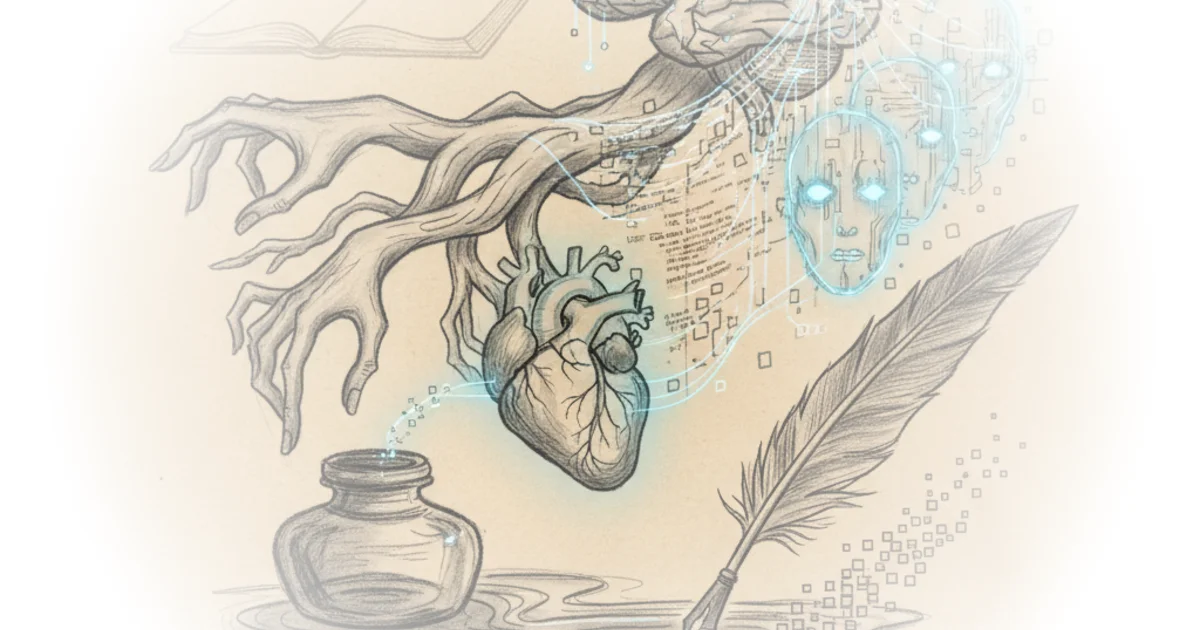
The piece gains depth by weaving in Stoic philosophy, specifically referencing the Enchiridion of Epictetus. Romero invokes the ancient text to suggest a path of acceptance: "Don't demand that things happen as you wish, but wish that they happen as they do happen, and you will go on well." However, he immediately complicates this by admitting that while he can intellectually accept the shift, the emotional toll is real. The argument here is that the "rotting canopy" of our information diet is not just about bad writing, but about a fundamental disconnection from the human experience that generates meaning.
We are being inadvertently extirpated, like a tumor, from the collective layer of thought, ideas, and reason.
Critics might argue that this romanticization of the past ignores the accessibility benefits of AI, which allows voices from marginalized communities to bypass traditional gatekeepers. Romero acknowledges the speed and cost advantages of AI writing but contends that these efficiencies come at the price of authenticity. He posits that we are trading the messy, rooted reality of human thought for a "good enough replica."
The Fyodor Incident
The core of Romero's evidence comes from a specific, personal failure of detection. He recounts reading an essay by an anonymous author named Fyodor, which was included in Ted Gioia's list of the year's best essays. The piece, titled Meditations for Phone Addicts, was subsequently flagged by a reader as AI-generated. Romero admits he missed the telltale signs, such as the "bland juxtaposition" of habits versus existential dread. He writes, "I enjoyed the AI-written post and didn't care about the annoying juxtaposition enough to even realize it was there." This admission is powerful because it undermines the confidence of even the most vigilant readers.
Romero highlights the reaction of the curator, Ted Gioia, who removed the essay not because it was bad, but because it was synthetic. Gioia stated, "Even if it was trained on Dostoevsky... I don't want it here." Romero uses this to illustrate a cultural rift: we are forced to choose between the utility of the content and the integrity of its origin. The author questions whether the value of a piece of writing changes if the reader didn't know it was generated by a machine. "Does it matter to me that it's AI-written now that I know? Does it change the value I ascribed to it in retrospect?" he asks. This line of questioning forces the reader to confront their own relationship with truth in the digital age.
The reference to the Inklings—the literary group that included Lewis and Tolkien—serves as a historical anchor, reminding readers that these concerns about the nature of reality and connection are not new, even if the technology is. Romero suggests that while the Inklings saw a real connection between people and the land, we now live in a world where "the atoms that made the ground I stand on also made up my body" is no longer true, even metaphorically.
The Vertigo of the Noösphere
Romero extends the argument to the broader publishing landscape, citing a Slate Star Codex investigation into the latest Hunger Games novel, Sunrise on the Reaping, which allegedly contains AI-written sections. He points out a specific failure mode: AI conflates semantic similarity with physical reality, confusing the "sticky" nature of a spider web with the "soft" nature of silk. "It's not just popular novels; the story is the same across a substantial proportion of books, essays, and articles being published today," Romero observes. This highlights the systemic risk: if we cannot distinguish between human and machine, the entire "noösphere"—the collective layer of thought—becomes a simulation.
He draws a parallel to the "Mary the color scientist" thought experiment, noting that AI knows everything about the physics of color but nothing about the experience of seeing it. "What AI, like Mary, doesn't know is what seeing a color is like," Romero writes. This distinction is crucial; it suggests that AI can mimic the form of human expression but cannot replicate the substance of human experience. The author concludes that while we might try to "put the genie back in the bottle," the reality is that we are already living in the world of the simulacrum.
I'm still unsure how to let go of my need for control. It's just… feeling it myself personally made me realize, for the first time, that my feet—my roots—no longer touch the ground; a new kind of vertigo I'm yet to get used to.
A counterargument worth considering is that Romero's fear of "uprooting" may be a natural reaction to any technological shift, similar to the panic over the printing press or the typewriter. However, the scale of generative AI's ability to flood the zone with content suggests a qualitative difference that justifies the alarm. The author's refusal to offer a simple solution—instead advocating for "equanimity toward the world as it is"—is both a strength and a weakness. It is honest, but it leaves the reader with a sense of helplessness.
Bottom Line
Romero's most compelling contribution is the shift from debating AI detection to examining the psychological cost of living in a world where the provenance of our thoughts is obscured. The argument's greatest vulnerability is its resignation to the inevitable, which risks becoming a self-fulfilling prophecy that discourages the very resistance needed to preserve human agency. Readers should watch for how institutions like publishers and curators will navigate this new reality, as their choices will determine whether we remain connected to the "strength of the hills" or drift further into the synthetic void.