In an era where intellectual humility is often mistaken for weakness, Wayfare offers a startling counter-narrative: that the most profound truths we encounter are not found in the text itself, but in the silence that follows. This piece challenges the modern obsession with decoding authorial intent, arguing instead that the "deeper meaning" of a life or a book is not a puzzle to be solved, but a reality to be co-created. For the busy mind seeking clarity amidst noise, this is not just a literary critique; it is a framework for re-evaluating how we process our own transformative moments.
The Finger and the Moon
Wayfare opens by invoking a classic Zen Buddhist parable to dismantle the binary of literal versus symbolic interpretation. "You're supposed to follow the finger and fix your attention on the moon," the piece notes, warning that focusing on the finger—whether through literalism or hyper-analysis—is a fundamental error. The editors argue that even when we shift to a metaphorical reading, "you're still focused on the finger—you're just looking at the finger from a different angle or a closer perspective." This distinction is crucial because it shifts the burden of truth from the text to the reader's engagement with it.
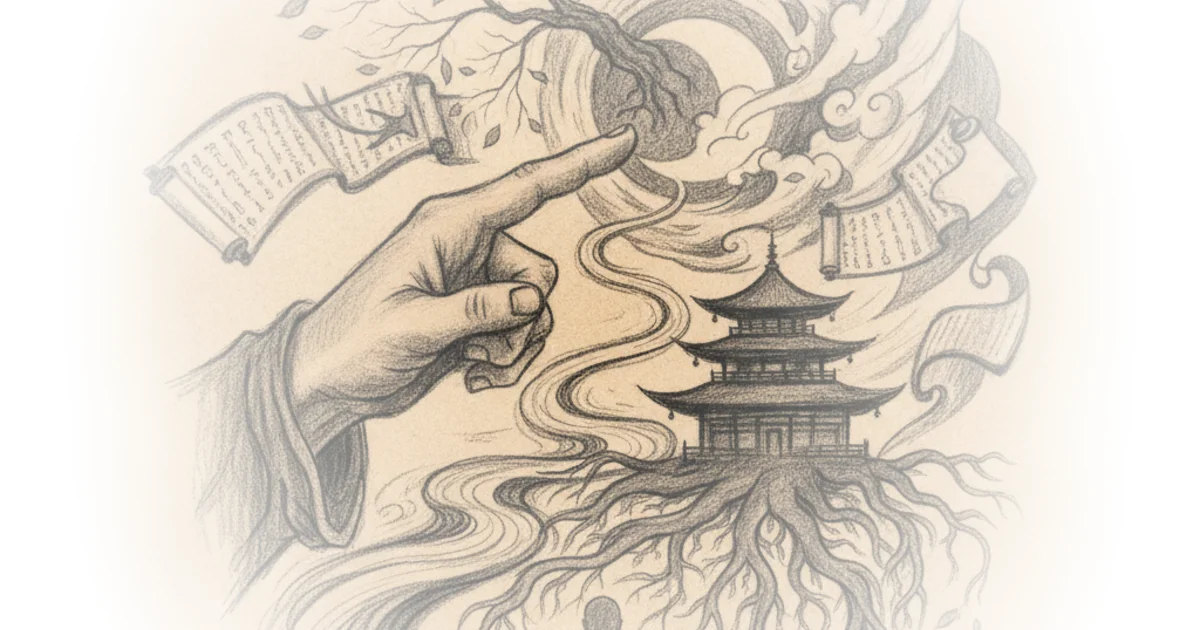
The commentary suggests that true religious or spiritual significance lies "beyond reason and cleverness and even language itself." This is a bold claim in a culture that prizes data and explicit definition. The piece posits that the goal is not to understand what the author meant, but to encounter "the thing that stands a chance of fundamentally changing you in some genuine, enduring way." By framing the text as a catalyst rather than a container, Wayfare liberates the reader from the anxiety of "getting it right." Critics might argue that this approach risks solipsism, where personal feeling overrides shared truth, yet the piece insists that this subjective co-creation is the only path to genuine transformation.
The deeper meaning is the part that you co-create with the words on the page.
The Superhumanities and the Altered State
The narrative then pivots to a personal account of a seventeen-year-old STEM prodigy whose worldview was shattered by Aldous Huxley's Brave New World. Wayfare describes this not as a simple literary appreciation, but as a "noetic experience of deep, ineffable insight marked by the feeling of communion with something foreign and, possibly, transcendent." The piece draws a parallel to the protagonist in Huxley's novel, John, who finds that words like "drums and singing and magic" give form to inexpressible hatred. Similarly, the author describes a moment where a novel "reprogrammed" them, turning reading and writing into spiritual practices.
This section introduces the concept of the "superhumanities," a term borrowed from scholar Jeffrey J. Kripal, which treats "super" or transcendent experiences as real and significant rather than dismissing them as psychological aberrations. Wayfare reports, "The superhumanities refers to the comparative study of 'super' (i.e., transcendent) human experiences through an open-minded empirical approach." This reframing allows the author to embrace the idea that a book could ignite a spiritual awakening without rejecting the biological reality of their developing mind. The piece acknowledges the onset of bipolar disorder and adolescent angst as the "psychophysical finger pointing at the moon," but insists these were merely the triggers, not the source.
This approach resonates with the historical context of the accompanying deep dive on Soma from Brave New World. Just as the fictional drug Soma was used to manufacture a state of collective blissful ignorance, the piece suggests that our modern reliance on purely materialist explanations creates a similar blindness, excising the very dimensions of art and spirituality that define our humanity. As the text notes, "God isn't compatible with machinery and scientific medicine and universal happiness. You must make your choice."
Choosing the Story That Sustains You
The final argument centers on the power of "both-and thinking." The piece rejects the notion that one must choose between a materialist explanation (mental illness, teenage angst) and a spiritual one (mystical experience). Instead, it argues for a synthesis where the physical and psychological are the "finger," and the transcendent is the "moon." Wayfare asserts, "To reread my experience through the lens of the superhumanities does not involve a rejection of any of these quite reasonable objections." This is a sophisticated move that validates the reader's skepticism while inviting them to a broader horizon.
The editors conclude that the story we tell ourselves about our lives determines the reality we inhabit. "If I continue reading this story in a way that dismisses it as spiritually insignificant, I will continue to coauthor and live in a spiritually insignificant story," they write. This is a call to agency. It suggests that the "truth" of our experiences is not a static fact to be uncovered, but a narrative to be authored. The piece ends by noting that embracing this spiritual significance brings "peace, purpose, liberation, and meaning," which are essential for anyone navigating a complex world.
The moon keeps calling me back.
Bottom Line
Wayfare's strongest argument is its refusal to let the material and the spiritual exist in opposition, offering a "both-and" framework that validates the mystery of human experience without denying the science of it. Its biggest vulnerability lies in its reliance on subjective testimony, which may feel abstract to readers seeking concrete proof of the transcendent. However, for those willing to look past the finger, the piece offers a compelling invitation to see their own lives as co-authored masterpieces rather than mere biological processes.