Andrew Henry delivers a fascinating twist on the history of neuroscience and faith: the "God helmet" didn't actually work, yet it successfully proved that the human brain is wired to believe in the divine if the stage is set correctly. While the device was a scientific dud, the experiment it inspired reveals a profound truth about religious experience—it is often less about external stimulation and more about internal expectation. For the busy reader, this isn't just a debunking of a quirky 90s gadget; it is a masterclass in how the placebo effect shapes our most sacred moments.
The Illusion of the Magnetic Field
Henry begins by dismantling the original premise of Dr. Michael Persinger's research, which claimed that electromagnetic bursts could trigger a sense of a "non-physical presence." The author notes that Persinger believed he had found the biological origin of religion, but the physical reality was far less mystical. "Turns out though that physically the God helmet wasn't doing anything," Henry writes, explaining that the magnets were too weak to penetrate the skull, affecting only the skin with a force comparable to a hair dryer. This revelation is crucial because it shifts the narrative from neurology to psychology. The subjects weren't being hacked by science; they were being hypnotized by the idea of science.
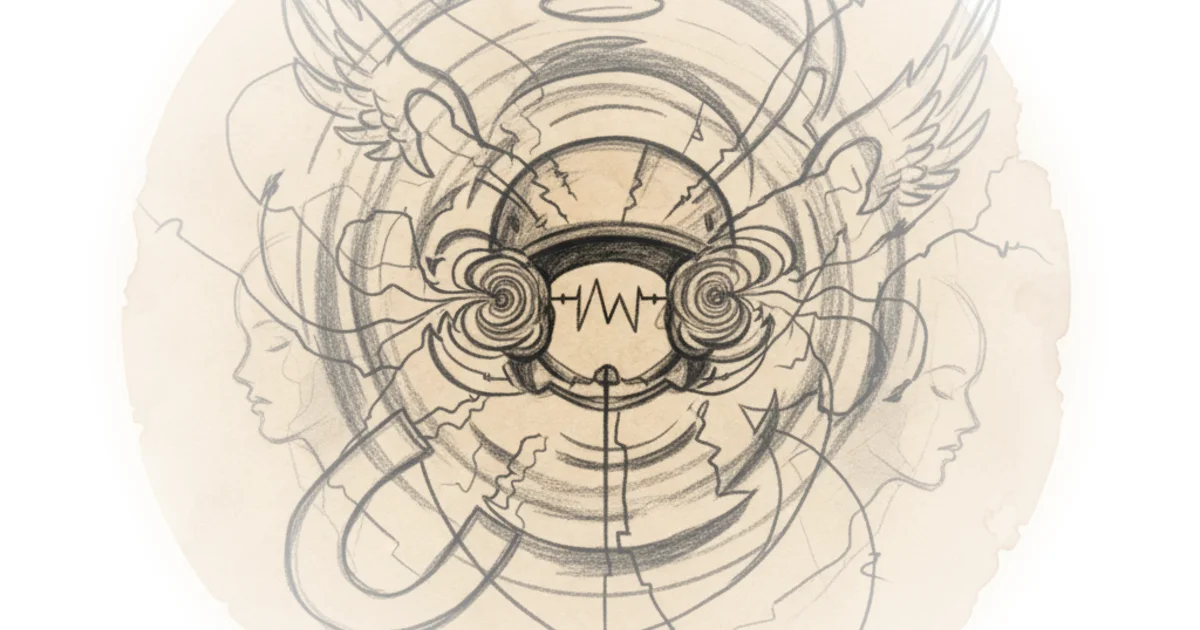
Critics might argue that Persinger's work still holds value as a historical curiosity, but Henry makes a compelling case that the failure of the hardware was actually the key to understanding the software of the mind. The 2005 study that debunked the helmet concluded that Persinger's results were not due to electromagnetism but were "achieved... through the power of suggestion." This distinction is vital. It suggests that the "ghost" in the machine was never a ghost at all, but a projection of the subject's own conditioned expectations.
The Power of the Setup
The commentary then pivots to the environment in which these experiences occurred. Henry points out that the subjects were placed in a sensory deprivation chamber, wearing opaque goggles in dim red light, which likely primed them for hallucination. "Persinger's test subjects wore the god helmet in a particularly weird setting," Henry observes, noting that this environment was "likely primed them towards certain experiences." The author effectively argues that the setting was a co-conspirator in the experiment. By creating an atmosphere of mystery and scientific rigor, the researchers inadvertently created a perfect recipe for the placebo effect.
"What's interesting is that while the placebo might be fake, the placebo effect is very, very real."
This insight reframes the entire debate. It is not that the subjects were lying; it is that their brains responded to the context of the experiment with genuine altered states. Henry explains that the placebo effect involves complex psychological mechanisms, including "expectations, conditioning, learning, motivation, bodily focus, reward, and reduction of anxiety." The helmet was merely the prop that allowed these mechanisms to run their course. The failure of the device was, paradoxically, its greatest success in demonstrating the power of the mind.
The Festival Experiment
To prove that the effect was indeed psychological, Henry details a 2017 study conducted at the Lowlands music festival in the Netherlands. This was a bold move, taking the experiment out of the lab and into a chaotic, alcohol-fueled environment. The researchers hypothesized that intoxication might lower inhibitions and increase susceptibility to the placebo effect. "Could being drunk make you more likely to fall for God helmet suggestion?" Henry asks, setting up a fascinating test of human vulnerability.
The results were telling. Despite the festival setting and the presence of alcohol, the study found no link between intoxication and mystical experiences. Instead, the data pointed to a different variable: pre-existing belief. "They found that people who already identified as spiritual before the experiment were more likely to experience something extraordinary," Henry reports. The subjects who felt the "presence" were those who were already looking for it. As the study concluded, "extraordinary experiences are most likely to occur in participants who have a spiritual worldview that matches the expectations provided by the manipulation."
This finding challenges the notion that religious experiences are purely random or supernatural. Instead, they appear to be a dialogue between the individual's worldview and the environment they inhabit. The helmet didn't induce the experience; it elicited it. Henry makes a sharp distinction here: "The difference between induce and elicit is the difference between real medicine and the placebo. The former implies actively causing a response, while the latter suggests drawing out a response already present." This is the core of the argument: we are not passive recipients of divine presence; we are active participants in creating it.
The Legacy of the Fake Helmet
Ultimately, Henry argues that the God helmet's legacy is not in its ability to simulate God, but in its ability to teach us about ourselves. The experiment inspired a new generation of scholars to study the "placebo effect" as a legitimate mechanism for religious experience. "Rather than discovering a new way to trigger mystical experiences, Persinger's experiment has instead inspired a whole generation of scientists of religion to take notice of the placebo effect," Henry writes. The device became a tool for understanding how belief works, rather than a tool for generating belief.
The author connects this to the broader field of religious studies, citing William James, who argued that understanding religion requires analyzing the experiences people report. Henry suggests that concepts like "belief, experience, and sacred" are "really messy and contested once you start pulling them apart." The God helmet experiment serves as a perfect case study for this messiness, showing how a fake machine can produce real feelings of the divine.
Bottom Line
Andrew Henry's coverage is a masterful deconstruction of a scientific myth that reveals a deeper psychological truth. The strongest part of his argument is the distinction between "inducing" and "eliciting" religious experience, which reframes the placebo effect not as a failure of science, but as a success of human psychology. The biggest vulnerability, however, is the potential reductionism of the argument; while the helmet was fake, it does not necessarily mean that all religious experiences are merely self-fulfilling prophecies. Still, for the reader seeking to understand the intersection of faith and science, this piece offers a compelling, evidence-based perspective on why we feel the presence of something greater than ourselves.